- What would a half-point Fed hike cost? A variable rate tied to prime, such as a credit card or home equity line, would rise the full 0.50 points. That is $50 a year on $10,000 of debt.
- What would it pay savers? After the last hike, tracked savings accounts changed by an average of 0.10 points on a 0.25 hike. At that pace, a half point adds about $20 a year on $10,000.
- At the middle account, it adds nothing. Fifty of 85 tracked accounts had not raised their rate 67 days after the September hike.
- A half point is not decided. Fed Governor Christopher Waller said it should be considered. The Fed votes on December 9.
Short answer: A half-point Fed hike would raise variable rates tied to prime by the full 0.50 points. That is $50 a year on $10,000 of debt. At the pace of the last hike, $10,000 in savings would earn about $20 more, and the middle account would earn nothing more.
Dennis has $30,000 drawn on a home equity line and $10,000 in a savings account. He reads the Fed news once a month. This month it said the Fed might raise its rate by half a point next month, twice the size of the September hike. He wanted to know one thing: what does that do to him?
The Fed is talking about a half point
The Fed's target range has been 3.75% to 4.00% since the hike on September 16, 2026. It held there at the October 27 and 28 meeting. Its next meeting is December 8 and 9. We covered what a December hike means for savers earlier this month.
On November 10, Fed Governor Christopher Waller said he would support at least a quarter-point hike in December. He said that if core prices rose 0.3% or more, "a stronger policy move may be needed." A half-point hike "should be considered," Reuters reported. The Bureau of Labor Statistics reported that core prices rose 0.3% in October, above the 0.2% forecast. On November 18, Waller told CNBC the Fed needs to get "more aggressive." He urged a half-point hike in December. The other option he named was a clear signal of faster hikes later.
One governor is not the whole Fed, and the vote is not taken. As of the close on November 9, futures priced about an 85% chance of a December hike, Reuters reported. They did not price the size.
What a half point does to debt
A variable rate on a credit card or home equity line is the prime rate plus a margin the lender sets. Prime moves with the Fed. It rose from 6.75% to 7.00% the business day after the September 16 hike, as our card APR report found. A half-point hike would take it to 7.50%.
Dennis's home equity line is prime plus a margin. A 0.50 point rise on $30,000 is $150 more interest over a year, about $12.50 a month. On $10,000 of debt it is $50 a year. On a $5,000 card balance it is $25. A quarter-point hike would cost half as much. There is no waiting period and no choice, because the loan agreement already allows the change.
What it did for savings last time
We track 85 savings accounts against the September hike. Sixty-seven days later, 35 had raised their rate and 50 had not. The average change across all 85 was 0.10 points. The Fed's move was 0.25. So the average saver got 40% of the hike.
The 50 that did not move include banks that pay 0.01% to 0.25%. They also include some that pay 3.50% to 4.20%. Ten accounts rose by more than the Fed's move, led by Openbank at 0.55 and Vio Bank at 0.45. On $10,000, Openbank's rise is worth $55 a year.
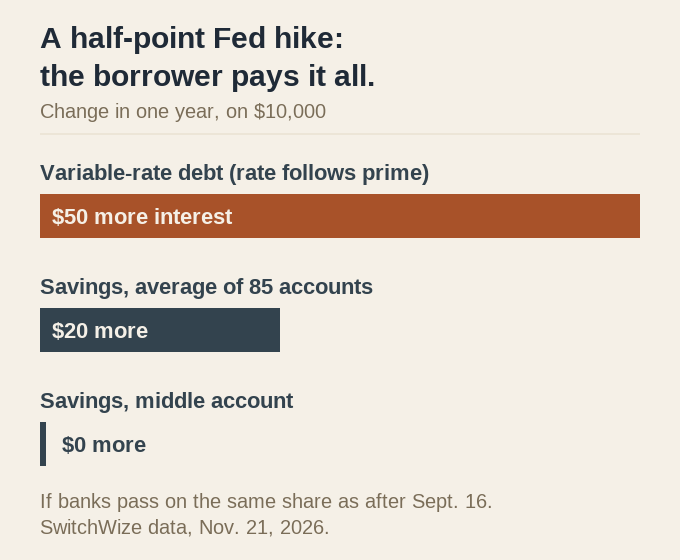
Put the two side by side. If banks pass on 40% of a half point, the average account rises 0.20 points. That is $20 a year on $10,000. The same half point costs the borrower $50. For Dennis, with $30,000 of debt and $10,000 saved, the year comes out $130 worse: $150 more interest and $20 more earned. At the middle account, he earns nothing more.
The gap has been stable
The share of accounts that had not moved fell slowly. On October 19, 33 days after the hike (see our day 33 report), 54 of 87 tracked accounts had the same rate. On November 12, it was 52 of 87. On November 21 it was 50 of 85. Late movers are real: Mitten raised its rate on day 64 and Western Alliance on day 62. But most of the banks that were going to move, moved early. The typical one took 9 days.
Where this math could mislead
This is a scenario, not a forecast. The Fed may raise a quarter point or hold. Banks may pass on more of a larger move, to keep customers. Or they may pass on less. The 40% share is one data point from one hike.
The 85 accounts are the ones we track, and the average treats each equally. A saver at a bank that did not move is not the average saver. Debt also differs. Some loans are fixed, some have caps, and a card margin can change. Check your own agreement for the index and the margin.
What Dennis did next
Dennis could not change the Fed. He could change two things. He checked his home equity line agreement and found the index and margin in writing. Then he looked at the account holding his $10,000. It paid 0.25%. On our list, an account paying 4.40% had no minimum and no monthly fee. The difference was 4.15 points, or $415 a year on $10,000, many times the $20 the Fed's half point might add. He opened the new account the same week and left the old one open with a small balance until the transfer cleared.
Sources
- Reuters, Fed's Waller plans to support at least a quarter-point rate hike in December, November 10, 2026. Includes the futures pricing as of the November 9 close.
- Business Day, Waller hints at more aggressive Fed response over inflation, November 18, 2026.
- Federal Reserve, FOMC statement, October 28, 2026. Target range 3.75% to 4.00%.
- Bureau of Labor Statistics, Consumer Price Index news release, October 2026 data released November 10, 2026. Core prices rose 0.3%.
- SwitchWize Fed hike tracker: 85 savings accounts, rates before the September 16, 2026 hike and on November 21, 2026.
- Prime rate of 7.00%: the Fed's upper range plus 3 points, from SwitchWize market data. See also our earlier card APR report.
- Interest figures are SwitchWize calculations: balance times rate change.
Dennis is a composite character. The rates, counts and dates are real. Interest figures use simple annual interest on a constant balance. Rates were checked on November 21, 2026 and can change after publication. This article is educational information, not individualized financial advice.
Quick answers
Will the Fed raise rates by a half point in December? Not decided. Fed Governor Christopher Waller said it should be considered. The Fed votes on December 9.
What would it do to my credit card? If your rate is variable, it would rise 0.50 points: about $50 a year on $10,000.
Would my savings rate rise a half point? Probably not. At the pace of the last hike, the average account would rise about 0.20 points. The middle account would not move.
What to Do Now
Frequently Asked Questions
Will the Fed raise rates by a half point in December?
What would a half-point Fed hike do to my credit card rate?
Would my savings rate go up by a half point too?
How fast do banks raise savings rates after a Fed hike?
The 5-minute money briefing
One email per week. The biggest changes in savings, money market, checking and CD rates.
Send me the weekly SwitchWize rate briefing: the biggest changes in savings, money market, checking and CD rates. Unsubscribe in one click. We never share your address.
Act on this: today's top savings


Ranked by SwitchWize's composite score. Some partner links may compensate SwitchWize.
Editorial review
What changed since the last update
Was this guide helpful?
Found an inaccurate, outdated, or missing claim? Report a correction. We verify reports against the relevant source before changing a guide or ranking.