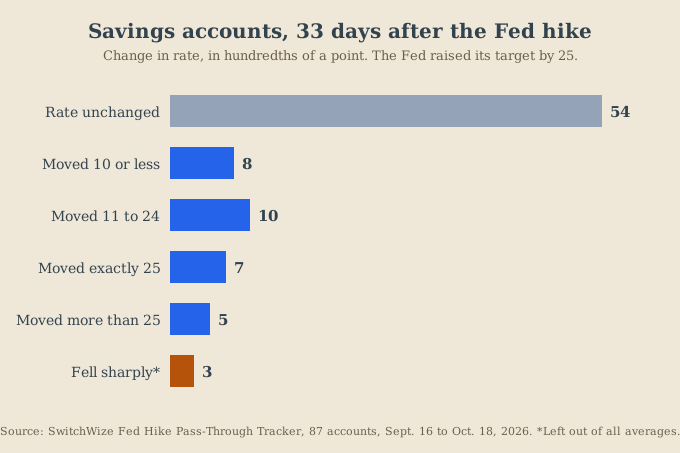
- Thirty-three days after the Federal Reserve's September 16, 2026 hike, 54 of the 87 savings accounts SwitchWize tracks still pay the same rate. Thirty raised their rate.
- The 30 that moved added 0.20 percentage points on average, short of the Fed's 0.25. Twelve matched or beat the full quarter point. Eight added 0.10 points or less.
- Accounts that started at 3% or more split into two groups with the same starting average of 3.48%. Those that moved now average 3.68% and those that did not still average 3.48%, a gap of $20 a year on $10,000.
Take a saver we'll call Renata. She is an illustration, not a real person. She keeps $10,000 in a savings account that paid 3.00% on September 16, the day the Federal Reserve raised its target range a quarter point, to 3.75% to 4.00%. She read the headlines and expected a raise of about $25 a year. Five weeks later her rate has not changed. She has no letter, no email and no sign that anyone at her bank noticed the meeting.
She is not unusual. SwitchWize's tracker compares each savings account's rate on September 16 with its latest reading. Of 87 accounts with a usable starting point, 54 show no change at all as of October 18.
What 33 days of tracking show
The tracker follows one savings account per bank. It records the rate on the day of the hike and every later reading. Here is where the 87 stand:
- 54 are unchanged.
- 30 are higher.
- 3 are sharply lower. CIT Bank went from 3.75% to 0.25%, Primis from 3.85% to 0.10%, and First Internet Bank of Indiana from 3.09% to 0.80%. We have not confirmed why. A cut that large three weeks after a hike more likely reflects a product or reading change than a real cut. We leave all three out of every average below.
Sixteen more accounts were left out because we had no recent starting rate. Some "unchanged" readings are also old: 16 of the 54 carry a stale flag, meaning the latest reading is behind. Those accounts may have moved without our seeing it.
The raise that did happen was smaller than the Fed's
Among the 30 that moved, the average increase was 0.20 points, and the middle account moved 0.20 points as well. Twelve accounts matched or beat the full 0.25. Openbank went up 0.55 points, TAB Bank 0.34, EagleBank 0.30 and EverBank 0.30.
At the other end, eight accounts added 0.10 points or less. That group includes Ally, Capital One, Discover, Marcus by Goldman Sachs, Sallie Mae Bank and Bread Savings. On Renata's $10,000, that is $10 a year, where a full quarter point would be $25.
The accounts that moved did not start in a different place. The 30 that rose began at 3.48% on average. The 30 accounts that started at 3% or more and did not move began at 3.48% too. Now the first group averages 3.68% and the second still sits at 3.48%. The middle account that moved pays 3.80% and the middle account that stood still pays 3.35%.
How long banks took
The median bank that moved waited 9 days. Ten moved within a week. Twelve more moved in the second week. Six took until the third week, and two waited longer, to day 25 and day 28.
Speed did not follow bank size. TAB Bank and Customers Bank moved within two days. Barclays, which started at 3.20%, showed no change in its latest reading. Chime, which pays far less, raised its rate by the full 0.25 points on day 21.
The 2022 cycle looked similar
The Fed does not set savings rates. It sets the rate banks pay each other for overnight money, and every bank chooses how much of a move to hand to savers. In the 2022 hiking cycle, Bloomberg estimated that banks passed roughly 40% of the increases into deposit rates by the end of 2022. In this tracker, the middle account has passed on none of the September move so far. SwitchWize's guide to deposit beta explains the idea in plain terms.
The FDIC's national average savings rate was 0.37% in its posting dated September 21, 2026. Many tracked accounts pay far more than that. Others, such as Wells Fargo at 0.01%, sit below it, and none of them moved.
What this data cannot say
It cannot say why a bank did or did not move. Banks do not announce these decisions. A bank may be waiting for the Fed's next meeting on October 27 and 28, or it may already have more deposits than it wants. The tracker follows one savings account per bank, so a bank with several savings products may have changed a different one. And the dates are when our tracker saw a change, which can lag the real change by a day or more.
What to do with it
Look at your own rate today and at what other accounts pay today. Do not wait for your bank to explain. The Fed's hike is already 33 days old. For the average account that moved, it was worth 0.20 points. For the 54 that did not, it has been worth nothing so far.
Renata checked her account again on day 33. It still said 3.00%. She did not wait for an email. She looked up what the 30 accounts that moved now pay, picked one near 3.68%, and wrote the date she opened it on her calendar. Her next question was a better one: not whether her bank would move, but how many more weeks she was willing to let it decide.
Frequently Asked Questions
Do banks raise savings rates right after the Fed raises rates?
How much of the Fed's rate hike do savings accounts pass on?
Should I move my savings if my bank has not raised its rate?
What should I do after reading 33 Days After the Fed Hike, 54 of 87 Savings Accounts Haven't Moved. The 30 That Did Added 0.20 Points.?
The 5-minute money briefing
One email per week. New rates, fed moves, and what to actually do about them.
No spam. Unsubscribe anytime.
Act on this: today's top savings


Ranked by SwitchWize's composite score. SwitchWize currently has no compensated product links.
Editorial review
What changed since the last update
Was this guide helpful?
Found an inaccurate, outdated, or missing claim? Report a correction. We verify reports against the relevant source before changing a guide or ranking.
