- SwitchWize's daily card tracker found 34 credit cards across 5 issuers with a changed disclosed APR in the 18 days after the Fed's September 16, 2026 hike, and 32 of them rose by at least the Fed's own 0.25 points.
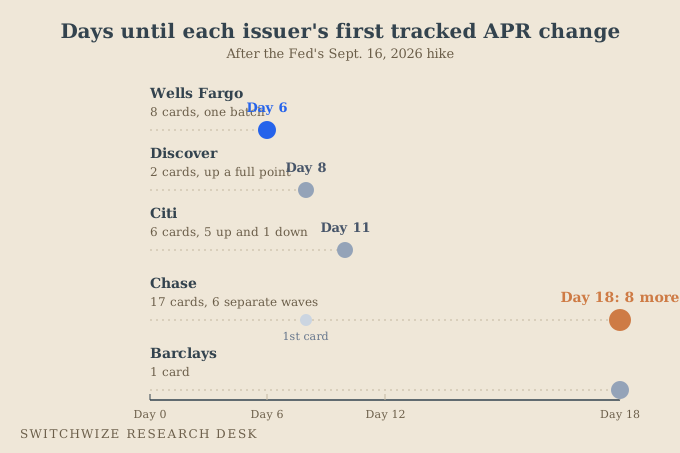
- Wells Fargo updated all 8 of its tracked variable-rate cards within 6 days. Chase, the issuer with the most cards in the data, took 18 days and spread the increase across six separate days before finally moving 13 cards in one 24-hour span.
- Three cards rose by more than the Fed's quarter point, up to 1.5 points on the Citi Double Cash, which on a $5,000 balance is about $62.50 a year that has nothing to do with the Fed at all.
Desmond carries an occasional balance on a Chase travel card, and he'd read enough to know the mechanism before the Federal Reserve ever met on September 16: a variable-rate card tracks the Prime Rate, and when Prime moves, the card's APR moves with it, automatically, with no letter and no 45-day notice, because he'd agreed to that structure the day he opened the account. So when the Fed raised its target range a quarter point that Wednesday, he didn't expect a notice. He expected a number.
He checked his card's own terms page the following Monday. Unchanged. He checked again the Monday after that. Still unchanged. It wasn't until October 4, eighteen days after the Fed's meeting, that the page finally showed a new range, 0.25 points higher at the floor, alongside twelve other Chase cards that updated the same day.
What SwitchWize actually tracked
SwitchWize's card-data pipeline checks the disclosed terms on more than 90 active credit-card product pages daily and logs every change against the prior reading. In the 18 days between the Fed's September 16 announcement and October 4, that tracker recorded a changed APR range on 34 distinct cards from 5 issuers: Wells Fargo, Chase, Citi, Discover and Barclays. Thirty-two of those 34 ended the window with a higher floor APR than before the hike, by at least the Fed's own 0.25 points. The other two didn't follow the pattern at all: the Chase Freedom Rise moved only on the high end of its range, and the Citi Strata Premier Card's range fell on both ends.
The textbook says this should already be settled
Researchers at the Federal Reserve Bank of Boston put it plainly in a March 2026 policy brief: "When the Federal Reserve raises or lowers the FFR, the prime rate typically adjusts within a month, meaning that the Fed's policy changes flow through to credit card rates rapidly." That's accurate about the index itself. The Wall Street Journal's survey-based Prime Rate, the number most variable cards are priced against as "Prime plus a margin," moved from 6.75% to 7.00% the business day after the Fed's September 16 decision. Matt Schulz, LendingTree's chief consumer finance analyst, told reporters the same week that cardholders should expect their rate to rise a quarter point "over the next couple of months."
Both of those statements describe the index and the eventual outcome correctly. Both are also built on the same kind of evidence: how the last hiking cycle, 2022 to 2023, played out on average across the whole industry, not a specific tally of specific cards. September 16 was the Fed's first hike since that cycle ended, so this is the first real chance since then to check the "couple of months" average against what actually happened card by card. SwitchWize's own tracking found the index moved in a day, but the specific, disclosed number on a specific card's own terms page moved on each issuer's own schedule, not on the Fed's. The rate didn't change because the Fed met. It changed whenever each issuer's own page caught up.
That gap exists because a variable-rate increase carries no notice requirement under Regulation Z (12 CFR 1026.55) in the first place, which also means no disclosure deadline. A "change in terms" letter has a mandatory 45-day clock. An index-tracking rate has none, so each issuer updates its own public page on whatever internal schedule its systems run, and nothing compels it to happen the same week the index itself moves, let alone the same day as any other bank.
How fast each issuer actually moved
Wells Fargo was the fastest and the cleanest. SwitchWize's tracker recorded all 8 of its active variable-rate cards, from the Active Cash Card to four separate hotel and travel co-brands, with an identical 0.25-point increase on both ends of the APR range, all logged within the same several-second batch on September 22, six days after the Fed's meeting.
Chase, which has more tracked cards than any other issuer in this dataset, did the opposite of a clean batch. Counting only each card's first recorded move, one Chase card changed on day 8 (the United Explorer), four more on day 11, two on day 16, one on day 17. Then, on October 4, eighteen days after the Fed's meeting, eight more Chase cards that hadn't moved at all yet finally got their first increase, among them the Sapphire Preferred, the Sapphire Reserve and the IHG One Rewards Premier. That same day, five cards that had already moved earlier picked up a further adjustment, bringing the day's total to thirteen Chase cards with a dated change, the single busiest day for any issuer in the whole three-week window.
Wells Fargo and Chase are both, by deposits, among the five largest banks in the country. Size alone doesn't predict which one moves first. What predicts it, as far as this data can show, is simply which issuer's internal process happened to run that week, which is not a number anyone outside the bank can see coming.
The part that isn't the Fed at all
Here's the honest complication: not every one of these 34 moves is actually the Fed. Thirty-two cards rose by the Fed's exact 0.25 points or close to it. Three rose by more. Discover's It Cash Back and It Balance Transfer cards both moved a full percentage point, four times the Fed's own increase. The Citi Double Cash moved 1.5 points, six times the Fed's move. On a $5,000 balance, the Fed's quarter point alone is about $12.50 a year. The extra 0.75 points on the Discover cards is another $37.50. The extra 1.25 points on the Double Cash is another $62.50, money the Fed's own September decision does not account for.
That's not necessarily a mistake. Card issuers also run ordinary, index-unrelated risk-based repricing on their own schedules, the same mechanism a 45-day change-in-terms notice usually covers, and there's no public way to separate "this much is Prime" from "this much is something else" once both land on the same disclosed number in the same three-week window. The Chase IHG One Rewards Premier card shows the same blending from a different angle: Chase's own October 1 press release announced the card's annual fee rising from $99 to $150 as part of a wider IHG portfolio overhaul, with existing cardholders not seeing the new fee until their 2027 renewal. That release said nothing about APR. SwitchWize's tracker recorded the same card's APR floor moving 0.25 points higher that same week anyway, a change nobody put out a press release for, because nobody has to.
One more honest limit: the dates above are when SwitchWize's tracker recorded each change, not necessarily the exact day each bank edited its page. The pipeline checks these pages roughly daily, so most of these readings should be within a day of the real change, but a slower-checked source could lag by more. The relative order, Wells Fargo fastest, Chase slowest and most fragmented, is the reliable part. The exact day count is a close estimate, not a certified timestamp.
What to actually check
A card's own current terms page, not a general rule of thumb, is the only reliable way to know whether an increase already landed. "A couple of months," the general guidance quoted earlier, is a fair average across the whole card industry. It is a poor prediction for any one specific card, since some issuers finish in under a week and others spread the same move across three weeks and six separate days.
Desmond went back to his Chase card's terms page a second time after the October 4 batch and actually read the number instead of assuming one. The new floor was 0.25 points higher, exactly what the Fed's move implied, nothing extra riding along with it. He wrote the date down next to it, October 4, not September 16, because that's the date that will actually matter the next time he does this math.
Sources
- Federal Reserve Bank of Boston, Falk Bräuning and Joanna Stavins, "How Interest Rate Changes Affect Credit Card Spending," Current Policy Perspectives 26-2, March 25, 2026.
- Federal Reserve, FOMC statement, September 16, 2026, raising the target range to 3.75%-4.00%.
- WCCB Charlotte, "Fed rate hike likely means more expensive credit cards and mortgages, but savers may rejoice," September 16, 2026, quoting Matt Schulz, LendingTree.
- Chase Media Center, "Chase Introduces New IHG One Rewards Premier Select Credit Card, Plus Updates Across Entire IHG One Rewards Card Portfolio," October 1, 2026.
- Consumer Financial Protection Bureau, Regulation Z, 12 CFR 1026.55, governing when an APR increase does and does not require advance notice.
- SwitchWize card-data tracker, 34 tracked cards across Wells Fargo, Chase, Citi, Discover and Barclays, September 16-October 4, 2026.
Desmond is a composite character; the card-tracking data, regulatory mechanism, and primary-source quotes cited are real. Rates referenced on this page were verified on October 4, 2026 and can change after publication. This article is educational information, not individualized financial advice.
Quick answers
How long after a Fed rate hike does my credit card APR actually go up? It depends on the issuer. SwitchWize's tracking of 34 cards across 5 issuers after the September 16, 2026 hike found Wells Fargo updated all 8 of its cards within 6 days, while Chase took 18 days and moved in six separate waves rather than one.
Does my card company have to warn me before raising my rate after a Fed hike? No, in most cases. A Prime-linked variable rate changes with no advance notice required under Regulation Z, because the rate structure was disclosed when the account opened, not when the specific increase happens.
If my APR went up more than 0.25 points, is that normal? It can be, but it isn't purely the Fed. Three of the 34 tracked cards rose by more than the Fed's quarter point, most likely ordinary risk-based repricing riding along in the same window, not an oversized Fed pass-through.
What to Do Now
Frequently Asked Questions
How long after a Fed rate hike does my credit card APR actually go up?
Does my credit card company have to warn me before raising my rate after a Fed hike?
If my card's APR went up more than 0.25 points after the September 2026 hike, is that normal?
What should I do after reading Wells Fargo Updated 8 Cards' Rate in 6 Days. Chase Took 18, Then Moved 13 at Once.?
The 5-minute money briefing
One email per week. New rates, fed moves, and what to actually do about them.
No spam. Unsubscribe anytime.
Act on this: today's top cards

Ranked by SwitchWize's composite score. SwitchWize currently has no compensated product links.
Editorial review
What changed since the last update
Was this guide helpful?
Found an inaccurate, outdated, or missing claim? Report a correction. We verify reports against the relevant source before changing a guide or ranking.
