How to choose
What to weigh before you pick
It usually comes down to 3 things. Compare your options on each before deciding.
What you earn on the spending you actually do.
The fee weighed against the rewards and credits you will use.
The intro offer and the spend required to earn it.
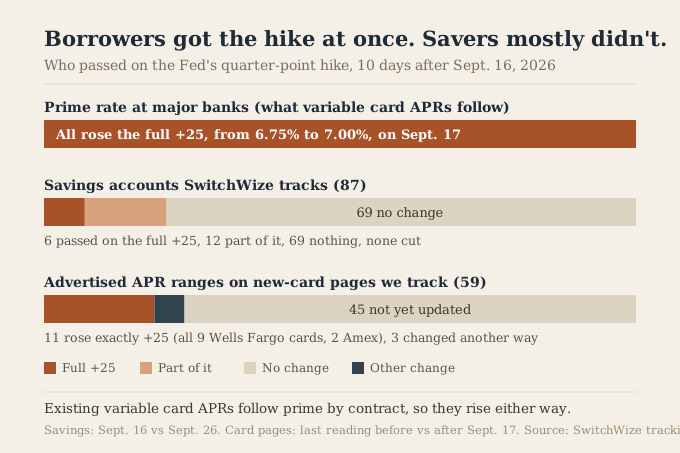
- Major banks raised the prime rate from 6.75% to 7.00% on September 17, 2026, the day after the Fed's hike. Variable card APRs are tied to prime, so card balances get the full increase automatically.
- Ten days after the hike, 69 of the 87 savings accounts SwitchWize tracks had not changed their rate. Six passed on the full quarter point, and 12 passed on part of it.
- The 2022-23 cycle went the same way: prime rose 5.25 points while the national average savings rate rose about a third of a point. On $20,000, moving from a 0.01% account to the 4.20% top rate is worth about $838 a year.
A Fed rate hike raises variable credit card APRs automatically, but savings rates only rise if each bank chooses to raise them. After the Federal Reserve lifted its target range by a quarter point on September 16, 2026, to 3.75% to 4.00%, prime rose the next morning, while 69 of the 87 savings accounts SwitchWize tracks were still unchanged ten days later.
We tracked both sides. For savings, we compared every account we follow on the day of the announcement and again on September 26. For credit cards, we compared the prime rate that most card APRs are built on, plus the advertised APR ranges on 59 card application pages we read regularly.
The borrowing side moved the next morning
Most variable-rate credit cards set your APR as the prime rate plus a fixed margin. Prime follows the Fed almost mechanically. On September 17, JPMorgan Chase, Bank of America, Citigroup, Wells Fargo, U.S. Bank, M&T and other large banks all raised prime from 6.75% to 7.00%.
That means a card that charged prime plus 12.49 points went from 19.24% to 19.49%, with no decision by anyone at the bank. You agreed to that link when you opened the card, so the issuer does not have to send a notice first. Our explainer on why a card's APR can rise when you never missed a payment covers the rules. The new rate usually shows up within one or two billing cycles, depending on the card agreement.
The advertised ranges on application pages, which only matter for new applicants, have been slower to catch up. Of the 59 card pages we compared before and after September 17:
- Cards
- 11
- Share of 59
- 19%
- Cards
- 3
- Share of 59
- 5%
- Cards
- 45
- Share of 59
- 76%
All nine Wells Fargo cards we track republished their ranges a quarter point higher on September 22, and two American Express cards did the same by September 20. None of the 18 Chase cards, 9 Capital One cards or 7 Bank of America cards we track had raised their advertised range as of their latest reading. That lag is in the marketing copy, not in what existing cardholders pay: if your card is tied to prime, your rate follows prime whether the application page has been updated or not.
The saving side mostly didn't move
Savings rates have no such link. Each bank decides for itself, and most decided to wait.
- Savings accounts
- 6
- Share of 87
- 7%
- Savings accounts
- 12
- Share of 87
- 14%
- Savings accounts
- 69
- Share of 87
- 79%
- Savings accounts
- 0
- Share of 87
- 0%
The six that passed on the full hike or more:
- Sept. 16
- 3.61%
- Sept. 26
- 3.95%
- Change
- +34 bps
- First moved
- Sept. 17
- Sept. 16
- 3.70%
- Sept. 26
- 4.00%
- Change
- +30 bps
- First moved
- Sept. 24
- Sept. 16
- 3.38%
- Sept. 26
- 3.63%
- Change
- +25 bps
- First moved
- Sept. 18
- Sept. 16
- 3.30%
- Sept. 26
- 3.55%
- Change
- +25 bps
- First moved
- Sept. 18
- Sept. 16
- 3.25%
- Sept. 26
- 3.50%
- Change
- +25 bps
- First moved
- Sept. 21
- Sept. 16
- 3.50%
- Sept. 26
- 3.75%
- Change
- +25 bps
- First moved
- Sept. 23
Several big names moved by less than half the hike. Ally, Capital One and Discover each went from 3.00% to 3.10% on September 25, nine days after the announcement. American Express did the same on September 23, and Marcus went from 3.40% to 3.50% on September 18.
Averaged across all 87, including the 69 that did nothing, savings rates rose about 3.6 basis points. That is about 14% of the Fed's move. The median account passed on none of it. Several large banks were at 0.01% before the hike and stayed there, including Wells Fargo, the same bank that raised the advertised APR on every card we track.
The last hiking cycle went the same way
This is not new. Between March 2022 and July 2023, the Fed raised its target range by a total of 5.25 percentage points. The prime rate went with it, from 3.25% on March 16, 2022 to 8.50% on July 27, 2023, and every variable card balance followed.
The FDIC's national average savings rate went from 0.06% in March 2022 to 0.42% in July 2023. It peaked at 0.47% in January 2024. In other words, borrowers got the full 5.25 points and the average saver got about 0.36 of a point, roughly 7% of the move. The FDIC's latest national average, for August 2026, is 0.38%.
Why the two sides move differently
A card APR is written into your contract as an index plus a margin. When the index moves, the rate moves, and nobody at the bank has to decide anything.
A savings rate is a price the bank sets to attract and keep deposits. A bank raises it when it needs more deposits or is losing customers to competitors, and a bank whose customers rarely move their money has little reason to raise it quickly. Our piece on deposit beta explains how banks decide how much of a Fed move to share.
Where this story gets more complicated
Savers are not all losing out. Three of the six accounts that passed on the full hike are cash accounts at investment apps (Wealthfront, Betterment and E*TRADE), and the best rates we track were already near 4% before the Fed moved: Newtek Bank paid 4.20% APY on the day of the announcement and still does. A saver who had already moved to one of those accounts gave up very little by the median bank sitting still.
And on the borrowing side, the hike itself is a small cost for most people. What matters far more is the size of the balance and the rate it already carried, which the next section puts in dollars.
What it means in dollars
On a $6,000 card balance, the quarter-point rise in prime adds about $15 a year in interest ($6,000 x 0.25%). At a 19.49% APR, the balance itself costs about $1,170 a year ($6,000 x 19.49%).
On $20,000 in savings, the full hike is worth $50 a year if your bank passes all of it on ($20,000 x 0.25%). At the average change in our set, it is worth about $7. At the median bank, it is worth nothing.
Which bank holds your savings matters far more. On the same $20,000, a 0.01% account earns about $2 a year. The top rate we track today, 4.20% APY at Newtek Bank, earns about $840. That $838 gap is about 17 times the value of the whole Fed hike. (Simple annual figures, before compounding and taxes.)
So the hike reached your card within a day, and it may never reach your savings unless you move the money yourself. If you carry a balance, paying it down or moving it to a 0% balance transfer card saves more than the hike costs. If your savings rate didn't move, you don't need to wait for your bank. Our Fed hike tracker shows every bank's before-and-after rate, and today's top rates are below.
Methodology
Savings figures come from SwitchWize's Fed-hike pass-through tracker, which compares each account's rate on September 16, 2026, the day of the announcement, with its latest reading through September 26. It uses one source per bank; most readings come from the bank's own rate page, and a few (including E*TRADE) come from a third-party rate aggregator, which can trail a bank's own change by a few days. Fourteen accounts were excluded for lacking a recent reading before the hike. Card figures compare the last advertised APR range SwitchWize recorded for each card before September 17, 2026 with the latest one after it, for the 59 cards with readings on both sides; an unchanged range means our latest reading had not changed, not that the issuer has ruled out a change. Prime rate figures come from the banks' own announcements and the Federal Reserve's H.15 series. Historical savings figures are the FDIC's monthly national average savings rate. Moves are in basis points (100 basis points equal one percentage point). This describes SwitchWize's tracked set over a ten-day window, not every account in the country.
Sources
- SwitchWize Fed-hike pass-through tracker, 87 savings accounts, September 16 vs September 26, 2026.
- SwitchWize card terms tracking, advertised APR ranges for 59 cards, last reading before vs after September 17, 2026.
- Federal Reserve, FOMC statement of September 16, 2026 (target range raised to 3.75% to 4.00%).
- Prime rate announcements from U.S. Bank, M&T Bank and Wells Fargo, and news reports of JPMorgan, Bank of America and Citigroup, effective September 17, 2026.
- Federal Reserve H.15 bank prime loan rate (FRED series DPRIME): 3.25% on March 16, 2022; 8.50% on July 27, 2023.
- FDIC national rates, average savings account rate: 0.06% (March 2022), 0.42% (July 2023), 0.47% (January 2024), 0.38% (August 2026).
- Federal Reserve, Regulation Z, 12 CFR 1026.55(b)(2) (index-linked rate changes).
Figures reflect a specific window and may not match current live rates. This page is informational, not financial advice. Free to cite with attribution to SwitchWize.
Frequently Asked Questions
Does a Fed rate hike raise my credit card APR?
Why didn't my savings account rate go up after the Fed hike?
Which savings accounts raised their rate after the September 2026 Fed hike?
Did savings rates keep up with the Fed in the last hiking cycle?
What matters more, the Fed hike or which bank I use?
The 5-minute money briefing
One email per week. New rates, fed moves, and what to actually do about them.
No spam. Unsubscribe anytime.
Act on this: today's top cards

Ranked by SwitchWize's composite score. We may earn a referral fee, and it never changes the ranking order.
Editorial review
What changed since the last update
Was this guide helpful?
Found an inaccurate, outdated, or missing claim? Report a correction. We verify reports against the relevant source before changing a guide or ranking.
