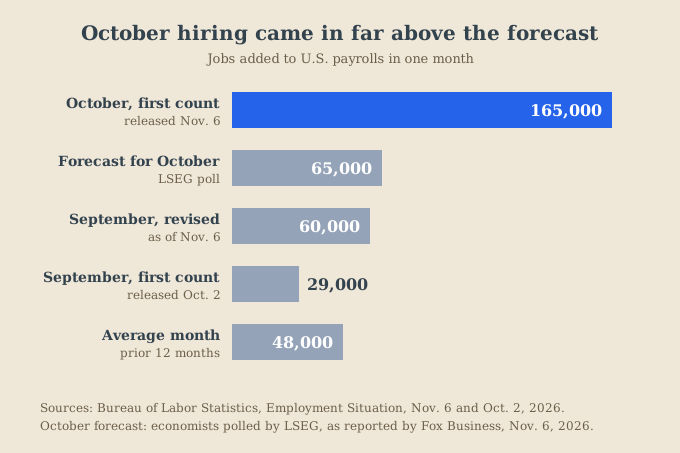
- U.S. employers added 165,000 jobs in October, the Bureau of Labor Statistics said on November 6. Forecasters expected 65,000. Odds of a Fed rate hike at the December 8-9 meeting rose to about 77% to 80%.
- 51 days after the Fed's last hike, on September 16, most savings accounts had not raised their rate. Of 87 accounts SwitchWize tracks, 32 raised their rate and 52 did not change.
- A second hike is worth little next to switching. On $18,000, a full 0.25-point raise adds about $45 a year. Moving from 3.20% to 4.40% adds about $216.
Take a saver we'll call Teodoro. He is an illustration, not a real person. He is 41 and keeps an $18,000 emergency fund in an online savings account paying 3.20%. On Friday he saw the news: hiring jumped, and a December Fed hike looks likely. His plan was to sit tight. If the Fed raises rates, he figured, his bank will raise his.
A hike is probably coming. But after the last one, most savings accounts did not raise their rate.
What the October jobs report showed
On November 6, the Bureau of Labor Statistics reported that employers added 165,000 jobs in October. Economists polled by LSEG had expected 65,000, Fox Business reported. The jobless rate was 4.1%, little changed.
The report also revised two earlier months. September's count was revised up from 29,000 to 60,000. August went from 133,000 to 186,000. Together, those two months had 84,000 more jobs than the earlier counts showed.
Pay rose too. Average hourly pay went up 14 cents in October, or 0.4%, to $38.00. Over the past 12 months it rose 3.1%.
How the odds of a December hike moved
Five weeks ago, a jobs report pushed the odds the other way. The first September count, 29,000, came in far below forecasts on October 2. Market odds of a hike at the October 28 meeting fell from about 70% to about 22% in four days, as we reported then. The Fed held rates on October 28.
Now that weak September number is twice as large, and October was strong. CME FedWatch is a tool that turns traders' bets on Fed rates into odds. It showed a 76.8% chance of a quarter-point hike in December, up from 66.9% a week earlier, per Fox Business. A quarter point is 0.25 percentage point. Scotsman Guide cited 80%, up from 67% the day before. The two were likely read at different times of day.
The Fed's next meeting is December 8 and 9. It last raised its main interest rate on September 16, to a range of 3.75% to 4.00%.
Why strong hiring makes a hike more likely
The Fed has two jobs: keep prices steady and keep people working. When hiring is weak, the second job argues for leaving rates alone. When hiring is strong, the Fed can focus on prices.
Strong hiring can push prices up. Employers who compete for workers raise pay. A 0.4% raise in one month would be about 4.9% over a year if it kept that pace. Higher pay lets people spend more, which can lift prices. A rate hike makes borrowing cost more, which slows spending.
One strong month is not proof. But weak hiring was the main argument for holding rates in October. This report showed hiring was stronger than it looked.
What the September hike did for savers
SwitchWize tracks 87 savings accounts against the September 16 hike. We record each account's rate the day before and every reading since. Here is how many had raised their rate at each check.
The count barely grew after the first few weeks. As of November 6, 51 days after the hike, 32 accounts had raised their rate. 52 had not changed. Three showed much lower rates. For two of them, the bank's own pages show the low rate belongs to a different account or a smaller balance. The bank had not cut the rate we were tracking. The third bank's pages show no rate at all. We leave all three out of the averages.
The most recent mover was Flagstar Bank. It went from 3.20% to 3.40% on November 5, 50 days after the hike.
Among the 32 that moved, the average raise was about 0.23 point. Fifteen passed on the full 0.25 or more. Across the 84 accounts we count, 87 minus those three, the average raise was about 0.09 point. That is roughly a third of what the Fed did. The typical account, the one in the middle of the list, did not raise its rate at all.
You can see every account on our Fed hike tracker.
Why most banks did not pass it on
The Fed sets one short-term rate that banks charge each other. It does not set your savings rate. Each bank decides that on its own.
A bank raises its savings rate when it wants more deposits or fears losing them. If savers stay even when their rate does not go up, the bank pays less interest. Online banks fighting for new savers tend to move first. Many big banks do not move their savings rates at all. Of the 52 unchanged accounts, 15 pay under 1%.
This is not new. Researchers at the Federal Reserve Bank of New York measured how much of the 2022 rate raises banks passed on to savers. By late 2022, the Fed's rate averaged 3.7%. Interest-paying deposits averaged 1.4%. Banks had passed on just under 40% of the hikes. They also found savings accounts moved less than CDs and money market accounts.
When waiting for the hike can make sense
Not every unchanged account is a bad one. Thirteen of the 52 already pay 3.50% or more. If your account is near the top, a December hike is a small bonus, and there is no reason to move.
A December hike is also not settled. Odds were near 70% for an October hike in late September, and the Fed did not move. Another jobs report comes out December 4. The September number just changed by 31,000 on a second count, so the October number could change too.
And a hike works both ways. Most credit card rates follow the prime rate, a base rate banks set that moves with the Fed's rate. After the September hike, Wells Fargo and Chase both raised their card rates within weeks. If you carry a card balance, a hike costs you more than it pays you in savings.
What a second hike is worth next to switching
Here is the math for Teodoro's $18,000, for one year. It assumes each rate holds.
- Extra interest a year
- $45
- Extra interest a year
- $36
- Extra interest a year
- $216
The 4.40% rate is PiBank's savings account. SwitchWize checked it against the bank's own page on November 6. It has no minimum balance, and the rate can change at any time.
Moving is worth almost five times a full hike, and it does not depend on the Fed. If the hike comes and the new bank passes it on, he gets that too.
What this data cannot say
It cannot say whether the Fed will hike on December 9. Odds are a market's bet, not a decision. It cannot say how any bank will respond to a second hike. Past behavior is a guide, not a promise. Our tracker covers 87 savings accounts, not every bank. Rates can change any day, and our figures leave out taxes.
Check your savings rate now
Look up your savings rate today, not after December 9. If it is well below the top rates, switching will earn you more than the hike. Keep enough at your main bank to cover bills and transfers.
Teodoro checked his rate on Saturday morning and saw 3.20%. He moved $15,000 to an account paying 4.40% and kept $3,000 at his old bank, linked to his checking. That move adds about $180 a year at today's rates. He put one date on his calendar, December 10, to see whether either bank passed on the hike.
Sources
- Bureau of Labor Statistics, The Employment Situation, October 2026, released Nov. 6, 2026 (165,000 jobs, 4.1% jobless rate, revisions, $38.00 average hourly pay, next release Dec. 4)
- Fox Business, US economy adds 165,000 jobs in October, Nov. 6, 2026 (LSEG forecast of 65,000; CME FedWatch 76.8%, up from 66.9%)
- Scotsman Guide, Hiring crushes expectations in October, Nov. 6, 2026 (CME FedWatch 80%, up from 67%)
- Federal Reserve, FOMC meeting calendar (Dec. 8-9 meeting)
- Federal Reserve Bank of New York, Liberty Street Economics, Deposit Betas: Up, Up, and Away?, Kang-Landsberg, Luck and Plosser, April 11, 2023
- SwitchWize Fed hike tracker, readings dated Oct. 3, Oct. 19, Oct. 29 and Nov. 6, 2026; SwitchWize approved savings snapshot, Nov. 6, 2026 (PiBank 4.40%, checked against pibank.com)
Frequently Asked Questions
Will the Fed raise rates in December 2026?
How many jobs were added in October 2026?
Did savings rates go up after the Fed's September hike?
Should I wait for a December hike before moving my savings?
Does a Fed hike raise credit card rates too?
The 5-minute money briefing
One email per week. New rates, fed moves, and what to actually do about them.
No spam. Unsubscribe anytime.
Act on this: today's top savings


Ranked by SwitchWize's composite score. SwitchWize currently has no compensated product links.
Editorial review
What changed since the last update
Was this guide helpful?
Found an inaccurate, outdated, or missing claim? Report a correction. We verify reports against the relevant source before changing a guide or ranking.
