- The market-implied chance of a Fed rate hike at the October 28 meeting fell from about 70% to as low as 16%, in one day, after the September jobs report missed estimates by roughly 61,000 jobs.
- It may not have mattered much either way: of the 87 savings accounts SwitchWize tracks, 60 still haven't moved a single basis point since the Fed's actual September 16 hike, and the typical account changed by exactly zero.
- On $25,000, the gap between the best tracked high-yield savings rate (4.27% APY) and a big bank's near-zero rate (0.01% APY) is already worth about $1,065 a year, a number that has nothing to do with what the Fed decides on October 28.
Nadia's one-year CD matured on September 30, two weeks after the Fed's last rate increase. She had $40,000 to decide what to do with, and she'd read, like a lot of people had, that the central bank was all but certain to raise rates again at its October 28 meeting. So she left the money sitting in her checking account, waiting for whatever better rate a second hike might bring before she locked anything in.
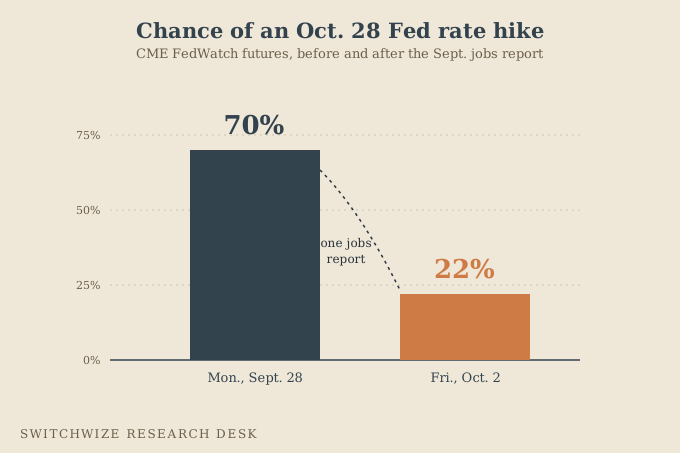
Then, on the Friday morning the jobs report came out, the "almost certain" hike she was waiting on stopped looking almost certain at all.
The number that moved overnight
The U.S. economy added 29,000 jobs in September, far below the roughly 90,000 forecasters had expected, and the unemployment rate rose to 4.2% from 4.1%, according to the Bureau of Labor Statistics data reported October 2. July's job count was revised down to a net loss of 23,000, and May's figure was revised down to just 63,000. Wage growth slowed too, to 0.1% for the month and 3.0% for the year.
Markets reacted within hours. CME's FedWatch tool, which converts interest-rate futures into an implied probability, put the odds of a quarter-point hike at the Fed's October 28 meeting at about 70% the Monday before the report. By Friday afternoon, that had fallen to 21.59%. Polymarket, a separate prediction market where traders bet real money on the outcome, told the same story with different numbers: about 69% before the report, 16% after.
Nothing about the Fed itself changed between those two readings. One report, about one month of hiring, moved a prediction about a decision less than four weeks away by roughly 50 percentage points.
Why one report can do that
A quarter-point hike has mostly been read, this cycle, as the Fed responding to inflation that officials themselves project at 3.7% for 2026 on their preferred gauge, well above their 2% target. A weak jobs report cuts against that case directly: the other half of the Fed's mandate is maximum employment, and a labor market that added just 29,000 jobs in September, with July's count revised down to an outright loss and May's revised lower too, reads as a market cooling faster than the Fed had planned for.
That tension is the honest complication here. This isn't a cancellation, just a delay. Both trackers still show meaningful odds attached to the Fed's final meeting of the year, on December 9. Polymarket's own contract for a December hike sits at about 68%, almost exactly where its October contract stood before Friday's report. The case for raising rates again this year did not disappear. It moved about two and a half months down the calendar, and it will move again the next time a jobs report, a CPI print, or anything else changes the Fed's read on that same tension between inflation and hiring.
What actually happened to savers after the last one
Here is the part the odds swing doesn't touch directly: even when the Fed does hike, most banks don't automatically follow. SwitchWize tracks 87 savings accounts against the Fed's actual September 16 increase, a confirmed quarter-point move, not a prediction. As of October 3, seventeen days later, 26 of those accounts had raised their rate. Sixty had not moved at all. The typical, or median, account in the group changed by exactly zero basis points.
That one cut, at First Internet Bank of Indiana, was a drop of more than two full percentage points, almost certainly an introductory rate expiring rather than anything to do with the Fed, and it's excluded from the pass-through math below for that reason. Among the banks that did move, the mean change across all 87 accounts was about 3 basis points against a 25-basis-point hike, pulled up almost entirely by a handful of accounts, like Openbank and TAB Bank, that raised by more than the Fed's own move. Economists call the share of a rate change a bank actually passes on to savers its deposit beta. A beta of 1 means a saver gets the whole move. A beta of zero means nothing changes no matter what the Fed does.
That 12%-ish pass-through, seventeen days in, isn't even unusually stingy by historical standards, it's just early. Research from the Federal Reserve Bank of New York's Liberty Street Economics found that the cumulative deposit beta across the banking system reached about 0.4, or 40%, by the peak of the 2015-2019 hiking cycle, a climb that took three full years. The 2022-2023 cycle reached roughly the same 0.4 ceiling in about a third of the time, driven by sharper, faster hikes. But the ceiling itself didn't move. Across two separate multi-year tightening cycles, the banking system as a whole never handed savers more than about 40 cents of every dollar the Fed raised, and plenty of individual banks, like Webster Bank, which has held a 0.01% savings rate through this entire cycle, hand over essentially nothing at all.
Where this leaves savers
None of this means the October meeting is irrelevant, or that savers should ignore the Fed entirely. A hike that does land, in December or any later meeting, is still a real event, and the handful of banks that do move tend to move within about eight days of it, per SwitchWize's own tracking. But the two historical cycles and the current one make the same point from different angles: the median bank's response to any given Fed meeting has been, reliably, nothing. Betting your decision on a single meeting's outcome means betting on the 26-out-of-87 chance that your specific bank is one of the ones that bothers to move at all.
The better bet is the one sitting in front of you right now. As of today, Peak Bank's high-yield savings account pays 4.27% APY, the top tracked rate in SwitchWize's database. On a $25,000 balance, that's about $1,067.50 in the first year. The same $25,000 at Webster Bank's 0.01%, a real, currently tracked rate, earns about $2.50. The $1,065 gap between those two numbers exists today, independent of anything the Fed does on October 28 or December 9.
Nadia didn't wait for the next meeting either. Ten more weeks of her $40,000 sitting in a checking account instead of the market's best tracked high-yield savings rate would have cost her about $328, a number with nothing to do with whether the Fed hikes at all. She moved the money into the top rate the week the odds collapsed, while she keeps comparing CD offers for whatever she does with it next.
Quick answers
Will the Fed hike rates in October 2026? It's no longer the likely outcome. Odds fell from about 70% to roughly 22% on CME FedWatch and to about 16% on Polymarket after the September jobs report, though both trackers still price a hike more heavily into the Fed's December 9 meeting instead.
Did savings account rates go up after the Fed's September hike? For most accounts, no. Of the 87 savings accounts SwitchWize tracks, 26 raised their rate in the 17 days afterward and 60 did not move. The typical account's change was zero.
Should I wait for the Fed's next meeting before opening a CD or high-yield savings account? Probably not on that basis alone. Most banks didn't move after the last confirmed hike, so the better use of your time is comparing today's top savings rates and CD rates directly rather than waiting on one calendar date.
(Nadia is a composite, built from typical outcomes in SwitchWize's own tracked data; the account, dates, and dollar figures are illustrative, not an individual case.)
Sources: CNBC, "Labor market faltered in September," Oct. 2, 2026; FXStreet, CME FedWatch odds analysis, Oct. 2, 2026; Yahoo Finance, Polymarket odds, Oct. 2, 2026; Federal Reserve Bank of New York, Liberty Street Economics, "Deposit Betas: Up, Up, and Away?," April 2023; SwitchWize get_fed_hike_pass_through and get_top_hysa_rates data, verified October 3, 2026.
Related reading: Fed rate hike savings impact · Which banks lag the Fed · Is now a good time to lock a CD · Money Map
Frequently Asked Questions
Will the Fed hike rates in October 2026?
Did savings account rates go up after the Fed's September hike?
Should I wait for the Fed's next meeting before opening a CD or high-yield savings account?
What should I do after reading A Fed Rate Hike Was Priced at 70%. One Jobs Report Cut It to 16%.?
The 5-minute money briefing
One email per week. New rates, fed moves, and what to actually do about them.
No spam. Unsubscribe anytime.
Act on this: today's top savings

Ranked by SwitchWize's composite score. SwitchWize currently has no compensated product links.
Editorial review
What changed since the last update
Was this guide helpful?
Found an inaccurate, outdated, or missing claim? Report a correction. We verify reports against the relevant source before changing a guide or ranking.
