- On October 28, 2026 the Federal Reserve held its target range at 3.75% to 4.00%. The vote was 10 to 2, and both dissenters wanted another quarter point increase.
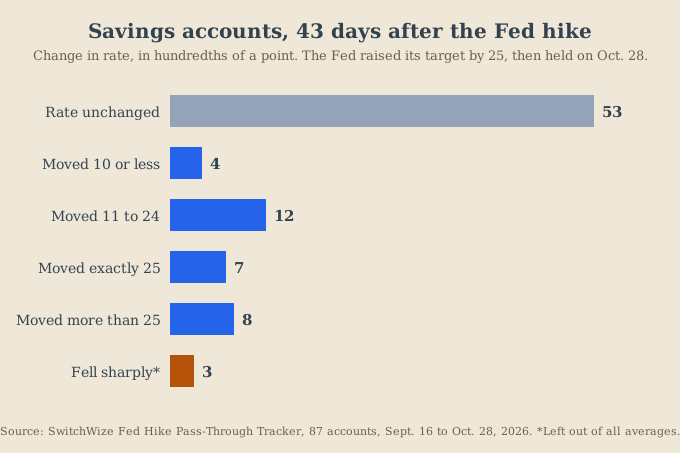
- Forty-three days after the September 16 hike, 53 of the 87 savings accounts SwitchWize tracks pay the same rate. Thirty-one raised their rate by 0.23 points on average. Three showed large drops that we leave out.
- A hold does not undo a hike, and it gives a bank no new reason to move. On $10,000, a 3.20% account earns $320 a year and a 4.40% account earns $440.
Take a saver we'll call Dolores. She is an illustration, not a real person. She keeps $10,000 in a savings account that paid 3.20% on September 16. When the Federal Reserve raised its target range a quarter point that day, she expected her bank to follow. On October 28 she watched the news instead. The Fed met again and did nothing. Her rate still said 3.20%, and she wondered if that was now permanent.
She asked a fair question. The Fed's decision is the reason people expect savings rates to move, and this week it did not move at all.
What the Fed did on October 28
The Fed kept its target range at 3.75% to 4.00%. Ten members voted to hold. Two voted against: Governor Lisa Cook and Cleveland Fed President Beth Hammack, who both preferred another quarter point increase. The statement said "inflation remains elevated" and that more information would help set the next step. It gave no promise about December.
So the hold is not a signal that hikes are over. Two of the twelve voters wanted to raise rates this week. It is also not a new hike. For a saver, the hold changes one thing: banks get no new push to raise what they pay.
Where the 87 accounts stand
SwitchWize's tracker compares each savings account's rate on September 16 with its latest reading, one account per bank. At day 43:
- 53 are unchanged.
- 31 are higher.
- 3 are sharply lower. CIT Bank went from 3.75% to 0.25%, Primis from 3.85% to 0.10%, and First Internet Bank of Indiana from 3.09% to 0.80%. We have not confirmed why, and we leave all three out of every average.
Seventeen more accounts were left out because we had no recent starting rate. Some "unchanged" readings are also old, so an account may have moved without our seeing it.
The 31 that moved added 0.23 points on average. The middle account added 0.23 as well. Fifteen matched or beat the full 0.25, led by Openbank at 0.55 and Synchrony at 0.45. Four added 0.10 points or less. Ally, Capital One and Discover each went from 3.00% to 3.20%.
One account joined the movers since our day 33 count, which had 30. In ten days, a net of one account changed its rate. That is the pace to expect.
A hold gives banks no reason to move
The Fed does not set savings rates. It sets the rate banks pay each other for overnight money. Each bank then picks what to pay savers, based on how much cash it wants and what rivals pay. SwitchWize's guide to deposit beta explains this in plain terms.
A bank that skipped the September hike had a reason to skip it. A hold removes the one outside event that might have changed its mind. The Fed's own history shows how long a pause can last. It held its target at 5.25% to 5.50% from July 2023 until its first cut in September 2024, about fourteen months, according to the Fed's published target series. A savings rate that waits for the Fed to "catch up" can wait a long time.
The other side matters too. Two dissenters wanted a hike, and the Fed has a meeting in December. If it hikes again, more banks may move then. Waiting on that is a bet, and you pay for the bet every month.
What waiting costs
Not every unchanged account pays little. Of the 29 unchanged accounts that started at 3% or more, 20 have a fresh reading, and they average 3.52%. Three of those pay 4% or more: Goldwater Bank, Live Oak Bank and Newtek Bank. A bank that did not move may already have been generous.
Still, the gap between accounts is real. On $10,000, a full quarter point is worth $25 a year. The gap between a poor rate and a good one is much larger.
Dolores's 3.20% earns $320. PiBank's 4.40% earns $440, a difference of $120 a year. PiBank states no minimum balance and FDIC insurance, and says its rate can change at any time. Some of the highest rates carry limits. EverBank's 4.20% is for new accounts only. Peak Bank's 4.27% falls to 3.40% on balances of $500,000 and above. Read the terms before you move money.
What this data cannot say
It cannot say why a bank did or did not move, because banks do not announce these decisions. The tracker follows one savings account per bank, so a bank with several savings products may have changed a different one. Dates are when our tracker saw a change, which can lag the real change by a day or more. And a rate we track is not the same as a rate we have checked against the bank's own page. Only the PiBank, EverBank and Peak Bank figures above were checked that way.
What to do with it
Look up your rate today. Then look up what other accounts pay today. Do not wait for the Fed's December meeting to decide for you. If your bank has not moved in 43 days, and the Fed just declined to push it, the most likely next move is no move.
Dolores checked what accounts paid that evening. She found one at 4.40% with no minimum, read the terms twice and noticed the rate could change. She opened it on a Thursday and moved half of her $10,000 first, to see how the transfer went. She kept the other half where it was, and wrote a date on her calendar to decide about that part in December, after the Fed met again.
Frequently Asked Questions
Did the Fed raise rates on October 28, 2026?
Will my savings rate go up after the Fed holds?
How much do I lose if my bank did not pass on the hike?
What should I do after reading The Fed Held Rates on Oct. 28. 53 of 87 Savings Accounts Still Haven't Passed On September's Hike.?
The 5-minute money briefing
One email per week. New rates, fed moves, and what to actually do about them.
No spam. Unsubscribe anytime.
Act on this: today's top savings



Ranked by SwitchWize's composite score. SwitchWize currently has no compensated product links.
Editorial review
What changed since the last update
Was this guide helpful?
Found an inaccurate, outdated, or missing claim? Report a correction. We verify reports against the relevant source before changing a guide or ranking.
