- Fifty-two of the 85 savings accounts SwitchWize tracks had not raised their rate 57 days after the Fed's September 16 hike. Thirty-three had.
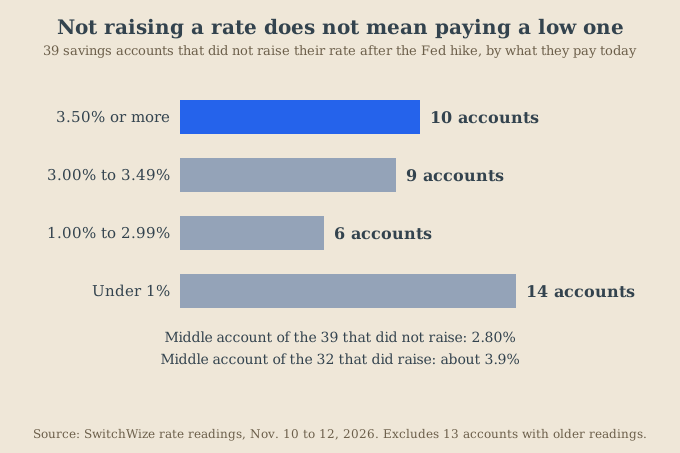
- Not raising a rate does not mean paying a low one. Of 39 unchanged accounts with a recent reading, 10 pay 3.50% or more. Fourteen pay 0.25% or less.
- On $20,000, an unchanged 4.00% account earns about $800 a year. An unchanged 0.01% account earns about $2.
- Judge your account by the rate you earn today, not by whether your bank followed the Fed.
Take a saver we'll call Tomas. He is an illustration, not a real person. He fixes city buses in Albuquerque. He keeps $20,000 in savings at a big bank that pays 0.25%.
A coworker told him her bank raised its savings rate after the Fed hike. His did not. He decided that the hike had not reached savers like him, and that nothing could be done.
He had the question backwards. What matters is not whether a bank raised its rate. It is what the bank pays now.
What the accounts did
The Fed raised its target rate by 0.25 points on September 16, 2026, to a range of 3.75% to 4.00%. SwitchWize tracks the savings rate at 85 banks that had a reading from before the hike. Fifty-seven days later, 33 had raised their rate. Fifty-two had not.
The 33 that moved did so at different speeds. The typical one took 9 days. A few, such as TAB Bank and Customers Bank, moved within two days.
Our earlier pieces cover that race, including the day 33 tracker and the day 43 update. This piece asks a different question about the 52 that did not move.
Where the unchanged accounts stand
Thirteen of the 52 have no reading from the last few days, so we left them out. That leaves 39 with a reading from November 10 to 12.
Those 39 are far from alike:
- 10 pay 3.50% or more. The highest is 4.20%.
- 9 pay 3.00% to 3.49%.
- 6 pay 1.00% to 2.99%.
- 14 pay under 1%. All 14 pay 0.25% or less.
The middle account of the 39 pays 2.80%. The middle account of the 32 that raised its rate pays about 3.9%. That is a gap of about 1.1 points, or about $220 a year on $20,000.
The top group did not need to move. Six of the ten were read directly from the bank's own page: Goldwater Bank and Live Oak Bank at 4.00%, Old National Bank at 3.85%, BrioDirect and Rising Bank at 3.75%, and North American Savings Bank at 3.60%. The other four, Newtek Bank, Colorado Federal Savings Bank, Forbright Bank and Popular Direct, come from rate listings we have not checked against the bank's own page.
The bottom group is mostly large banks and credit unions. Wells Fargo and Webster Bank pay 0.01%. HSBC and First Citizens pay 0.10%.
What the gap costs
Here is the same $20,000 in four accounts. One raised its rate and three did not. Ally went from 3.00% to 3.20%.
Goldwater did nothing after the Fed moved and still pays 0.80 points more than Ally, which did. On $20,000 that is $160 a year. Against Wells Fargo the gap is about $798.
Tomas's 0.25% earns $50 a year. At 4.00% he would earn about $800, or $750 more.
What the data cannot tell you
We track one standard savings account at each bank. A bank may have a better or worse product that we do not list.
Some top rates have conditions, such as a minimum balance, a limit on how much earns the rate, or new customers only. Read the terms before you move money.
An unchanged rate can change tomorrow. A bank that has waited may raise it, or lower it. If the Fed hikes again at its December 8 to 9 meeting, more banks may move.
Another 18 accounts could not be measured because they had no reading from before the hike. They are not in these counts.
What to do
- Find your rate. It is on your statement or app, listed as APY, the yearly rate with compounding.
- Compare it with the middle. The middle account that raised its rate pays about 3.9%. If you earn far less, you are giving up money.
- Ignore whether your bank moved. Look only at the number.
- Check the terms. Minimums and new customer offers can change the answer.
- See the full list. Our savings rates page shows which accounts we checked against the bank's own page.
What Tomas did next
On Saturday, Tomas looked up his rate again. It was 0.25%, as before. He found an account that has paid 4.00% since before the Fed hike. He read the minimum and the terms, then opened it online and moved $19,900. He left $100 in the old account until the first interest payment showed up.
Sources
- SwitchWize Fed hike tracker, savings accounts measured against the Sept. 16, 2026 Fed hike, as of Nov. 12, 2026 (85 accounts measured, 33 moved, 52 unchanged, median 9 days to first move; methodology)
- SwitchWize rate readings, Nov. 10 to 12, 2026 (39 unchanged accounts with a recent reading; 6 read from the bank's own page, 4 from rate listings)
- Federal Reserve, FOMC statement of September 16, 2026 (target range 3.75% to 4.00%)
Frequently Asked Questions
Did banks raise savings rates after the Fed hike?
If my bank did not raise its savings rate, is it a bad deal?
Which savings accounts did not raise rates but still pay a lot?
How much does a low savings rate cost?
The 5-minute money briefing
One email per week. The biggest changes in savings, money market, checking and CD rates.
Send me the weekly SwitchWize rate briefing: the biggest changes in savings, money market, checking and CD rates. Unsubscribe in one click. We never share your address.
Act on this: today's top savings


Ranked by SwitchWize's composite score. Some partner links may compensate SwitchWize.
Editorial review
What changed since the last update
Was this guide helpful?
Found an inaccurate, outdated, or missing claim? Report a correction. We verify reports against the relevant source before changing a guide or ranking.
