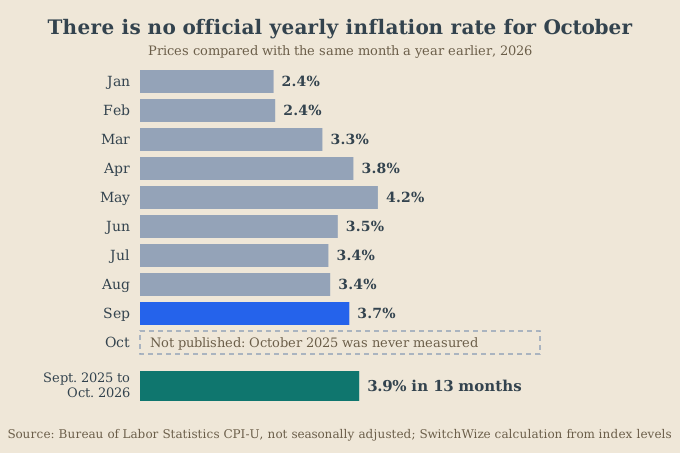
- The government published no yearly inflation rate for October 2026. It never measured prices in October 2025, so it has nothing to compare with.
- Prices rose 0.4% in October alone. From September 2025 to October 2026, a 13-month span, they rose 3.9%. That is about 3.6% a year.
- A savings account needs about 3.61% APY to match that before tax. On November 10, 15 of 26 verified accounts paid it and 11 did not.
- A saver with $20,000 at 3.20% falls about $88 behind in buying power over 13 months. At 4.00% the same saver ends about $85 ahead.
Take a saver we'll call Priya. She is an illustration, not a real person. She is a dental hygienist in Tucson. She keeps $20,000 in a savings account that pays 3.20%.
On Tuesday she searched for the October inflation rate. She found that prices rose 0.4% in a month. She could not find a yearly number, because there was none. She wanted one thing: is my savings keeping up?
What the October report says
The Bureau of Labor Statistics published the October price report on November 10. Prices rose 0.4% from September. Economists had expected 0.3%. September's rise was 0.6%.
Prices without food and energy rose 0.3%. That is the same as in August and September. Food rose 0.5%. Energy rose 0.7%, after a 5.2% jump in September.
Why there is no yearly number
Yearly inflation compares prices with the same month a year ago. For October that means October 2025. The agency has no October 2025 prices. Its own release says it "did not collect survey data for October 2025 because of a lapse in appropriations." That was the 2025 federal shutdown.
So the bureau says it cannot publish a 12-month change for October 2026. The table shows a dash. The last yearly figure was 3.7% for September. In the chart above, October is the empty bar.
The number you can work out yourself
The bureau still publishes the price index for every month. It is just a level, set so that 1982 to 1984 equals 100. You can divide one level by another.
September 2025 is the last month before the gap. Its index was 324.800. October 2026 was 337.511. Divide the second by the first and prices rose 3.9% over those 13 months.
That is 13 months, not 12. Spread evenly over a year it comes to about 3.6%. Both are close to September's official 3.7%. The gap in the data hides less than it first seems.
We used the index before the bureau's adjustment for normal seasonal swings, which is the one it uses for yearly figures. Using September 2026 the same way gives 3.7%, which matches the official number.
What 3.9% means for a savings account
Interest only helps if it grows your money faster than prices grow. Over 13 months, an account needs to pay about 3.61% APY (the yearly rate a savings account pays, with compounding) to match a 3.9% price rise before tax. Here is what that does to Priya's $20,000.
- Interest in 13 months
- $694
- Prices add
- $783
- Result
- About $88 behind
- Interest in 13 months
- $794
- Prices add
- $783
- Result
- About even
- Interest in 13 months
- $868
- Prices add
- $783
- Result
- About $85 ahead
- Interest in 13 months
- $955
- Prices add
- $783
- Result
- About $172 ahead
On November 10, SwitchWize had checked 26 savings accounts against each bank's own page. The top rate was 4.40%, at PiBank. The median was 3.66%. Fifteen paid 3.61% or more. Eleven paid less, including accounts at 3.20% and 3.00%.
Some of those rates have conditions. Peak Bank, Apple Bank and Salem Five pay their top rate to new customers only. A few pay less on large balances or need a $25,000 minimum. Check the fine print before you move money.
Tax makes it harder. Interest counts as income. Our earlier piece on savings rates after tax shows that a saver in the 12% bracket needs about 4.20% to break even at 3.7% inflation.
What could change next
The Fed held its target rate at 3.75% to 4.00% on October 28. The vote was 10 to 2. The two members who voted no wanted a quarter-point hike. The Fed's statement said inflation "remains elevated."
After the price report, CNBC said traders in the futures market fully expected a quarter-point hike at the December 8 to 9 meeting. That is a market bet, not a decision. A hike would push some savings rates up. Many banks were slow to follow the September hike, as our week-by-week tracker shows.
What the 3.9% cannot tell you
It is a rough figure, not an official one. The 13-month span is not a year. Priya's own prices, rent, gas and groceries, may have moved more or less than the average.
The recent pace also looks different from the yearly one. From July to October, prices rose 1.1%. If that continued for a year it would be about 4.4%. But September had a big energy jump, and one quarter of a year is a noisy guide. Prices without food and energy rose 0.3% a month, or about 3.7% a year at that pace.
The bureau should be able to publish a normal yearly figure again for November, because it did measure prices in November 2025.
What to do
- Find your rate. Look at the APY on your statement or app. Compare it with 3.61%.
- Compare it with verified accounts. Our list of savings rates shows which ones we checked against the bank's own page.
- Think about tax. If interest is taxed at your rate, the break-even is higher.
- Keep cash you need soon in cash. Our guide to how inflation affects your money explains how rising prices eat into cash.
- Check again in December. The Fed meets December 8 and 9, and the next price report should carry a yearly number.
What Priya did next
Priya worked it out on her phone. At 3.20%, her $20,000 would earn about $694 over 13 months. Prices would add about $783. She was $88 behind.
She found a verified account paying 4.00% with no minimum and no fee, and moved $20,000 on Wednesday night. The same math now has her about $85 ahead. She set a reminder for December 10, to check whether the Fed's decision changed anything.
Sources
- Bureau of Labor Statistics, Consumer Price Index, October 2026, released Nov. 10, 2026 (all items +0.4% seasonally adjusted; core +0.3%; food +0.5%; energy +0.7%; October 2026 index 337.511; no 12-month change published) and Table 5
- Bureau of Labor Statistics, CPI-U all items, not seasonally adjusted, monthly index levels January 2025 to October 2026 (series CUUR0000SA0; October 2025 not available because of the 2025 lapse in appropriations)
- Federal Reserve, FOMC statement, October 28, 2026 (target range 3.75% to 4.00%; vote 10 to 2; dissenters Lisa D. Cook and Beth M. Hammack)
- CNBC, Consumer prices rose 0.4% in October, Nov. 10, 2026 (CME FedWatch pricing for the December 8 to 9 meeting)
- SwitchWize rate data, verified savings accounts checked Nov. 10, 2026 (26 accounts; median 3.66%; top 4.40%)
Frequently Asked Questions
What was the inflation rate in October 2026?
Why is there no yearly inflation number for October?
How can I work out inflation myself?
What savings rate keeps up with 3.9% inflation?
Will the Fed raise rates in December 2026?
The 5-minute money briefing
One email per week. The biggest changes in savings, money market, checking and CD rates.
Send me the weekly SwitchWize rate briefing: the biggest changes in savings, money market, checking and CD rates. Unsubscribe in one click. We never share your address.
Act on this: today's top savings


Ranked by SwitchWize's composite score. Some partner links may compensate SwitchWize.
Editorial review
What changed since the last update
Was this guide helpful?
Found an inaccurate, outdated, or missing claim? Report a correction. We verify reports against the relevant source before changing a guide or ranking.
