How to choose
What to weigh before you pick
It usually comes down to 3 things. Compare your options on each before deciding.
The rate that actually sticks after any promo expires.
Monthly fees and the balance needed to earn the top rate.
Transfer speed, withdrawal limits, and ATM reach.
- The May 2026 I bond composite rate is around 4.26%, made of a 0.90% fixed rate plus a 3.34% inflation rate, and a top high-yield savings account currently pays more than that while staying fully liquid.
- On a $10,000 balance, the maximum a single person can buy in I bonds per year, the headline-yield edge goes to the savings account, and the savings account also lets you withdraw on day one instead of waiting a year.
- I bonds still win in two specific cases: you are in a high-tax state and want the state-tax exemption, or you want a fixed return locked above inflation for the life of the bond.
The reflex every time inflation makes headlines is to buy I bonds. In 2026 that reflex points the wrong way for most people. The May 2026 I bond composite rate is 4.26%, and the best high-yield savings accounts pay more than that with none of the strings. Savings rates on this page were last verified recently. For most savers in 2026, the I bonds vs high yield savings 2026 comparison clearly favors the flexibility and higher returns of savings accounts.
That does not make I bonds useless. It means the decision turns on two things the headline rate hides: your state tax rate, and whether you need the money soon. Get those two right and the answer is clean.
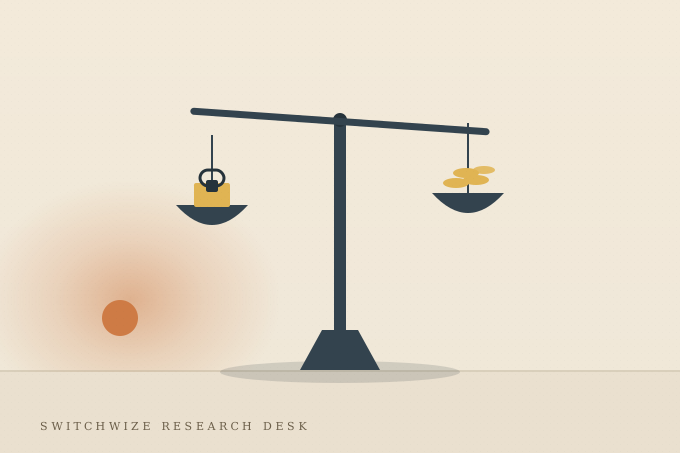
The line: in a no-income-tax state, a top high-yield account beats the I bond (currently around 4.26%) outright. The I bond pulls ahead only once your state income tax rate is high enough, roughly 8% or more, for its state-tax exemption to close the gap.
What an I bond actually pays in 2026
An I bond rate has two parts. A fixed rate, set when you buy and locked for the life of the bond, plus an inflation rate that resets every six months. For bonds issued from May 2026 through October 2026, the fixed rate is 0.90% and the annualized inflation rate is 3.34%, which combine into the 4.26% composite rate for the first six months, per TreasuryDirect.
The 0.90% fixed piece is the part that matters long term. It is a guaranteed return above inflation, locked for as long as you hold the bond, up to 30 years. The 3.34% inflation piece will rise or fall with CPI at every reset, so the 4.26% headline is not a rate you keep, it is a rate for one six-month window.
What a high-yield savings account pays, and what it does not cost you
The best high-yield savings accounts pay 4.20% APY right now, above the I bond composite. They are FDIC insured, and they stay fully liquid. No 12-month lockup, no early-redemption penalty, no $10,000 annual cap.
The contrast with a big-bank account is the real story. The national average savings yield is 0.38%, so the choice that actually costs people money is not I bond versus high-yield account, it is high-yield account versus the 0.40% account they already have. That gap is the loyalty tax, and on cash it dwarfs the I bond question. You can see the live dollar figure on the Bank Gap Index.
Side by side
- I bond (May 2026)
- 4.26% composite (6 months)
- Top high-yield savings
- 4.20% APY
- I bond (May 2026)
- 0.90% for the life of the bond
- Top high-yield savings
- None, rate floats
- I bond (May 2026)
- Locked 12 months, penalty before 5 years
- Top high-yield savings
- Withdraw any time
- I bond (May 2026)
- $10,000 per person
- Top high-yield savings
- None
- I bond (May 2026)
- Exempt
- Top high-yield savings
- Taxable
- I bond (May 2026)
- Deferred until redemption
- Top high-yield savings
- Taxed yearly
- I bond (May 2026)
- U.S. Treasury
- Top high-yield savings
- FDIC, up to $250,000
The line where I bonds still win
Two cases flip the math toward the bond.
You live in a high-tax state. I bond interest is exempt from state and local income tax. A high-yield account is not. In a state with a 9% to 13% income tax, that exemption is worth roughly 0.4 to 0.6 points of yield on a 4-plus-percent rate, which can close the headline gap or reverse it. In a no-income-tax state the exemption is worth nothing, and the liquid account keeps its full lead. Your state rate is the swing variable, so run it before you decide.
You want a real return locked for years. The 0.90% fixed rate is a guaranteed return above whatever inflation runs, held for as long as you own the bond. A savings rate can fall. If you are setting aside money you will not touch for five years or more and you want certainty that it beats inflation, the fixed piece is worth something a floating savings rate cannot promise.
Outside those two cases, the high-yield account wins. It pays a higher headline rate today, it never locks your money, and for an emergency fund the liquidity alone settles it. You cannot touch an I bond for a year, which disqualifies it as emergency cash on its own.
Rather than guess at your own break-even, run your state rate and balance through the T-bill tax-equivalent calculator. It is built for Treasury-vs-bank comparisons and uses the same state-tax mechanics that decide the I bond question.
When each one wins
- Take this side
- High-yield savings, always
- The reasoning
- I bonds physically cannot be redeemed in year one
- Take this side
- Lean toward I bonds, up to $10,000
- The reasoning
- State-tax exemption can close or reverse the headline gap
- Take this side
- Lean toward high-yield savings
- The reasoning
- Nothing offsets the I bond's lower headline rate
- Take this side
- I bonds
- The reasoning
- The 0.90% fixed rate holds even if inflation cools
- Take this side
- High-yield savings
- The reasoning
- No lockup, no penalty, no $10,000 annual cap
Where each one belongs
- Emergency fund and near-term cash: high-yield savings. The 12-month I bond lockup rules it out. Compare the top accounts on the live savings page.
- Money you will not need for 5-plus years, and you want inflation protection: I bonds, up to the $10,000 limit, especially in a high-tax state.
- A middle bucket you can lock for a known term: a CD can beat both if you want a fixed nominal rate without the inflation reset. See HYSA vs CD and CDs vs bonds vs treasuries. For a liquid Treasury option, SGOV vs a high-yield account covers the after-tax angle.
Quick answers
What is the I bond rate right now? I bonds issued from May 2026 through October 2026 pay a 4.26% composite rate for six months, from a 0.90% fixed rate plus a 3.34% inflation rate.
Do I bonds beat a savings account? On headline rate, no. A top high-yield account pays 4.20% and stays liquid. I bonds win mainly in a high-tax state, where their state-tax exemption can close the gap, or when you want a fixed real return locked for years.
Can I use an I bond as my emergency fund? No. You cannot redeem for the first 12 months, so emergency cash belongs in a liquid high-yield account.
Sources
- TreasuryDirect: I bond interest rates
- TreasuryDirect: May 1, 2026 rate announcement
- FDIC national deposit rates
- SwitchWize methodology
Methodology
I bond rates are set by the U.S. Treasury and published at TreasuryDirect; the May 2026 figures reflect the May 1, 2026 rate announcement linked above. SwitchWize tracks savings APYs daily from bank websites and regulatory filings, cross-referenced against FDIC national rate data. Tax treatment is general and not personalized advice; your result depends on your state rate, your bracket, and your timeline. This is educational information, not personalized financial advice.
Source: S&P Capital IQ Pro; SNL Financial Data. Calculations: FDIC. Reflects the $2,500 product tier for savings and interest checking accounts.
Frequently Asked Questions
What is the current I bond rate in 2026?
Are I bonds better than a high-yield savings account in 2026?
Do I bonds beat savings accounts after tax?
How much can I put in I bonds and how long are they locked?
Act on this: today's top savings


Ranked by SwitchWize's composite score. We may earn a referral fee, and it never changes the ranking order.
Editorial review
What changed since the last update
Was this guide helpful?
Found an inaccurate, outdated, or missing claim? Report a correction. We verify reports against the relevant source before changing a guide or ranking.
