- EE bonds issued in 2026 pay a low headline rate near 2.40%, far below top savings and I bonds, and are a poor choice if you sell early.
- Their one real feature: hold exactly 20 years and the Treasury guarantees the bond doubles, an effective 3.53% locked for two decades with zero risk.
- They fit only money you are certain to leave untouched for 20 years, such as a long-horizon gift for a child, and almost no one else.
Almost every guide tells you to skip EE bonds, and on the numbers they are right. The headline rate is dismal, the money is locked, and if you cash out early you get almost nothing. Then there is the one feature that makes them worth understanding: a guarantee no savings account, CD, or I bond will give you. Rates on this page were last verified recently. Whether are EE bonds worth it 2026 depends on whether you value that guarantee more than raw yield.
Hold an EE bond for exactly 20 years and the U.S. Treasury guarantees it will be worth at least double what you paid. That is a fixed, risk-free return locked for two decades. The question is not whether that is valuable. It is whether your money can truly sit still for 20 years.
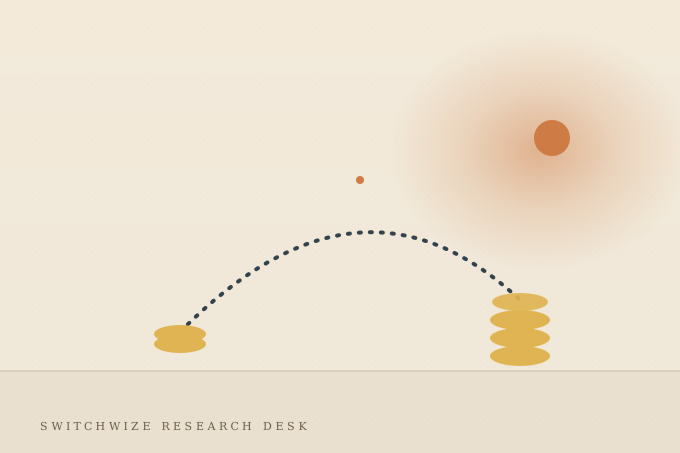
What an EE bond actually pays
Two numbers, and they tell opposite stories.
- The headline rate. EE bonds issued in 2026 earn a fixed rate near 2.40%. Against a top high-yield account at 4.20% or a 1-year Treasury at 4.40%, that is a bad rate, and it is what you earn if you redeem before 20 years.
- The 20-year guarantee. At the 20-year mark, the Treasury makes a one-time adjustment so the bond is worth at least double your purchase price. Doubling over 20 years is an effective annual return of about 3.53%, fixed and risk-free, regardless of what rates or inflation do over those two decades.
The entire value lives at year 20. Redeem at year 15 or even year 19 and you get only the 2.40%, not the double. It is the most all-or-nothing instrument in personal finance.
EE bonds vs the alternatives
- EE bond
- ~2.40% fixed
- I bond
- ~4.26% composite
- Top high-yield savings
- 4.20%
- EE bond
- Guaranteed double at 20 yrs (~3.53%)
- I bond
- Inflation protection
- Top high-yield savings
- Full liquidity
- EE bond
- Exactly 20 years
- I bond
- Medium term
- Top high-yield savings
- Any
- EE bond
- Locked 1 yr, penalty before 5
- I bond
- Locked 1 yr, penalty before 5
- Top high-yield savings
- Withdraw any time
- EE bond
- Exempt
- I bond
- Exempt
- Top high-yield savings
- Taxable
For medium-term cash, I bonds or a high-yield account win easily. EE bonds only pull ahead at the 20-year line, and only if you actually reach it.
Who EE bonds actually fit
This is a narrow tool for a specific job.
- A locked 20-year horizon. Money you are genuinely certain you will not touch for two decades, where a fixed guaranteed double is worth more than a higher but uncertain rate.
- A long gift for a child. Buying for a newborn that matures around college or adulthood is the classic fit: the 20-year clock and the lockup are features, not bugs, and the interest can be tax-advantaged for education.
- A guaranteed-return corner of a portfolio. For someone who wants one slice of truly risk-free, rate-proof money locked for the long run, the doubling guarantee delivers it.
For everyone else, the low rate and the all-or-nothing 20-year requirement make EE bonds the wrong tool. The right answer for most cash is liquid and higher-yielding.
Quick answers
Are EE bonds worth it in 2026? Only for a locked 20-year horizon, where the guaranteed double (about 3.53% effective) beats an uncertain rate. For anything shorter, savings or I bonds pay more.
How does the double work? The Treasury adjusts the bond at year 20 so it is worth at least double; redeem earlier and you get only the ~2.40% rate.
EE or I bonds? I bonds for inflation-protected medium-term cash; EE bonds only for a fixed 20-year guarantee you will hold to maturity.
Methodology
EE bond rates and the 20-year doubling guarantee are set by the U.S. Treasury and published at TreasuryDirect; the 2026 figures reflect the current rate announcement. SwitchWize tracks savings and Treasury yields daily from bank and Treasury data, cross-referenced against FDIC national rate data. Tax treatment is general, not personalized advice. This is educational information, not personalized financial advice.
What to Do Now
Is an EE Bond Right for This Money?
- Best next move
- EE bond
- Why
- The guaranteed double is a real, risk-free 3.53% effective return
- Best next move
- Skip EE bonds
- Why
- Early redemption pays only the poor 2.40% headline rate
- Best next move
- I bond instead
- Why
- Higher current yield with the same state-tax exemption
- Best next move
- High-yield savings instead
- Why
- Full liquidity beats any locked guarantee you can't reach
Compare current insured savings options on the SwitchWize savings page, then use the CD ladder calculator if your timeline is shorter than 20 years.
Sources
Rates referenced on this page were verified on July 10, 2026 and can change after publication. This content is educational and is not personalized financial, tax, or investment advice.
Frequently Asked Questions
Are EE bonds worth it in 2026?
How does the EE bond 20-year double work?
EE bonds or I bonds in 2026?
What are the rules and limits on EE bonds?
The 5-minute money briefing
One email per week. New rates, fed moves, and what to actually do about them.
No spam. Unsubscribe anytime.
Act on this: today's top savings


Ranked by SwitchWize's composite score. We may earn a referral fee, and it never changes the ranking order.
Editorial review
What changed since the last update
Was this guide helpful?
Found an inaccurate, outdated, or missing claim? Report a correction. We verify reports against the relevant source before changing a guide or ranking.
