- Consumer prices rose 3.7% in the year to September 2026, the Bureau of Labor Statistics reported on October 14. To buy next year what $10,000 buys today, you will need $10,370.
- The best verified savings rate SwitchWize tracks is 4.27%. On $10,000 that is $57 ahead of inflation before tax. After tax it is $6 ahead at the 12% bracket and $37 behind at the 22% bracket.
- Of 71 tracked savings accounts with a current reading, 45 pay less than 3.7%, and 17 pay less than 1%. Six pay the 4.20% a 12% taxpayer needs to break even. None pay the 4.74% a 22% taxpayer needs.
Dwight filled his truck in Columbus, Ohio, on Wednesday morning and counted the receipt twice. He is 44 and works as a maintenance planner. He keeps an emergency fund of $20,000 in a savings account at a large bank. He checked the rate that night. It was 0.01%. That is $2 of interest a year.
That Wednesday the government published the September price report. Prices were up 3.7% from a year earlier. For Dwight's $20,000 to keep its buying power for a year, it has to grow by $740. At 0.01% it grows by $2. The other $738 is quietly taken from him, because the same money will buy less.
What the September report showed
The Bureau of Labor Statistics said on October 14 that its consumer price index rose 0.6% in September and 3.7% over twelve months. In August, the yearly figure was 3.4%. The rise came mostly from energy. Energy prices rose 5.2% in the month and 20.4% over the year. Gasoline rose 9.1% in September and 34.2% over the year.
Food prices were flat for the month and up 2.5% over the year. Rent and other shelter costs rose 0.4% for the month and 3.2% over the year. The core measure, which leaves out food and energy, was 2.6% over the year. It was 2.4% in August.
What $10,000 does in five different accounts
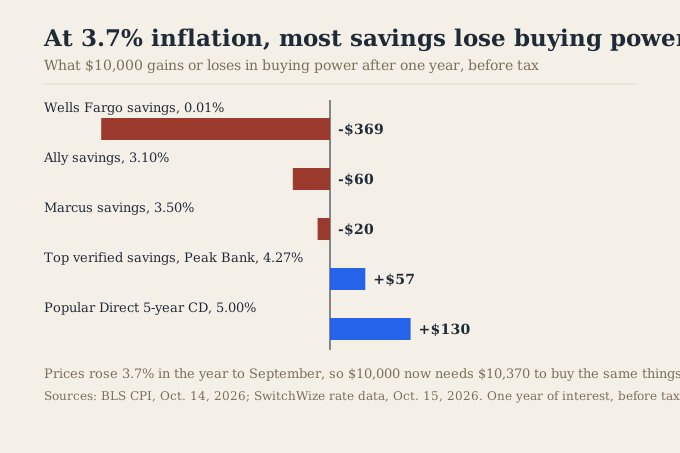
Start with the simplest test. Prices rose 3.7%, so $10,000 now needs $10,370 a year from now to buy the same things. Anything below $370 of interest is a loss in buying power.
Here are one year of interest and the gap, before tax, using rates SwitchWize tracked on October 15:
- Wells Fargo savings at 0.01% pays $1, which leaves you $369 short.
- Ally at 3.10% pays $310, which leaves you $60 short.
- Marcus at 3.50% pays $350, which leaves you $20 short.
- Peak Bank at 4.27%, the best rate in our verified list, pays $427, which leaves you $57 ahead.
- Popular Direct's five-year CD at 5.00% pays $500, which leaves you $130 ahead.
The big gap is between the first row and the second. Moving from 0.01% to 3.10% fixes almost all of the damage. Moving from 3.10% to 4.27% turns a small loss into a small gain.
Why tax moves the bar to 4.20%
Interest on a savings account is taxed as ordinary income. So the number that counts is what you keep. A saver in the 12% federal bracket keeps 88 cents of each interest dollar. To keep pace with 3.7%, the account has to pay 3.7 divided by 0.88, which is 4.20%. In the 22% bracket the account has to pay 3.7 divided by 0.78, or 4.74%. State income tax, which we did not count, pushes both numbers higher.
Run Peak Bank's 4.27% through that. At the 12% bracket, $427 of interest becomes $376 after tax. That is $6 ahead of inflation. At the 22% bracket it becomes $333, which is $37 behind. The five-year CD does a little better, at $70 ahead for the 12% bracket and $20 ahead for the 22% bracket, because 5.00% is a higher starting point.
Of the 71 accounts, 45 pay less than 3.7%. Of those, 17 pay less than 1%, and several are large banks: Wells Fargo at 0.01%, Webster at 0.01%, HSBC at 0.10%, First Citizens at 0.10%. Twenty accounts beat inflation before tax but not after it, for a 12% taxpayer. Six reach 4.20%. None reach 4.74%.
Gasoline did this, and core prices rose less
There is an honest complication. The jump from 3.4% to 3.7% came mostly from gasoline, which makes up a smaller share of a typical budget than the headline number suggests. Core inflation was 2.6%. Against 2.6%, the 4.27% account is 1.67 points ahead before tax, and even a 22% taxpayer's after-tax 3.33% stays ahead.
So the answer depends on your budget. A household that drives a lot feels something near 3.7% or more. A household that drives little may feel something closer to 2.6%. Neither number is wrong. The rate you need depends on which prices you actually pay.
Rates may also move. The Fed raised its target a quarter point on September 16, to a range of 3.75% to 4.00%, and meets again on October 27 and 28. Banks have not rushed to pass the raise on. By October 15, 30 of the 87 savings accounts we measure had raised their rate and 54 had not changed. The typical account moved by zero. Peak Bank's 4.27% is also a rate for new accounts only. Balances of $500,000 or more earn 3.40%, and the bank can change the rate at any time.
Social Security gets a raise. Savers do not.
The Social Security Administration announced a 3.6% raise for 2027 on the same day as the price report. It reaches about 76 million people and averages about $75 more per month for retirees. It is the largest since 2023's 8.7%, and it follows 2026's 2.8%. The number is built from the July, August and September readings of a related price index, so it will not exactly match 3.7%.
The difference with savings is that the raise is automatic. A savings account is not. A retiree on Social Security gets 3.6% in January without lifting a finger. A retiree with $20,000 at 0.01% gets an extra $2. Savings rates rise only when the owner moves the money, and banks do not tell customers to do that.
What Dwight does with his $20,000
On Thursday night Dwight opened a second account at a bank paying 4.25%, with no minimum balance. He moved $20,000 over. That earns about $850 a year. He is in the 12% bracket, so he keeps about $748. Against the $740 he needs to match inflation, he is $8 ahead. Last week he was $738 behind.
He did not move all of it. He left $2,000 at his old bank, next to his checking account, for bills. He has a note on his phone for the Fed meeting on October 27. If his new rate drops below 4.20%, he will look again. On the receipt from Wednesday, the gas cost him $61.40. He kept it as a reminder.
Sources
- U.S. Bureau of Labor Statistics, "Consumer Price Index Summary, September 2026", released October 14, 2026: all items +0.6% for the month and +3.7% over twelve months; core +0.3% and +2.6%; energy +5.2% and +20.4%; gasoline +9.1% and +34.2%; food 0.0% and +2.5%; shelter +0.4% and +3.2%. The August figures (3.4% headline, 2.4% core) are from the BLS release of September 11, as reported by Trading Economics.
- Social Security Administration, "Social Security Announces 3.6 Percent Benefit Increase for 2027", October 14, 2026, and Fox Business: 3.6%, about 76 million recipients, about $75 per month average retirement increase, based on third-quarter readings of the CPI-W. The 2023 (8.7%) and 2026 (2.8%) raises are from SSA's published COLA history.
- SwitchWize approved rate snapshots, savings and CDs, as of October 15, 2026: Peak Bank Envision at 4.27% (new accounts only; $500,000 and above earn 3.40%; rate can change at any time), Popular Direct 60-month CD at 5.00% ($10,000 minimum, early withdrawal fee of 730 days of simple interest).
- SwitchWize Fed Hike Tracker, dataset as of October 15, 2026, day 30 after the September 16 hike: 87 accounts measured, 30 raised, 54 unchanged, 3 moved lower. Of the 71 with a current reading, 45 pay under 3.7%, 17 under 1%, 26 pay 3.7% or more, and 6 pay 4.20% or more. Ally (3.10%), Marcus (3.50%) and Wells Fargo (0.01%) rates are tracked readings from the same dataset. Fed target range of 3.75% to 4.00%.
- Break-even rates are SwitchWize arithmetic: 3.7 divided by (1 minus tax rate). The 12% and 22% brackets are federal ordinary-income brackets; state tax is not included. Interest counted as one year at the stated APY on $10,000.
- Dwight is a composite character. His balance and bracket are chosen for illustration.
What to Do Now
Dwight is a composite character; the price report, Social Security announcement, and account rates cited are real. Figures were verified on October 16, 2026. Savings rates change often. This article is educational information, not tax or investment advice.
Quick answers
Is my savings account beating inflation in 2026? Only if it pays more than 3.7% APY, and more than that after tax. Of the 71 savings accounts SwitchWize tracks with a current reading, 26 pay 3.7% or more before tax and 45 pay less. Accounts near 0.01% lose about $369 of buying power per year on $10,000.
What savings rate do I need to beat 3.7% inflation after tax? Divide 3.7% by one minus your tax rate. In the 12% bracket that is 4.20%. In the 22% bracket it is 4.74%. State income tax raises both.
Why did inflation jump to 3.7% in September 2026? Mostly gasoline, which rose 9.1% in September and 34.2% over the year. Core inflation was 2.6%.
Will the Fed raise rates again in October 2026? The Fed meets October 27 and 28. It raised its target a quarter point on September 16, to 3.75% to 4.00%. By October 15, 30 of 87 tracked savings accounts had raised their rate and 54 had not changed.
Frequently Asked Questions
Is my savings account beating inflation in 2026?
What savings rate do I need to beat 3.7% inflation after tax?
Why did inflation jump to 3.7% in September 2026?
Will the Fed raise rates again in October 2026?
The 5-minute money briefing
One email per week. New rates, fed moves, and what to actually do about them.
No spam. Unsubscribe anytime.
Act on this: today's top savings


Ranked by SwitchWize's composite score. SwitchWize currently has no compensated product links.
Editorial review
What changed since the last update
Was this guide helpful?
Found an inaccurate, outdated, or missing claim? Report a correction. We verify reports against the relevant source before changing a guide or ranking.
