- The 2027 Social Security cost-of-living adjustment will almost certainly be 3.4% or 3.5%. Two of the three monthly inflation readings it uses are already out, and September only decides the rounding.
- For the average retired worker's $2,087.52 check, that is about $71 to $73 more a month. After the Medicare Part B increase the program's trustees projected, about $64 to $66 is left, or roughly $770 to $800 a year.
- Money sitting in a savings account paying 0.01% can matter as much as the raise: about $19,000 moved to an account paying 4.25% earns roughly what the whole net COLA adds in a year.
The 2027 Social Security raise will almost certainly be 3.4% or 3.5%, and the gap between the two is about $2 a month for the average retiree. The Social Security Administration will announce the exact figure on October 14, 2026, but two of the three inflation readings it uses are already published by the Bureau of Labor Statistics.
Loretta, 72, has a printout of a news story taped to her refrigerator: "Biggest Social Security raise in years." Her check is $2,087 a month, almost exactly the national average for a retired worker. She has already penciled a number into her 2027 budget. Loretta is a composite, but her plan is a common one, and the number on her refrigerator is not the one that will reach her bank account.
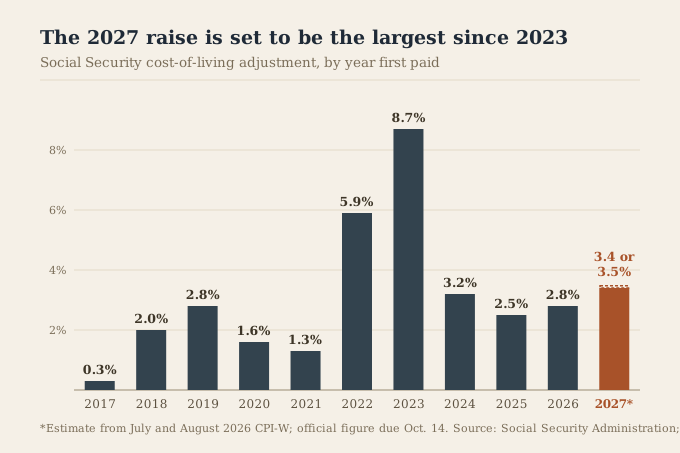
How the raise has moved since 2017
The raise has swung widely over the last decade. Per the Social Security Administration's COLA history, checks rose 0.3% in 2017, then between 1.3% and 2.8% a year through 2021. Inflation after the pandemic pushed the raise to 5.9% in 2022 and 8.7% in 2023, the largest since 1981. It then fell back to 3.2%, 2.5% and 2.8%.
Three times since 2010, there was no raise at all: in 2010, 2011 and 2016, because prices had not risen from one year's measuring window to the next. The law does not allow a cut, so a year of falling prices simply means no raise.
Inflation has picked up again this year. The CPI-W, the price index Social Security uses, was 3.52% higher in August 2026 than in August 2025, per the Bureau of Labor Statistics. That is why a 3.4% or 3.5% raise would be the largest since 2023.
How the Social Security raise is calculated
The formula is written into the Social Security Act, and the Social Security Administration publishes its own worked example. It takes the average CPI-W for July, August and September, compares it with the same three-month average from the year of the last raise, and rounds the increase to the nearest tenth of a percent.
The CPI-W is the Consumer Price Index for Urban Wage Earners and Clerical Workers. It tracks prices for households that get most of their income from wages, not for retirees.
For the 2026 raise, the math was 317.265 (the July to September 2025 average) divided by 308.729 (the 2024 average), an increase of 2.8%. For 2027, 317.265 becomes the base. We rechecked the method against Bureau of Labor Statistics data for the last three raises, 3.2%, 2.5% and 2.8%, and it reproduced each one.
Here is where the 2027 raise stands. The CPI-W was 327.104 in July 2026 and 328.481 in August. With those two numbers fixed, September can only move the three-month average a little:
- Three-month average
- 327.913
- Increase over 317.265
- 3.36%
- 2027 COLA
- 3.4%
- Three-month average
- 328.022
- Increase over 317.265
- 3.39%
- 2027 COLA
- 3.4%
- Three-month average
- 328.131
- Increase over 317.265
- 3.42%
- 2027 COLA
- 3.4%
- Three-month average
- 328.241
- Increase over 317.265
- 3.46%
- 2027 COLA
- 3.5%
- Three-month average
- 328.350
- Increase over 317.265
- 3.49%
- 2027 COLA
- 3.5%
- Three-month average
- 328.460
- Increase over 317.265
- 3.53%
- 2027 COLA
- 3.5%
The dividing line is a September rise of about 0.17%. Below it, the raise rounds to 3.4%. Above it, 3.5%. Reaching 3.6% would take a September jump of about 0.46% in a single month, and dropping to 3.3% would take a September decline of more than 0.12%. The Senior Citizens League, which tracks the COLA every month, and independent analyst Mary Johnson both estimate 3.5%. AARP's own tracker is the outlier at 3.6%, built on a bet that September prices jumped further than July and August did, on oil prices tied to the conflict around the Strait of Hormuz and on data-center construction pushing up hardware and electricity costs. That is a real possibility, not a published fact: it is a forecast of what September might show, not a reading of what it did.
What September has done before
The index these numbers come from is not seasonally adjusted, so September has its own habits. We looked at the August-to-September change in the CPI-W for each of the last 12 years:
In 7 of those 12 years, September rose less than 0.17%, which would mean 3.4% this year. In 4, it rose between 0.17% and 0.46%, which would mean 3.5%. Only once, in 2017, did it rise more, when hurricanes Harvey and Irma pushed up gasoline prices. Last September's rise was 0.26%. Past years are a rough guide, not a forecast: this year's inflation has been running hotter than most of those years, which tilts the odds toward 3.5%.
What the raise is worth after Medicare
For most retirees, the raise does not arrive whole. The standard Medicare Part B premium, which is usually taken straight out of the Social Security check, was $202.90 a month in 2026. The 2026 Medicare Trustees Report projected it rising to about $209.50 in 2027, a $6.60 increase, as reported by the Military Officers Association of America. The official 2027 premium comes out later this fall and could land higher.
The average retired worker received $2,087.52 in August 2026, per the Social Security Administration's monthly snapshot. Here is what each outcome means for that check:
- Monthly raise
- $70.98
- After $6.60 Part B increase
- $64.38
- Net per year
- $773
- Monthly raise
- $73.06
- After $6.60 Part B increase
- $66.46
- Net per year
- $798
The difference between the two outcomes is $2.08 a month. The difference between the headline raise and what lands in the account is larger than that, and it is the same in both rows.
Where the raise falls short
A raise that matches the CPI-W does not necessarily match a retiree's own costs. The CPI-W weights prices the way working households spend, and retirees spend a larger share of their money on health care and housing. The Bureau of Labor Statistics tracks an experimental index for Americans 62 and older that gives medical care and housing more weight, but the law ties the raise to the CPI-W, so that is what counts.
The raise can also bring a tax bill. Social Security benefits become partly taxable once half the benefit plus other income tops $25,000 for a single filer or $32,000 for a married couple filing jointly, per the Social Security Administration. Those lines date to 1983, a second, higher tier was added in 1993, and neither has ever been adjusted for inflation, per the Congressional Research Service. Every raise pushes a few more retirees over them, and so does any other income they add, including savings interest, which the IRS counts in the same total.
The money in the savings account
The COLA is set by formula. The interest on a retiree's savings is not, and it can be the larger number.
Some large banks pay 0.01% on standard savings, including Wells Fargo, unchanged in SwitchWize tracking as of October 4. The national average savings rate we track is 0.38%, and CIT Bank, the top rate in SwitchWize tracking today, pays 4.25%. On $20,000, that is $2 a year at 0.01%, $76 at 0.38%, and $850 at 4.25%.
At 3.5%, the average retiree's net raise is $798 a year. About $19,000 moved from a 0.01% account to one paying 4.25% earns roughly the same amount, and it does not wait for October 14 or depend on the September inflation reading. From an account paying the 0.38% average, it takes about $21,000.
For a single retiree getting the average benefit, half of that benefit is about $12,500 a year, so a thousand dollars or so of interest on its own is unlikely to reach the $25,000 line. For households with pensions, retirement account withdrawals or large balances, the interest counts, so check the math before assuming the extra interest is tax-free.
You can compare current rates on our savings rate table, and see why the biggest banks can pay so little.
What Loretta did
Loretta crossed out the number on her budget and wrote in $66, the 3.5% raise minus the projected Medicare increase, with $64 in pencil beside it in case September comes in soft. Then she looked at the $30,000 she keeps in savings at the bank where she opened her first account in 1979, earning 0.01%, or $3 a year. She kept $5,000 there for the bills she pays in person and moved $25,000 to an online savings account paying just over 4%. That move adds about $1,000 a year, more than the raise she had taped to the refrigerator, and she will know it is working before the October 14 announcement.
Quick answers
What will the 2027 Social Security COLA be? Almost certainly 3.4% or 3.5%. It is 3.4% if September's CPI-W rises less than about 0.17% from August, and 3.5% if it rises between about 0.17% and 0.46%. The official number comes out October 14, 2026.
How much will the average check go up? About $71 to $73 a month on the average retired worker's $2,087.52 benefit, or about $64 to $66 after the projected $6.60 Medicare Part B premium increase.
When does the raise start? With December 2026 benefits, which are paid in January 2027.
Methodology
CPI-W values are the not-seasonally-adjusted U.S. city average index (series CWUR0000SA0) from the Bureau of Labor Statistics, confirmed directly against BLS's published historical table on October 4, 2026. The COLA formula and the 317.265 base come from the Social Security Administration's published 2026 COLA computation; we confirmed the same method reproduces the 2024, 2025 and 2026 raises. Three-month averages are rounded to three decimals, as the Social Security Administration does. The September thresholds are the CPI-W levels that put the rounded increase at 3.35%, 3.45% and 3.55%. Chart years are the year each raise was first paid; the Social Security Administration's table lists each raise under the prior year, when it took effect with December benefits. The Part B figures are projections from the 2026 Medicare Trustees Report and will be replaced by the official 2027 premium. Savings rates are from SwitchWize rate tracking as of October 4, 2026; interest figures use the annual percentage yield without compounding beyond it. Loretta is a composite character; her situation is illustrative, and the math is real.
Sources
- Social Security Administration: Cost-of-living adjustment history and latest COLA computation
- Social Security Administration: Monthly Statistical Snapshot, August 2026
- Bureau of Labor Statistics: Consumer Price Index (CPI-W series CWUR0000SA0)
- 2026 Medicare Trustees Report, via MOAA, June 17, 2026
- The Senior Citizens League: COLA Watch
- Social Security Administration: tax withholding and combined income thresholds; IRS Tax Topic 423; Congressional Research Service: Social Security benefit taxation
Frequently Asked Questions
What will the Social Security COLA be for 2027?
How is the Social Security COLA calculated?
How much will the average Social Security check go up in 2027?
When is the 2027 COLA announced?
The 5-minute money briefing
One email per week. New rates, fed moves, and what to actually do about them.
No spam. Unsubscribe anytime.
Answer a few questions about your situation and goals. Money Map points you to the highest-value next step across savings, mortgage, cards, and debt.
Editorial review
What changed since the last update
Was this guide helpful?
Found an inaccurate, outdated, or missing claim? Report a correction. We verify reports against the relevant source before changing a guide or ranking.
