- Decumulation is the untaught half of retirement: how much to withdraw, which accounts to draw first, and how to handle sequence risk, required minimum distributions, and Social Security.
- Current research puts a safe starting rate near 3.9%, not a fixed 4%, and the biggest threat is sequence-of-returns risk, best met with a one-to-two-year cash bucket.
- A tax-smart drawdown order and Roth conversions in low-income gap years can meaningfully extend how long the money lasts and cut the lifetime tax bill.
For your entire working life, the instruction was the same: save more, invest, let it compound. Then you retire, and the instruction reverses, and almost no one has taught you the second half. Spending a portfolio down is genuinely harder than building it, because the math runs backward and the risks are new. Withdraw too much and you run out. Withdraw too little and you deny yourself the retirement you saved for. Sell at the wrong moment and you do damage that never heals. This is the playbook for that second half. This page is reviewed by the SwitchWize Editorial Team and updated as the underlying research changes; figures are sourced below with dates. Your retirement withdrawal strategy 2026 should balance these competing risks by matching your spending plan to your specific situation.
How much is actually safe to withdraw
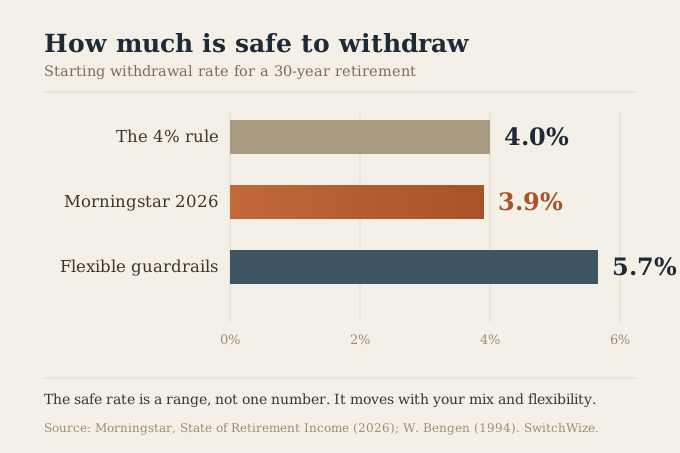
The famous answer is the "4% rule," and it is worth knowing where it comes from, because its origin explains both its usefulness and its limits. The rule traces to financial adviser William Bengen's 1994 study, "Determining Withdrawal Rates Using Historical Data," and was reinforced by the 1998 Trinity Study from three Trinity University professors. Both found that a retiree could withdraw about 4% of a portfolio in the first year, adjust that dollar figure for inflation each year after, and have a high chance of not running out over 30 years.
That was 1994. The more current answer is slightly lower. Morningstar's 2026 retirement-income research puts the safe starting rate near 3.9% for a portfolio holding 30 to 50% in stocks, up from 3.7% in 2025 as market assumptions improved. The direction matters more than the decimal: the safe rate is not a fixed law, it is a research estimate that moves with markets, your asset mix, and your horizon.
There is also an important lever. Retirees willing to adjust spending to markets, a "guardrails" approach that trims withdrawals in bad years and allows more in good ones, can safely start meaningfully higher, up to around 5.7% in Morningstar's work. Flexibility buys income. A rigid rule buys certainty at the cost of spending less than you could.
Apply a safe withdrawal rate like the classic 4% rule to a portfolio to see the annual income it can sustainably support, and the portfolio size needed for a target income.
This is a planning assumption, not a guaranteed safe rate. Stress-test multiple rates and horizons.
First-Year Planned Withdrawal
$40,000
Use this result as one input in your broader Money Map, not as a one-off number.
What to do
Compare brokerage accounts
Pre-tax estimates. For illustration only — not financial advice.
The risk that matters most, and the cash bucket
The single largest threat to a retirement portfolio is not low average returns. It is sequence-of-returns risk: the danger that a downturn arrives early in retirement, and you sell investments into it to fund your spending. Two retirees with identical average returns can end up in completely different places depending only on the order those returns arrive, because selling depressed assets locks in losses that never get the chance to recover.
The defense is structural, not predictive. Hold one to two years of spending in cash and short-term instruments, a cash bucket. When markets fall, you spend from the bucket instead of selling investments at a loss, and you refill it from gains when markets recover. It converts the terrifying question, "what if the market crashes right after I retire," into a manageable one.
Because that bucket is money you cannot afford to see dip, it belongs in federally insured, liquid accounts, not investments. Current options for the near-term portion:
The withdrawal order of operations
Once you know how much to withdraw and have protected against sequence risk, the next question is which account to draw from. This is where a tax-smart order can add years to a portfolio's life. The common default, and it is a default rather than a universal law, runs:
- Taxable accounts first. Spending brokerage money first lets your tax-advantaged accounts keep compounding, and long-term capital gains are often taxed more gently than ordinary income.
- Tax-deferred accounts next. Traditional 401(k)s and IRAs are taxed as ordinary income on withdrawal, so drawing them in the middle years spreads that tax out.
- Roth accounts last. Roth money grows tax-free and, for Roth IRAs and now Roth 401(k)s, carries no lifetime required distributions, so it is the most valuable to leave untouched longest.
- Account type
- Taxable brokerage
- Why it ranks here
- Preserves tax-advantaged growth; gentler capital-gains rates
- Account type
- Tax-deferred (traditional 401k/IRA)
- Why it ranks here
- Spreads ordinary-income tax across years
- Account type
- Roth (IRA and 401k)
- Why it ranks here
- Tax-free, no lifetime RMDs, best left to grow
This is analysis, not gospel. Your own brackets, the chance to do Roth conversions, required distributions, and estate goals can all reorder it. The point is that the order is a lever you control, and pulling it deliberately beats withdrawing at random. Model your own drawdown and its longevity here:
Stress-test how long a retirement portfolio may last under withdrawals, inflation, expected returns, a first-year market shock, and a cash-bucket buffer.
Stress case: market decline before the first withdrawal year is over.
Cash and short-term reserves you hold outside your invested portfolio, ready to spend from.
Years of spending to keep in cash so a downturn does not force you to sell investments. Two is a common choice.
Starting Withdrawal Rate
5.0%
Use this result as one input in your broader Money Map, not as a one-off number.
Probability of success
Runs 2,000 randomized simulations drawn from 1928–2025 market returns.
What to do
Build this in Money Map
Pre-tax estimates. For illustration only — not financial advice.
The gap years and Roth conversions
Between the day you stop working and the day required distributions and Social Security begin, many retirees have a window of unusually low taxable income. That window is one of the most valuable and most wasted opportunities in retirement planning.
In those low-income years, you can convert traditional balances to Roth at a low tax rate, filling up your current bracket without spilling into a higher one. Every dollar converted reduces future required minimum distributions, which are taxed as ordinary income, and becomes tax-free Roth money for later or for heirs. Done across several gap years, deliberate conversions can noticeably cut a lifetime tax bill. The art is in the sizing: convert enough to use the low bracket, not so much that you trigger a higher one.
Required minimum distributions: the withdrawals you do not choose
Eventually the government requires you to draw down tax-deferred accounts, whether you need the money or not. Under the SECURE 2.0 Act, required minimum distributions (RMDs) begin at age 73 for people born between 1951 and 1959, and age 75 for those born in 1960 or later. You may defer your first RMD to April 1 of the following year, though that stacks two withdrawals into one tax year, often a mistake.
One recent change matters for planning: Roth 401(k) accounts no longer require lifetime distributions as of 2024, aligning them with Roth IRAs. That makes Roth balances even more useful to hold late. Estimate your own required amount:
Calculate a required minimum distribution, then estimate remaining distribution need, QCD impact, tax withholding, IRMAA headroom, and missed-RMD penalty exposure.
Use the retirement account balance as of December 31 of the prior year.
The rule engine derives your 2026 age and statutory RMD starting age from birth year.
Inherited accounts and the Joint Life table require additional facts; the calculator will stop and flag those cases.
For 2026, QCDs are generally limited to $111,000 and must go directly from an eligible IRA to a qualified charity.
The canonical 2026 IRMAA package supplies the threshold. A 2026 RMD may affect Medicare premiums after the usual two-year lookback.
Required Minimum Distribution
$20,325
Use this result as one input in your broader Money Map, not as a one-off number.
What to do
Build this in Money Map
Pre-tax estimates. For illustration only — not financial advice.
Coordinating Social Security
The last piece is timing. Delaying Social Security increases the benefit for each year you wait, up to age 70, which is effectively a guaranteed, inflation-adjusted raise that few private products can match. For many retirees, the strongest plan is to spend down the portfolio in the early years specifically to enable delaying Social Security, trading some invested balance now for a larger, guaranteed, lifelong benefit later. That coordination, portfolio and Social Security working together rather than in isolation, is where a withdrawal plan becomes a retirement plan.
How we source this
The safe-withdrawal figures are drawn from Morningstar's published 2026 retirement-income research and the original Bengen (1994) and Trinity (1998) studies, cited below with dates. Required-distribution ages and Roth rules reflect the SECURE 2.0 Act and current IRS guidance. Where we present a framework, such as the withdrawal order of operations, it is labeled as SwitchWize analysis and a default to adapt, not a sourced fact. Rate-dependent figures carry a verification date, and this page is reviewed by the SwitchWize Editorial Team.
Sources
- Morningstar, The State of Retirement Income (2026 research); base-case starting rate 3.9%, up from 3.7% in 2025, and flexible approaches up to about 5.7%.
- William P. Bengen, "Determining Withdrawal Rates Using Historical Data," 1994; and Cooley, Hubbard, and Walz, the "Trinity Study," Journal of the AAII, 1998.
- Internal Revenue Service, required minimum distributions, and the SECURE 2.0 Act (RMD ages 73 and 75; Roth 401(k) lifetime RMDs eliminated from 2024).
Figures are current as of the verification date above and depend on assumptions that change; safe-withdrawal research is probabilistic, not a guarantee. This is general educational information, not personalized tax, investment, or retirement advice.
What to Do Now
Frequently Asked Questions
What is a safe withdrawal rate in 2026?
Which accounts should I withdraw from first in retirement?
What is sequence-of-returns risk and how do I protect against it?
When do required minimum distributions start?
Should I do Roth conversions in early retirement?
Answer a few questions about your situation and goals. Money Map points you to the highest-value next step across savings, mortgage, cards, and debt.
Editorial review
What changed since the last update
Was this guide helpful?
Found an inaccurate, outdated, or missing claim? Report a correction. We verify reports against the relevant source before changing a guide or ranking.
