- Your FI number is annual retirement expenses divided by a safe withdrawal rate, about 25 times expenses at 4%, from the Bengen and Trinity research.
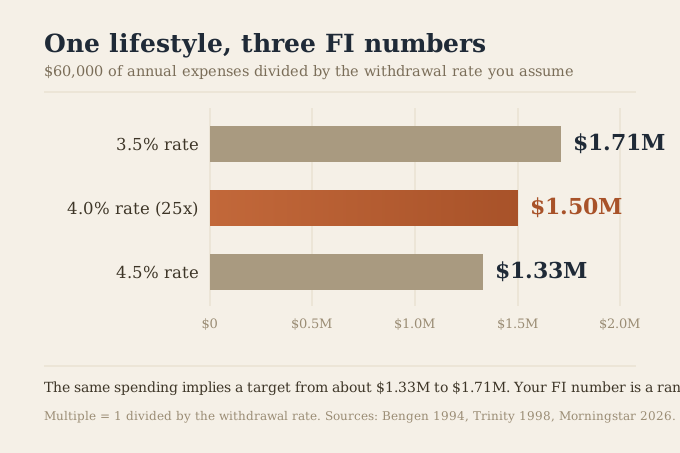
- The honest answer is a range, not a point: the same $60,000 of expenses implies roughly $1.33 million to $1.71 million depending only on the withdrawal-rate assumption.
- Coast FIRE is the practical milestone most people miss: the point where existing savings can grow into the target with no further contributions, so work becomes optional for saving long before income.
There is a number that changes the meaning of your job. Below it, you work because you have to. At or above it, you work because you choose to. It has a name, the financial-independence number, or FI number, and unlike most of personal finance it is defined by a single line of arithmetic. And yet most people carry around a figure that is either pulled from a headline, a round number that feels big, or a target a calculator handed them once without explaining. This guide replaces that with a number you understand, including the part almost no one tells you: the honest answer is a range, and where you land in it is a decision, not a fact. This page is reviewed by the SwitchWize Editorial Team; figures are sourced below with dates.
The one formula
Financial independence has a precise definition: your investments generate enough that you no longer need earned income to cover your expenses. Turning that into a number takes one equation.
FI number = annual expenses ÷ safe withdrawal rate.
At a 4% withdrawal rate, dividing by 0.04 is the same as multiplying by 25, which is why financial independence is often shortened to the 25x rule. Spend $60,000 a year and your FI number is $1.5 million. Spend $40,000 and it is $1 million. The number scales entirely off what you spend, which is the first useful insight: independence is bought with a low expense number as much as with a high savings number, and the expense side is often the one you control faster.
The 4% figure is not folklore. It comes from financial adviser William Bengen's 1994 study, later reinforced by the 1998 Trinity Study, both of which tested historical market data and asked how much a retiree could withdraw, adjusted for inflation each year, without running out over a 30-year retirement. The answer, in the large majority of historical periods, was about 4% of the starting balance. That is where 25x comes from. It is a strong, evidence-based anchor. It is also, as the next section shows, not a single guaranteed number.
Your number is a range, not a point
Change the withdrawal rate and the FI number moves hard, because you are dividing by a small number and small changes to a small denominator swing the result. Hold expenses at $60,000 and watch the target move:
- Multiple
- ~22x
- FI number on $60k expenses
- ~$1.33 million
- Multiple
- 25x
- FI number on $60k expenses
- $1.50 million
- Multiple
- ~26x
- FI number on $60k expenses
- ~$1.54 million
- Multiple
- ~29x
- FI number on $60k expenses
- ~$1.71 million
The spread between the 3.5% and 4.5% targets is roughly $380,000 for the exact same lifestyle. That is not a rounding difference. It is the single most important thing to understand about your FI number, and it is why a precise-looking figure can be quietly wrong.
Which rate should you use? Morningstar's 2026 retirement-income research puts a safe starting withdrawal rate near 3.9% for a portfolio holding 30 to 50% in stocks over a 30-year retirement, a touch below the classic 4%. But the 30-year horizon is the catch. Bengen tested a traditional retirement. If you retire at 45 and could live to 95, you are funding 50 years, not 30, and a portfolio has more chances to hit a bad stretch. Longer retirements argue for a lower withdrawal rate, which means a larger multiple, closer to 28 or 30 times expenses than 25. The flip side is flexibility: a retiree genuinely willing to trim spending in down markets can sustain a higher starting rate. Your number is a point on that range, chosen for your horizon and your willingness to adjust, not a universal constant.
Estimate a withdrawal-rate target and savings timeline with funded-goal and zero-return safeguards.
A planning assumption, not a guaranteed safe rate; taxes, fees, inflation, and retirement length matter.
Enter a consistent nominal or inflation-adjusted assumption and express expenses on the same basis.
Your FIRE Number
$1,500,000
Use this result as one input in your broader Money Map, not as a one-off number.
What to do
Explore investing accounts
Pre-tax estimates. For illustration only — not financial advice.
The four flavors of financial independence
Financial independence is not one destination. The shorthand the movement uses, borrowed from the FIRE label for Financial Independence, Retire Early, describes four versions worth knowing even if retiring early is not your goal.
- Lean FIRE. Independence built on a deliberately low expense base, often under roughly $40,000 a year. The number is smaller and arrives sooner, at the cost of a tighter lifestyle.
- Fat FIRE. Independence on a generous expense base, with room for travel, a larger home, and slack. A bigger number, more comfort, a longer road.
- Barista FIRE. Partial independence. Part-time work or a job that provides health benefits covers some expenses, so the portfolio only has to cover the rest. It lowers the effective FI number by shrinking what the investments must replace.
- Coast FIRE. The one most people cross without noticing, covered on its own below.
These are not rigid categories so much as dials. The expense base sets the multiple's dollar size; the amount of ongoing work you are willing to keep sets how much the portfolio has to shoulder. Most real plans land between the pure versions.
Coast FIRE: the milestone you probably cross first
There is a moment, often years or decades before full independence, when your existing balance is already enough. Not enough to live on now, but enough that, left alone, compounding will grow it into your full FI number by the time you plan to retire. That is Coast FIRE, and it changes the decision you face.
The math is the FI number run in reverse. If your target is $1.5 million at age 65 and you assume a 5% real return, the balance that would grow into it over 25 years is about $443,000 today. Reach roughly that figure at age 40 and you are Coast FI: you never have to save another dollar for retirement, because growth alone finishes the job. You still need income to pay today's bills, which is why Coast FIRE is compatible with a normal career, a sabbatical, a lower-paying job you actually like, or self-employment. It converts the question from "can I stop working" to the far more reachable "can I stop saving," and the second question turns true long before the first.
Estimate a current no-additional-contribution balance under a constant real-return assumption.
Enter a retirement target from your broader planning assumptions.
Enter an after-inflation return scenario; no return is guaranteed.
Coast FIRE Number
$347,066
Use this result as one input in your broader Money Map, not as a one-off number.
What to do
Plan Your FIRE Path
Pre-tax estimates. For illustration only — not financial advice.
The traps that make a good number lie
The formula is honest. The way people apply it usually is not. Four traps quietly inflate or deflate a real FI number.
Taxes. The 25x multiple assumes the whole withdrawal is yours to spend. It usually is not. Money in a traditional 401(k) or IRA is taxed as ordinary income on the way out, so covering $60,000 of spending from tax-deferred accounts can require withdrawing noticeably more. Roth balances and the principal portion of taxable-account withdrawals are gentler. Compute your number on your pre-tax spending need, and plan the mix of account types, because the mix changes your real, spendable rate. See our retirement withdrawal playbook for the drawdown order that manages this.
Pre-Medicare healthcare. For anyone retiring before 65, health coverage is often the single largest line item the budget forgets. It belongs in the expense figure that feeds the multiple, and it can add a meaningful amount to the target.
Inflation of the target itself. The FI number is usually stated in today's dollars, which is fine as long as you are consistent: use a real (inflation-adjusted) return and keep your savings growing in real terms. The mistake is freezing today's dollar target while your actual future expenses drift upward with inflation. The number you need in nominal dollars on your retirement date is larger than the number you computed today.
Sequence-of-returns risk. Two retirees with identical average returns can end very differently if one meets a market crash in the first few years and sells to fund spending. This is the deepest risk in the withdrawal phase, and it is the reason the safe rate sits below the long-run average return. It is also why a cash buffer matters, which is the next point.
Where the cash sits still matters
An FI plan is not all stocks. Most sound plans hold one to two years of spending in cash and short-term instruments, the buffer that lets you avoid selling investments in a downturn. That cash is real money doing a real job, and its yield is not a rounding error. On a two-year buffer against $60,000 of annual spending, roughly $120,000, the difference between a 0.40% account and a widely available rate near 4% is over $4,000 a year, on the safest slice of the portfolio, for no added risk. The gap between what most cash earns and what it could is one of the easiest to close in the whole plan.
These are current high-yield savings rates, live as of today, all at FDIC-insured banks:
Methodology
The core formula, annual expenses divided by a safe withdrawal rate, is standard financial planning, and the 25x shorthand follows directly from a 4% rate. The illustrative FI numbers apply that formula to a $60,000 expense figure across withdrawal rates of 3.5% to 4.5%; the multiples are simply the reciprocal of each rate (1 divided by 0.035 is about 28.6, and so on), rounded. The 3.9% base case is Morningstar's 2026 published figure for a 30 to 50% equity portfolio over a 30-year retirement. The Coast FIRE example discounts a $1.5 million target back 25 years at a 5% assumed real return, a common planning assumption rather than a guarantee; a different return or horizon changes the coasting balance. Tax and healthcare adjustments are directional, since they depend on account mix, state, and coverage. The per-household calculators above let you replace every assumption with your own.
How we source this. The withdrawal-rate research is drawn from Bengen's 1994 study, the 1998 Trinity Study, and Morningstar's current retirement-income work, cited below with dates. Rates in the live table are sourced from primary institutions and the FDIC; see our methodology and editorial team. We take no payment for organic rankings.
Sources
- William Bengen (1994), "Determining Withdrawal Rates Using Historical Data," and the 1998 Trinity Study on sustainable withdrawal rates.
- Morningstar, 2026 retirement-income research on safe starting withdrawal rates.
- IRS, retirement account rules for the tax treatment of tax-deferred and Roth withdrawals.
Figures are current as of mid-2026 and rounded. The illustrative FI numbers are arithmetic worked from a $60,000 expense figure and stated withdrawal rates, not proprietary estimates. Free to cite with attribution to SwitchWize.
What to Do Now
Frequently Asked Questions
How do I calculate my FI number?
Is the 4% rule still accurate in 2026?
What is the difference between Lean, Coast, Barista, and Fat FIRE?
What is Coast FIRE and how do I know if I have reached it?
Does the FI number account for taxes?
Answer a few questions about your situation and goals. Money Map points you to the highest-value next step across savings, mortgage, cards, and debt.
Editorial review
What changed since the last update
Was this guide helpful?
Found an inaccurate, outdated, or missing claim? Report a correction. We verify reports against the relevant source before changing a guide or ranking.
