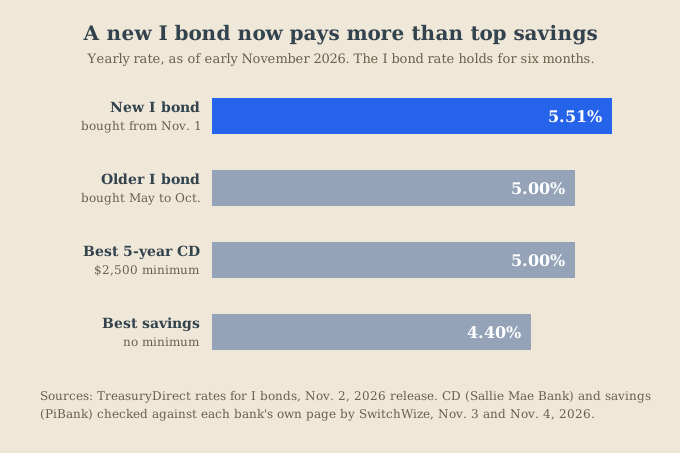
- I bonds bought from November 1, 2026 through April 30, 2027 earn 5.51% for their first six months, according to TreasuryDirect. That beats the best savings rate SwitchWize has checked, 4.40%, and the best five-year CD, 5.00%.
- Inside the 5.51% is a 1.40% fixed rate, the highest since November 2006. It stays with the bond for up to 30 years. The other part follows inflation and changes every six months.
- For money you might need within a year, savings still earns more. Cashed after 12 months, $10,000 in an I bond earns about $416 after the 3-month interest penalty. A 4.40% savings account pays $440.
Take a saver we'll call Bernadette. She is an illustration, not a real person. She is 57 and has $10,000 sitting in a savings account at 4.40%. On Monday she saw a headline: I bonds now pay 5.51%. Her first thought was simple. That is more than her bank pays, so she should move the money today.
She is right that 5.51% is more. But that rate lasts only six months, and cashing out before five years costs 3 months of interest.
What Treasury announced
On November 2, 2026, the Treasury's Bureau of the Fiscal Service set the new savings bond rates. I bonds issued from November 1, 2026 through April 30, 2027 earn 5.51% for their first six months. Series EE bonds bought in the same window earn a fixed 2.90%.
The 5.51% has two parts. One is a 1.40% fixed rate. The other is an inflation rate of 4.08% a year, which works out to 2.04% for six months. The inflation part comes from the government's main measure of everyday prices, the Consumer Price Index. The release says that index rose from 330.213 in March 2026 to 336.94 in September.
How the 5.51% is put together
Treasury publishes the formula on its I bond rates page. Add the fixed rate, twice the six-month inflation rate, and a small extra amount from multiplying the two.
For November that is 1.40% + 4.08% + 0.03% = 5.51%. Here is why the split matters. Every I bond, old or new, gets the same inflation part for the next six months. The fixed part is set the month you buy, and it never changes.
That is why an I bond bought last summer pays less this winter. A bond bought from May to October 2026 has a 0.90% fixed rate. With the same 2.04% inflation part, it earns 5.00% for its next six months. The new bond pays 0.51 percentage point more, almost all from its higher fixed rate. That gap lasts as long as you keep both bonds.
How the fixed rate has changed since 2019
The fixed rate is the piece most headlines skip. Here is what it has been for each six-month window since May 2019, from Treasury's own table.
For two and a half years, from May 2020 through October 2022, the fixed rate was 0%. That was the stretch when I bonds made the news. In May 2022 the inflation part alone pushed the first-six-month rate to 9.62%, using Treasury's formula. Buyers lined up for the headline and got a fixed rate of zero.
Those 2022 bonds are still out there, and Treasury's table shows what they earn now: 4.08%, the inflation part and nothing more. A bond bought this month earns 5.51%. The difference is the fixed rate, and it lasts for the life of each bond.
The last time the fixed rate reached 1.40% was November 2006. The closest since then was 1.30%, in May 2007 and again in November 2023 and May 2024. Treasury does not publish how it picks the fixed rate.
How it compares with savings and CDs
SwitchWize checks savings and CD rates against each bank's own page. The best savings rate in our November 4 check was PiBank's 4.40%, with no minimum. The best five-year CDs in our November 3 check paid 5.00%. Sallie Mae Bank asks for $2,500 to open one, and Popular Direct asks for $10,000.
So for the next six months the new I bond pays the most of the three. The rules are very different, though.
- New I bond
- 5.51% for six months
- Best savings
- 4.40%, can change any time
- Best 5-year CD
- 5.00%, locked for 5 years
- New I bond
- $10,000 a person per year
- Best savings
- Set by the bank
- Best 5-year CD
- Set by the bank
- New I bond
- After 12 months
- Best savings
- Any time
- Best 5-year CD
- Any time, with a penalty
- New I bond
- Last 3 months of interest, before 5 years
- Best savings
- None
- Best 5-year CD
- 180 days of interest at Sallie Mae
- New I bond
- None
- Best savings
- Yes
- Best 5-year CD
- Yes
The tax line matters most for people in high-tax states. I bond interest is free of state and local income tax, and you can wait to pay federal tax until you cash the bond. Savings and CD interest is taxed by your state each year. In a state with a 5% income tax, a 4.40% savings rate keeps about 4.18% after state tax.
When savings still wins
The 5.51% only lasts six months. The rate for the next six months depends on inflation from September to March, and Treasury announces it around May 1. So over one year, you may earn less than 5.51%.
Say Bernadette buys $10,000 of I bonds this month and cashes them in a year. The first six months earn about $275 at 5.51%. Cashing before five years costs the last 3 months of interest. If the rate stays at 5.51% in May, she walks away with about $416. If inflation stalls and only the 1.40% fixed rate is left, she walks away with about $311. Her savings account at 4.40% pays $440 if its rate holds.
- Interest
- About $416
- Interest
- About $311
- Interest
- $440
So for money she might need within a year, the savings account wins even against a bigger headline rate. The I bond also locks the money for the first 12 months, with no way out for a real emergency.
Over five years, the I bond can pull ahead. After five years there is no penalty. Suppose every rate stayed where it is today. Over five years, $10,000 would grow by about $3,122 in the new I bond. It would grow by $2,763 in a 5.00% CD and $2,402 at 4.40% in savings.
That five-year I bond figure is the least certain number here. It assumes inflation keeps running at its recent pace. In May 2025 the six-month inflation rate was 1.43%. If it fell back there, the I bond would earn 4.28%, and $10,000 would grow by about $2,358 over five years. That is less than a savings account that held 4.40%, though savings rates would likely fall too if inflation cooled. The fixed rate is the only part anyone can promise.
What this data cannot say
It cannot say what the I bond will pay after April 2027. That depends on inflation numbers that have not been released. It cannot say how long PiBank, Sallie Mae or Popular Direct will keep their rates; savings rates can change any day. Our figures leave out taxes unless we say otherwise. They use Treasury's formula but skip its rounding, so a real bond's value may differ slightly.
What to do with it
Split the money by when you might need it. Cash you could need within a year belongs where you can reach it. Money you can leave alone for five years or more can earn the 1.40% fixed rate, up to $10,000 a person each year.
Bernadette sorted her $10,000 that evening. She kept $6,000 in savings, which covers four months of her bills. She opened a TreasuryDirect account and bought $4,000 of I bonds on Wednesday, so she would not put it off. She put two dates on her calendar: May 1, to see the next rate, and November 2031, when the penalty ends.
Sources
- TreasuryDirect, Fiscal Service announces new savings bonds rates, dated Nov. 2, 2026
- TreasuryDirect, I bond interest rates (fixed rate, inflation rate and composite rate tables), read Nov. 5, 2026
- TreasuryDirect, I bonds (12-month minimum, 3-month penalty, tax rules) and purchase limits, read Nov. 5, 2026
- SwitchWize approved savings snapshot, Nov. 4, 2026 (PiBank 4.40%, checked against pibank.com) and approved CD snapshot, Nov. 3, 2026 (Sallie Mae Bank and Popular Direct 60-month CDs at 5.00%, checked against each bank's page)
Frequently Asked Questions
What is the I bond rate for November 2026?
Is 5.51% better than a high-yield savings account?
How much can I put into I bonds?
When can I cash out an I bond?
Why does my older I bond pay less than 5.51%?
The 5-minute money briefing
One email per week. New rates, fed moves, and what to actually do about them.
No spam. Unsubscribe anytime.
Act on this: today's top savings


Ranked by SwitchWize's composite score. SwitchWize currently has no compensated product links.
Editorial review
What changed since the last update
Was this guide helpful?
Found an inaccurate, outdated, or missing claim? Report a correction. We verify reports against the relevant source before changing a guide or ranking.
