- How long do banks take to raise savings rates? Of 85 savings accounts SwitchWize tracks, 35 raised their rate in the 65 days after the Fed's September 16, 2026 hike. The middle one took 9 days.
- Four took more than a month: Axos (36 days), Flagstar (50), Western Alliance (62) and Mitten (64, raised on November 19).
- Banks that waited longer did not raise by less. The ones that moved within 7 days averaged +0.26 points. The four that took 31 days or more averaged +0.27.
- A wait of 50 to 64 days cost a saver with $10,000 between $3.42 and $4.38. A rate that sits 0.95 points below the best costs $95 a year on the same $10,000.
Short answer: Most banks that raise their savings rate do it within two weeks of a Fed hike. Of 85 accounts SwitchWize tracks, 35 raised their rate in the 65 days after the September 16, 2026 hike, and the middle one took 9 days. Four took over a month. Waiting cost a $10,000 saver under $5. A lower rate costs far more.
Priya keeps $10,000 in savings at her bank. She read in September that the Fed had raised its rate. Two months later her statement still showed the same rate. She asked herself whether her bank was about to raise it, or whether she had missed something. She did not want to move the money for nothing. She also did not want to lose money by waiting.
Both worries are fair, and the numbers answer both. As of November 19, 2026, 35 of the 85 savings accounts SwitchWize tracks have raised their rate since the Federal Reserve's September 16 hike. 50 have not. None have lowered it. Of the 35, most moved fast, and a few took a long time.
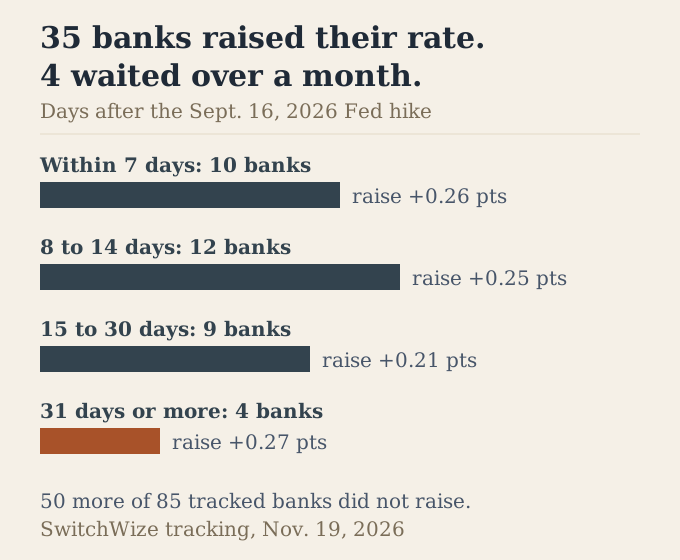
How fast the 35 banks moved
The middle bank took 9 days to make its first raise. 10 of the 35 moved within a week. TAB Bank moved the next day. Customers Bank, Sallie Mae and Wealthfront moved in 2 days. Another 12 moved in 8 to 14 days, including Ally, Capital One and Discover, which each took 9. That is 22 of 35 inside two weeks.
9 more took 15 to 30 days. Four took longer than that, and those four are the ones this article follows. We covered earlier checkpoints at day 33 and day 43. For the banks that have not moved at all, see who stalled and what they pay.
The four that waited more than a month
Axos waited 36 days and raised its rate from 3.75% to 4.01% on October 22. Flagstar waited 50 days. It moved on November 5, from 3.20% to 3.40%. Western Alliance Bank waited 62 days. It moved on November 17, from 3.80% to 4.00%. Mitten waited 64 days. It moved on November 19, the day we ran these numbers, from 4.01% to 4.41%.
Two details to know. Mitten's starting reading is from September 12, four days before the hike. And the latest reading for Axos is from November 10, so it may have moved again since. These are the rates we recorded, not a promise of what you would be offered.
Waiting longer did not mean a smaller raise
You might expect a bank that waits 60 days to raise by less. In our data it did not. We split the 35 by how long each waited and averaged the size of the raise. Banks that moved within 7 days averaged +0.26 points. Banks that moved in 8 to 14 days averaged +0.25. Banks that moved in 15 to 30 days averaged +0.21. The four that took 31 days or more averaged +0.27. The Fed raised its target by 0.25 points.
Those groups are small, so do not read much into the differences between them. The plain finding is that a late raise was not a half-hearted one. Flagstar and Western Alliance each added 0.20 points. Mitten added 0.40.
What the wait cost, and what the gap costs
Take a saver with $10,000. Suppose each late bank had raised its rate by a full quarter point on day one instead. Over the days each bank waited, the saver would have earned more: $3.42 at Flagstar (50 days), $4.25 at Western Alliance (62 days) and $4.38 at Mitten (64 days). The math is $10,000 times 0.25% times days waited, divided by 365.
That is the price of waiting for a bank to catch up: under $5.
The price of a low rate is much larger. At 3.40%, $10,000 earns $340 in a year. At 4.35%, which is what Openbank and CIT Bank showed on November 19, it earns $435. The difference is $95 a year. At Western Alliance's 4.00% the gap to 4.35% is $35 a year. Mitten, at 4.41%, is above it. These are rates we track, not rates we have verified as the best available, and rates change.
The last time the Fed raised rates a lot
Banks have been slow to pass on Fed raises before. The Fed raised its target by 4.5 percentage points between March 2022 and February 2023. On February 21, 2023, the FDIC's weekly list put the average savings rate across insured banks at just 0.35%. Most banks passed almost none of it to savers. The ones that did were the online banks that compete for deposits. In 2026 the same split shows up in smaller form. Some banks move in days. Many do not move at all.
So the useful question is not whether your bank has moved yet. Ask how far your rate is from what other insured banks pay.
Where these numbers could mislead
We only count a bank as moved or unchanged when we have a reading from before the hike and one from after it. 19 accounts had no recent starting reading and are left out. One had a change too large to be believable and is also left out. So the 85 are not every savings account in the country.
Some accounts have not been rechecked recently. Chime's latest reading is from October 17. A bank listed as unchanged may have moved since its last reading. Rates also change without notice, and an account's terms, such as a minimum balance, can matter.
The Fed meets again on December 8 and 9. Traders expect another quarter point hike. If it comes, the same pattern will probably repeat, with some banks moving in days and some not at all.
What Priya did next
Priya looked up her rate and compared it with what other FDIC-insured banks pay. Hers was 0.95 points below the one she found, a gap of $95 a year on her $10,000. She stopped asking whether her bank would move. She opened a second account at the higher-paying bank, moved the money on Friday, and checked that the balance had arrived. The first account stays open with a small balance, so that automatic payments do not break. Her steps follow our guide to switching a savings account without breaking payments.
Sources
- SwitchWize savings rate tracking, 85 savings accounts measured against the Federal Reserve's September 16, 2026 hike (effective September 17), readings through November 19, 2026. Method: SwitchWize Fed hike tracker.
- Federal Reserve, FOMC statement of October 28, 2026: target range 3.75% to 4.00%.
- FDIC, weekly national rates and rate caps, February 21, 2023 (savings national rate 0.35%).
- Market pricing for the December 8 to 9, 2026 meeting: CME FedWatch figures as reported by Regards of Wall Street, read November 20, 2026.
Priya is a composite character. The rates, counts and dates are real. Interest figures are simple yearly math on $10,000 and are not compounded. Rates were checked on November 19, 2026 and can change after publication. These are tracked rates, not offers. This article is educational information, not individualized financial advice.
Quick answers
How long do banks take to raise savings rates? In our tracking, the middle bank took 9 days. 22 of the 35 that raised did it within 14 days. 4 took more than a month. 50 of 85 had not raised their rate by day 65.
Does waiting longer mean a smaller raise? No. Banks that moved within 7 days averaged +0.26 points. The four that took 31 days or more averaged +0.27.
What does a late raise cost? For $10,000, about $3.42 to $4.38 at the three banks that waited 50 to 64 days. That assumes each raised a quarter point on day one instead.
Should I wait for my bank? The wait costs little, but a low rate costs more. Compare your rate with other insured banks and look at the yearly gap in dollars.
What to Do Now
Frequently Asked Questions
How long do banks take to raise savings rates after a Fed hike?
Does waiting longer to raise a rate mean a smaller raise?
How much does a late rate raise cost a saver?
Should I wait for my bank to raise my savings rate?
The 5-minute money briefing
One email per week. The biggest changes in savings, money market, checking and CD rates.
Send me the weekly SwitchWize rate briefing: the biggest changes in savings, money market, checking and CD rates. Unsubscribe in one click. We never share your address.
Act on this: today's top savings


Ranked by SwitchWize's composite score. Some partner links may compensate SwitchWize.
Editorial review
What changed since the last update
Was this guide helpful?
Found an inaccurate, outdated, or missing claim? Report a correction. We verify reports against the relevant source before changing a guide or ranking.
