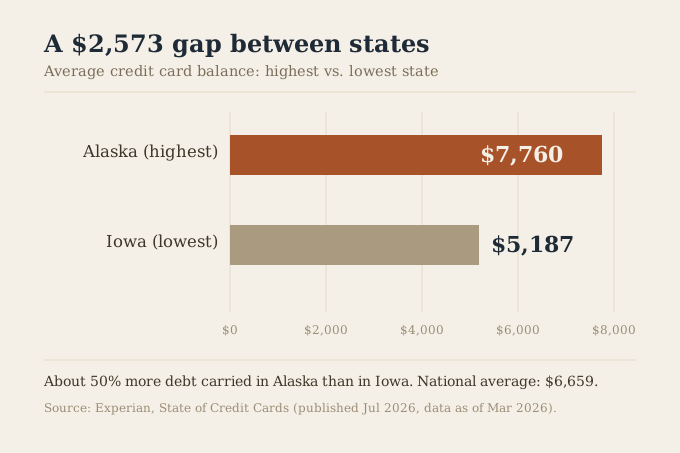
- Alaska carries the highest average credit card balance at $7,760; Iowa carries the lowest at $5,187, a $2,573 gap, or about 50% more in Alaska.
- The pattern across all 51 entries (50 states plus DC) tracks cost of living more consistently than any other single factor: expensive states cluster at the top, lower-cost states at the bottom.
- The national average is $6,659, a population-weighted figure from Experian, distinct from a simple average of the state-level figures.
Alaska carries the highest average credit card balance in the country, $7,760, about 50% more than Iowa's $5,187, the lowest. This report ranks every state using Experian's own credit bureau data, the same primary source behind SwitchWize's national report on the true cost of credit card debt, and looks at what actually explains the gap between states. Figures last verified recently. Understanding credit card debt by state reveals how regional economic factors influence consumer borrowing patterns across America.
The numbers
- The highest. Alaska: $7,760 average balance, followed by Washington, D.C. ($7,740) and Hawaii ($7,654).
- The lowest. Iowa: $5,187, followed by Wisconsin ($5,264), Kentucky ($5,279), West Virginia ($5,287), and Mississippi ($5,327).
- The spread. $2,573 between the highest and lowest state, about a 50% difference.
- The national figure. $6,659, Experian's population-weighted average across all cardholders.
Every state, ranked
- State
- Alaska
- Average balance
- $7,760
- State
- District of Columbia
- Average balance
- $7,740
- State
- Hawaii
- Average balance
- $7,654
- State
- Connecticut
- Average balance
- $7,494
- State
- New Jersey
- Average balance
- $7,464
- State
- Florida
- Average balance
- $7,444
- State
- Texas
- Average balance
- $7,383
- State
- Maryland
- Average balance
- $7,358
- State
- Nevada
- Average balance
- $7,293
- State
- Colorado
- Average balance
- $7,189
- State
- Georgia
- Average balance
- $7,145
- State
- California
- Average balance
- $7,129
- State
- Virginia
- Average balance
- $7,122
- State
- New York
- Average balance
- $6,901
- State
- Washington
- Average balance
- $6,867
- State
- Arizona
- Average balance
- $6,850
- State
- Massachusetts
- Average balance
- $6,801
- State
- Delaware
- Average balance
- $6,742
- State
- New Hampshire
- Average balance
- $6,735
- State
- Rhode Island
- Average balance
- $6,641
- State
- Illinois
- Average balance
- $6,545
- State
- South Carolina
- Average balance
- $6,505
- State
- Utah
- Average balance
- $6,459
- State
- North Carolina
- Average balance
- $6,398
- State
- Tennessee
- Average balance
- $6,257
- State
- Wyoming
- Average balance
- $6,236
- State
- Louisiana
- Average balance
- $6,170
- State
- Oregon
- Average balance
- $6,149
- State
- Pennsylvania
- Average balance
- $6,100
- State
- Oklahoma
- Average balance
- $6,072
- State
- Montana
- Average balance
- $6,064
- State
- Idaho
- Average balance
- $6,060
- State
- Minnesota
- Average balance
- $5,989
- State
- Alabama
- Average balance
- $5,932
- State
- New Mexico
- Average balance
- $5,925
- State
- Kansas
- Average balance
- $5,915
- State
- Missouri
- Average balance
- $5,879
- State
- Maine
- Average balance
- $5,878
- State
- Vermont
- Average balance
- $5,876
- State
- North Dakota
- Average balance
- $5,849
- State
- Nebraska
- Average balance
- $5,813
- State
- Michigan
- Average balance
- $5,791
- State
- Ohio
- Average balance
- $5,706
- State
- Arkansas
- Average balance
- $5,624
- State
- South Dakota
- Average balance
- $5,587
- State
- Indiana
- Average balance
- $5,467
- State
- Mississippi
- Average balance
- $5,327
- State
- West Virginia
- Average balance
- $5,287
- State
- Kentucky
- Average balance
- $5,279
- State
- Wisconsin
- Average balance
- $5,264
- State
- Iowa
- Average balance
- $5,187
Why the gap tracks cost of living, not obviously anything else
Look at the top of the list and a pattern jumps out before any other explanation does: Alaska, Washington D.C., Hawaii, Connecticut, New Jersey, Maryland, and California are all among the most expensive places in the country to live. The bottom of the list runs the other direction: Iowa, Wisconsin, Kentucky, West Virginia, and Mississippi are all lower-cost states, mostly in the Midwest and South. That's not a coincidence, and it's not a claim about financial habits varying by geography. A dollar of everyday expenses, groceries, gas, a car repair, a medical copay, costs more in a high-cost state, and more of it tends to get financed on a card when cash flow is tight, regardless of how carefully someone manages money. A $7,760 balance in Alaska and a $5,187 balance in Iowa can represent genuinely comparable relative financial positions once cost of living is accounted for.
What actually matters more than your state's rank
Where a state ranks on this list says something about regional cost of living. It says very little about what a given balance actually costs the person carrying it, which depends entirely on the card's APR, not on geography. SwitchWize's companion report on the true cost of credit card debt covers that math directly: average credit card APRs running in the low-to-mid 20s regardless of state, and what a typical balance costs in interest over a year. The state ranking here is context; the APR math there is the actionable number.
The honest counterargument
Cost of living is the pattern that holds up most consistently, but it isn't the only factor in play, and this ranking doesn't control for income, local credit-market competition, or state-level differences in how debt gets reported and collected. A handful of states (Texas, Nevada) sit high on the list despite having no state income tax and comparatively lower overall tax burdens, which cost-of-living alone doesn't fully explain, suggesting other regional financial-behavior factors are involved too. Treat the ranking as a real, useful pattern worth understanding, not a complete causal explanation for every state's position.
Methodology
State-level average credit card balances are Experian's own published data from its "State of Credit Cards" research, published July 27, 2026, with underlying data as of March 2026, drawn from Experian's own consumer credit database rather than a media aggregator's estimate. The $6,659 national average is Experian's own population-weighted figure and should not be confused with a simple, unweighted average of the 51 state-level figures shown here, which would produce a different number since it would treat every state's contribution equally regardless of its actual cardholder population.
How we source this. State and national balance figures are Experian's own published research. See our methodology and editorial team. This report was written by a former bank treasurer and reviewed by the SwitchWize Research Desk. We take no payment for organic rankings or citations.
Sources
- Experian, State of Credit Cards (published July 27, 2026, data as of March 2026): average credit card balance by state and national average.
Figures are current as of Experian's most recent published research and update when Experian republishes, typically annually. This page is informational, not financial advice. Free to cite with attribution to SwitchWize.
Frequently Asked Questions
Which state has the most credit card debt per person?
Which state has the least credit card debt?
What is the national average credit card balance in 2026?
Why do some states have much higher credit card balances than others?
Does a higher average balance mean people in that state are worse with money?
The 5-minute money briefing
One email per week. New rates, fed moves, and what to actually do about them.
No spam. Unsubscribe anytime.
Act on this: today's top cards



Ranked by SwitchWize's composite score. SwitchWize currently has no compensated product links.
Editorial review
What changed since the last update
Was this guide helpful?
Found an inaccurate, outdated, or missing claim? Report a correction. We verify reports against the relevant source before changing a guide or ranking.

Adeesh Setya is Head of Financial Research & Principal at SwitchWize, with 25+ years of experience in deposits, treasury management, banking products, and financial services. He previously served as Treasurer at Merrill Lynch Bank USA and Morgan Stanley Bank USA, where he managed bank funding, deposits, and interest-rate risk. He writes on Federal Reserve policy, the general marketplace for banking products, and what they mean for savers and consumers.
Available for on-record interviews, background briefings, and custom data cuts.
research@switchwize.com