- The national Bank Gap measures the difference between average and best widely available savings rates on a fixed $25,000 balance.
- The pretax gap is the same nationwide; state taxes change what you keep after tax.
- The Bank Gap Index provides the current national result before you compare the after-tax effect in your state.
The Bank Gap, the difference between the average savings rate and the best available one, is a single national measure. Its pretax value on a $25,000 balance is identical everywhere in the country, but what closing that gap is worth after tax differs with each state's tax law, not with the accounts themselves. This report ranks all 50 states. See the live Bank Gap Index for the current national gap and pretax value. Figures last verified recently.
The numbers
- The national gap. The live Bank Gap Index reports the current difference between the national-average savings rate and the best widely available rate.
- The pretax value. The Index also reports the current annual value on a $25,000 representative balance, identical in every state before tax.
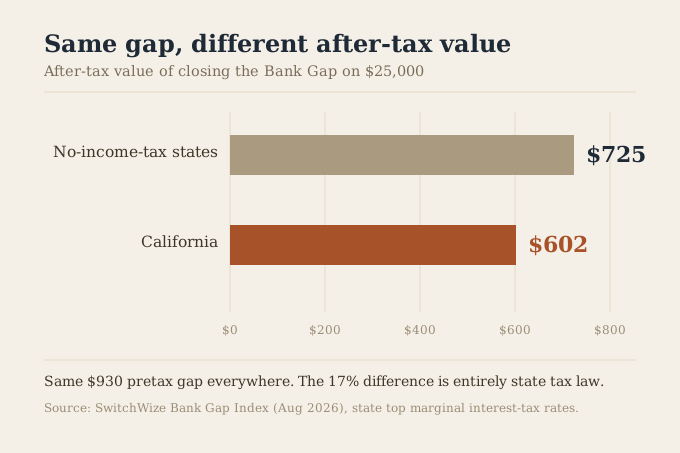
- The best after-tax outcome. About $725 a year in the nine states with no income tax.
- The worst after-tax outcome. About $602 a year in California, a roughly 17% reduction from the no-tax-state figure.
Why the same gap is worth different amounts
Savings account interest is ordinary income, taxed at the federal level everywhere and at the state level wherever a state chooses to tax it. The Bank Gap itself measures a difference in pretax rates, so it doesn't change from state to state. But the value of actually closing that gap, moving from the national-average account to the best available one, is an after-tax outcome, and that number shrinks by whatever your state takes off the top. A no-income-tax resident keeps the entire pretax gap after federal tax alone; a California resident loses an additional 13.3 percentage points of that gain to the state, on top of the same federal bite everyone pays.
Every state, ranked
The table below applies each state's published top marginal interest-tax rate against the national $930 pretax gap, at a representative 22% federal bracket, to estimate the after-tax value of closing the Bank Gap on a $25,000 balance in that state.
- State
- Alaska
- Top interest tax rate
- 0%
- After-tax value
- $725
- State
- Florida
- Top interest tax rate
- 0%
- After-tax value
- $725
- State
- Nevada
- Top interest tax rate
- 0%
- After-tax value
- $725
- State
- New Hampshire
- Top interest tax rate
- 0%
- After-tax value
- $725
- State
- South Dakota
- Top interest tax rate
- 0%
- After-tax value
- $725
- State
- Tennessee
- Top interest tax rate
- 0%
- After-tax value
- $725
- State
- Texas
- Top interest tax rate
- 0%
- After-tax value
- $725
- State
- Washington
- Top interest tax rate
- 0%
- After-tax value
- $725
- State
- Wyoming
- Top interest tax rate
- 0%
- After-tax value
- $725
- State
- Arizona
- Top interest tax rate
- 2.5%
- After-tax value
- $702
- State
- North Dakota
- Top interest tax rate
- 2.5%
- After-tax value
- $702
- State
- Louisiana
- Top interest tax rate
- 3%
- After-tax value
- $698
- State
- Indiana
- Top interest tax rate
- 3.05%
- After-tax value
- $697
- State
- Pennsylvania
- Top interest tax rate
- 3.07%
- After-tax value
- $697
- State
- Ohio
- Top interest tax rate
- 3.99%
- After-tax value
- $688
- State
- Kentucky
- Top interest tax rate
- 4%
- After-tax value
- $688
- State
- Michigan
- Top interest tax rate
- 4.25%
- After-tax value
- $686
- State
- Arkansas
- Top interest tax rate
- 4.4%
- After-tax value
- $684
- State
- Colorado
- Top interest tax rate
- 4.4%
- After-tax value
- $684
- State
- North Carolina
- Top interest tax rate
- 4.5%
- After-tax value
- $684
- State
- Utah
- Top interest tax rate
- 4.65%
- After-tax value
- $682
- State
- Oklahoma
- Top interest tax rate
- 4.75%
- After-tax value
- $681
- State
- Missouri
- Top interest tax rate
- 4.8%
- After-tax value
- $681
- State
- Illinois
- Top interest tax rate
- 4.95%
- After-tax value
- $679
- State
- Alabama
- Top interest tax rate
- 5%
- After-tax value
- $679
- State
- Massachusetts
- Top interest tax rate
- 5%
- After-tax value
- $679
- State
- Mississippi
- Top interest tax rate
- 5%
- After-tax value
- $679
- State
- West Virginia
- Top interest tax rate
- 5.12%
- After-tax value
- $678
- State
- Georgia
- Top interest tax rate
- 5.49%
- After-tax value
- $674
- State
- Iowa
- Top interest tax rate
- 5.7%
- After-tax value
- $672
- State
- Kansas
- Top interest tax rate
- 5.7%
- After-tax value
- $672
- State
- Maryland
- Top interest tax rate
- 5.75%
- After-tax value
- $672
- State
- Virginia
- Top interest tax rate
- 5.75%
- After-tax value
- $672
- State
- Idaho
- Top interest tax rate
- 5.8%
- After-tax value
- $671
- State
- Nebraska
- Top interest tax rate
- 5.84%
- After-tax value
- $671
- State
- New Mexico
- Top interest tax rate
- 5.9%
- After-tax value
- $671
- State
- Rhode Island
- Top interest tax rate
- 5.99%
- After-tax value
- $670
- State
- South Carolina
- Top interest tax rate
- 6.4%
- After-tax value
- $666
- State
- Delaware
- Top interest tax rate
- 6.6%
- After-tax value
- $664
- State
- Montana
- Top interest tax rate
- 6.75%
- After-tax value
- $663
- State
- Connecticut
- Top interest tax rate
- 6.99%
- After-tax value
- $660
- State
- Maine
- Top interest tax rate
- 7.15%
- After-tax value
- $659
- State
- Wisconsin
- Top interest tax rate
- 7.65%
- After-tax value
- $654
- State
- Vermont
- Top interest tax rate
- 8.75%
- After-tax value
- $644
- State
- Minnesota
- Top interest tax rate
- 9.85%
- After-tax value
- $634
- State
- Oregon
- Top interest tax rate
- 9.9%
- After-tax value
- $633
- State
- New Jersey
- Top interest tax rate
- 10.75%
- After-tax value
- $625
- State
- New York
- Top interest tax rate
- 10.9%
- After-tax value
- $624
- State
- Hawaii
- Top interest tax rate
- 11%
- After-tax value
- $623
- State
- California
- Top interest tax rate
- 13.3%
- After-tax value
- $602
The five states where a Treasury fund matters most
California, Hawaii, New York, New Jersey, and Oregon occupy the bottom five spots in this ranking for the same reason: they tax interest income at the highest marginal rates in the country. For residents of these states specifically, there's a second lever beyond simply moving to the best-paying savings account: Treasury income is exempt from state and local tax, so a Treasury-only money market fund can preserve more of its after-tax yield than a savings account, even at a similar or modestly lower headline rate. SwitchWize's companion deep-dive works through the full math, and a practical setup guide covers exactly how to hold one in an ordinary brokerage account.
The honest counterargument
This ranking uses a representative $25,000 balance and a 22% federal bracket; your own numbers will scale the dollar figures up or down, though the relative ranking between states holds regardless of balance size, since it's driven entirely by the tax-rate differences, not the dollar amount. It also uses each state's single top marginal rate rather than a full bracket schedule, so a saver well under their state's top bracket will see a smaller state-tax bite than shown here, and the after-tax figure for that person sits somewhere between the no-tax-state number and the figure listed for their state. Treat the ranking as an ordering of which states erode the gap more or less, not a precise personal quote.
Methodology
The national Bank Gap figures (3.72-percentage-point gap, 0.38% national average, 4.10% best available rate, $25,000 representative balance, $930 pretax value) are SwitchWize's own Bank Gap Index data as of the August 2026 monthly snapshot. Each state's top marginal interest-tax rate is SwitchWize's own maintained state-tax dataset, used consistently across its state-level Bank Gap content. The after-tax value applies a representative 22% federal bracket plus each state's top rate to the $930 pretax figure; this is an illustrative, order-of-magnitude calculation, not a personal tax computation, and does not account for state-specific standard deductions, bracket structure below the top rate, or local (city/county) taxes beyond the state rate shown.
How we source this. National rate-gap figures are SwitchWize's own tracked Bank Gap Index data; state tax rates are SwitchWize's own maintained dataset, cross-referenced against published state tax law. See our methodology and editorial team. This report was written by a former bank treasurer and reviewed by the SwitchWize Research Desk. We take no payment for organic rankings or citations.
Sources
- SwitchWize, Bank Gap Index: national savings-rate gap, monthly snapshot.
- State top marginal interest-tax rates: SwitchWize's own maintained state-tax dataset, cross-referenced against published state tax law.
Figures are current as of the August 2026 Bank Gap Index snapshot and change monthly as rates move; state tax rates change with state legislation. This page is informational, not tax or financial advice. Free to cite with attribution to SwitchWize.
Frequently Asked Questions
What is the Bank Gap, and does it vary by state?
Which states get the most value from closing the Bank Gap?
Which states lose the most value to taxes?
If I'm in a high-tax state, is there a way around this?
How was the after-tax value calculated?
The 5-minute money briefing
One email per week. New rates, fed moves, and what to actually do about them.
No spam. Unsubscribe anytime.
Act on this: today's top savings



Ranked by SwitchWize's composite score. SwitchWize currently has no compensated product links.
Editorial review
What changed since the last update
Was this guide helpful?
Found an inaccurate, outdated, or missing claim? Report a correction. We verify reports against the relevant source before changing a guide or ranking.

Adeesh Setya is Head of Financial Research & Principal at SwitchWize, with 25+ years of experience in deposits, treasury management, banking products, and financial services. He previously served as Treasurer at Merrill Lynch Bank USA and Morgan Stanley Bank USA, where he managed bank funding, deposits, and interest-rate risk. He writes on Federal Reserve policy, the general marketplace for banking products, and what they mean for savers and consumers.
Available for on-record interviews, background briefings, and custom data cuts.
research@switchwize.com