- A 30-year Treasury yielding north of 5% looks attractive against the post-2008 near-zero era, but absolute yield is a vacuum; the real test is the term premium over the 5-year or 10-year point on the curve.
- Twenty extra years of duration means twenty extra years of exposure to inflation shocks, fiscal shifts, and policy changes no forecast can capture today, plus a structurally growing supply of long-end debt to fund the deficit.
- Market liquidity is not the same as position liquidity: you can sell a 30-year Treasury in seconds, but selling early triggers capital gains tax if rates fell or locks in a paper loss if rates rose.

A friend who manages money recently made me a pitch: the 30-year Treasury is yielding north of 5%. By the standards of the last three decades, that looks generous. His argument was simple: lock in that rate for a slice of the portfolio, and secure a low-risk return that has grown scarce in fixed income.
On its face, the case is clean. Clean cases demand pressure-testing, so let's work through it the way the conversation actually unfolded, question by question.
Is 5% actually attractive, or just attractive relative to recent memory?
Compared to the near-zero environment of the post-2008 era or the pandemic lows, 5% feels like a windfall. But absolute yield is a vacuum. To find its true value, you have to look at the opportunity cost relative to the 5-year or 10-year Treasury yields sitting on the curve right now. If the spread is thin, the incentive to lock up capital for three decades starts to evaporate.
Are you being paid enough to go out an extra 20 years?
This is the real question. A 30-year bond doesn't just represent more time, it represents more exposure to everything: inflation shocks, fiscal shifts, geopolitical volatility, and technological disruption that could redefine growth in ways no current model can capture. The term premium, the extra yield investors demand for bearing that uncertainty, is the metric worth interrogating. If the 30-year offers only a marginal premium over the 10-year, you are absorbing two decades of additional risk for a sliver of extra return. Is that a fair trade, or a bet that the future stays uncharacteristically calm?
Look at that premium over time and the picture gets more interesting. It has been unusually thin for most of the last decade.
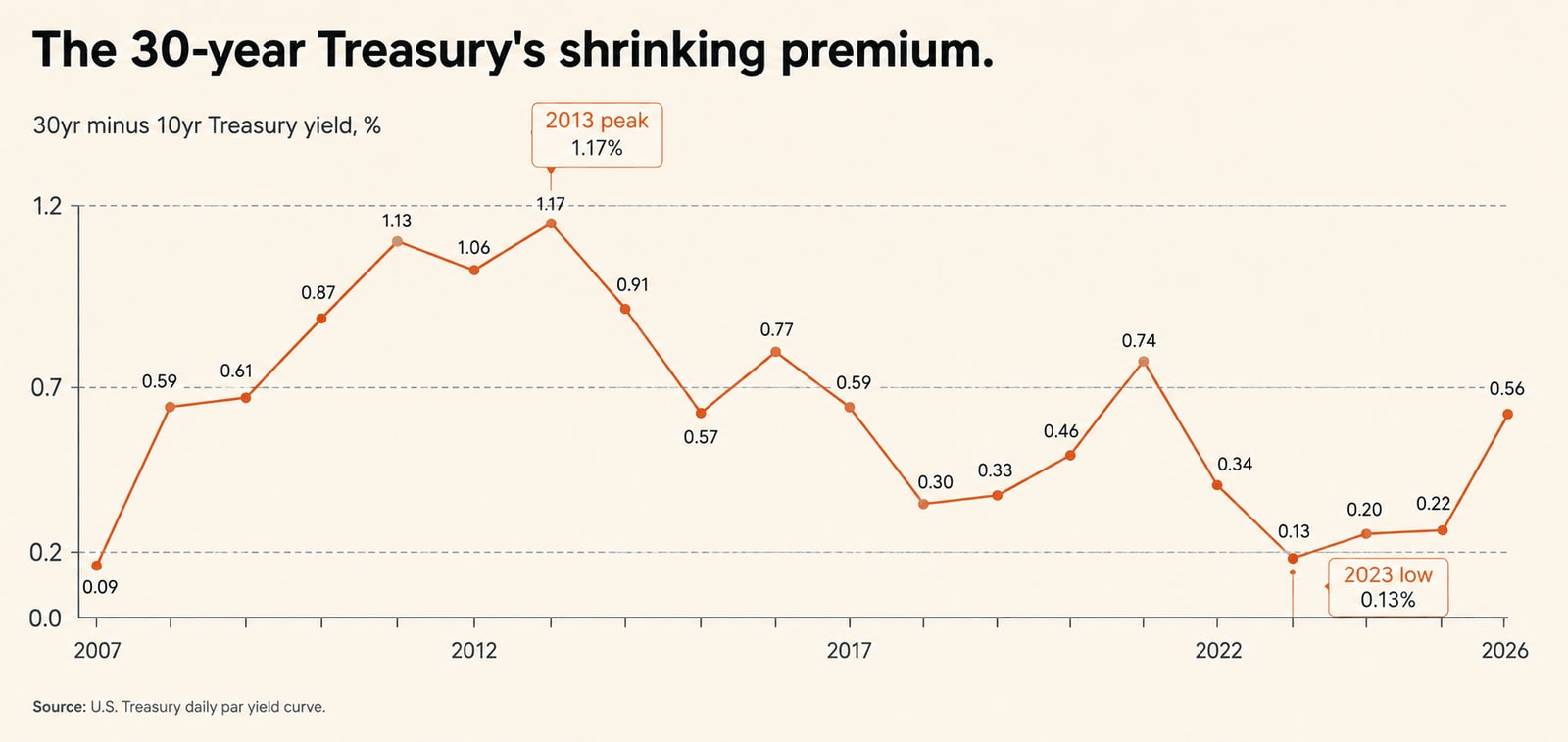
That compression is the uncomfortable part of my friend's pitch. For most of the stretch since 2015, the market has not been paying much extra to go from 10 years to 30. The premium widened again in 2026, which is exactly the kind of move that makes the trade worth revisiting rather than assuming it is permanently stingy or permanently generous.
What about the deficit?
Federal borrowing needs are not just large, they are structural. As the Treasury issues more debt to fund a growing deficit, the sheer volume of long-end supply can pressure yields higher over time. Higher yields are enticing for tomorrow's buyer, but they translate to immediate price depreciation for today's holder. In a world of steadily rising supply, is 5% a ceiling or a floor?
Isn't liquidity a non-issue? It's a Treasury.
Market liquidity and position liquidity are often conflated. Yes, you can sell a 30-year Treasury in seconds; it is one of the most liquid instruments in the world. But the cost of doing so is where the risk hides. If rates fall, selling early triggers capital gains tax on a security you bought for income. If rates rise, you are anchored to a paper loss for decades unless you hold to maturity. Either way, the exit is rarely as simple as the entry.
So, buy or not?
That's the wrong starting question. The better one is: what job is this capital hired to do? If you want a permanent, low-maintenance allocation to income, and can tolerate real-term principal swings over thirty years, a position is defensible. But if the goal is to keep dry powder in a world changing faster than any 30-year forecast can track, the 5-year or 10-year points on the curve offer a comparable reward with a fraction of the duration risk. For most savers building or maintaining a cash ladder, laddering shorter Treasuries against CDs does more of that job than a single 30-year position.
Where I'd land
The choice was never really about the sticker yield. It's about whether the extra twenty years of uncertainty is actually paying you to show up. Before you commit capital that far out on the curve, price it against current CD and savings rates, and be honest about what that money is actually for. If the honest answer is "I don't know yet," that itself is the answer: keep it liquid until it isn't. That's the same discipline I applied to every balance sheet I managed as a bank Treasurer, and it's the same conviction behind every comparison we build at SwitchWize: the decision is always yours, we just make sure you're seeing the whole picture before you make it.
Frequently Asked Questions
Is a 30-year Treasury yielding north of 5% actually a good deal?
What is the term premium and why does it matter here?
What happens if I need to sell a 30-year Treasury before it matures?
What should I do after reading The 30-Year Treasury's Hidden Catch?
The 5-minute money briefing
One email per week. New rates, fed moves, and what to actually do about them.
No spam. Unsubscribe anytime.
Answer a few questions about your situation and goals. Money Map points you to the highest-value next step across savings, mortgage, cards, and debt.
Editorial review
What changed since the last update
Was this guide helpful?
Found an inaccurate, outdated, or missing claim? Report a correction. We verify reports against the relevant source before changing a guide or ranking.

Adeesh Setya is Head of Financial Research & Principal at SwitchWize, with 25+ years of experience in deposits, treasury management, banking products, and financial services. He previously served as Treasurer at Merrill Lynch Bank USA and Morgan Stanley Bank USA, where he managed bank funding, deposits, and interest-rate risk. He writes on Federal Reserve policy, the general marketplace for banking products, and what they mean for savers and consumers.
Available for on-record interviews, background briefings, and custom data cuts.
research@switchwize.com