- Cash is not one asset: checking, high-yield savings, money market accounts and funds, CDs, Treasury bills, and I-bonds each trade liquidity, yield, and tax differently.
- The method is always the same: sort cash by its job, match each job to a vehicle by how fast you need it, then choose the highest after-tax yield that fits.
- Every option here is federally backed when used correctly, so the choice is about fit, not safety; the account you pick matters more than the amount, since the national average is 0.40% and high-yield pays near 4%.
Most people treat cash as a single thing that lives in one account. That habit is quietly expensive. The dollars you spend from this week, the emergency fund you cannot afford to lose, the down payment you need next spring, and the surplus you have not gotten around to deploying are four different kinds of money with four different jobs. Put them all in the same place and at least three of them are in the wrong one. Savings rates on this page were last verified recently. This guide explains where to keep your cash 2026 by matching each dollar's purpose to its ideal account type.
This is a complete guide to the American cash toolkit: what each vehicle is for, what it pays, how quickly you can reach it, and how it is taxed. The goal is not to find the single best account. It is to match every dollar to the account that fits its purpose.
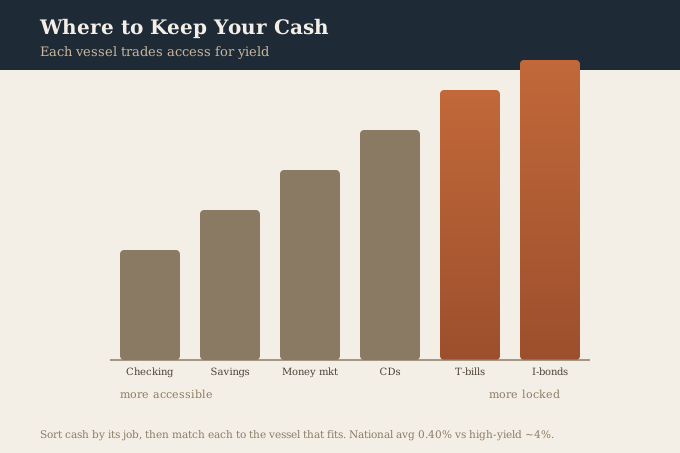
The method: job first, yield second
Before any account names, the decision is always made in the same order:
- What is this money's job? Spending, an emergency reserve, a known near-term goal, or idle surplus.
- How fast might you need it? Instantly, within days, or on a known date.
- Only then, what pays the most after tax among the vehicles that fit the first two answers.
Chasing the highest yield first is the classic mistake, because it can lock money you actually need next week, or leave your emergency fund exposed to market risk. Liquidity is a requirement; yield is an optimization on top of it.
The vehicles, from most liquid to most locked
Checking. The account you spend from. It pays almost nothing, and that is fine, because its job is access, not yield. Keep roughly one to two months of expenses plus a small buffer here, and no more. A large idle checking balance is pure forgone interest.
High-yield savings. The workhorse for cash that must stay safe and reachable. It is FDIC insured, the balance cannot dip, and widely available accounts pay close to 4% against a national average near 0.40%. This is the correct home for an emergency fund and most short-term reserves.
Money market deposit accounts. A bank account close to high-yield savings, FDIC insured, sometimes with check-writing or a debit card and a higher minimum. Treat it as a savings-account variant, not a different asset class.
Money market funds. Held at a brokerage, not a bank. A government money market fund can pay a competitive yield and is convenient for cash you keep alongside investments, but it is an investment, not an insured deposit, with a small tail risk. Use it for brokerage cash, not for money that must never dip.
CDs. A fixed rate for a fixed term. You give up access, and in exchange you lock a rate that will not fall if the market does. Best for money with a known horizon, and laddered when you want both a locked rate and periodic access.
Treasury bills. Short-term US government debt, paying close to short-term rates and, crucially, exempt from state and local income tax. In a high-tax state, a T-bill's after-tax yield can beat a bank account with a higher headline rate. A T-bill ladder restores regular liquidity.
I-bonds. Inflation-linked savings bonds for medium-term cash you want protected against rising prices. They cannot be touched for a year and penalize redemption before five, so they are a reserve, never an emergency fund.
Matching cash to its job
- Best home
- Checking
- Why
- Instant access; yield is irrelevant here
- Best home
- High-yield savings
- Why
- Insured, instant, cannot dip
- Best home
- High-yield savings or T-bills
- Why
- Safe, near-term, T-bills win after tax in high-tax states
- Best home
- CD or T-bill ladder
- Why
- Locks a rate for the horizon
- Best home
- I-bonds
- Why
- Rate tracks inflation; not liquid for a year
- Best home
- Government money market fund
- Why
- Convenient beside investments
The tax angle most people miss
Two accounts with the same headline rate can pay different amounts after tax. Bank interest is taxed as ordinary income at both the federal and state level. Treasury bills and Treasury money market funds are exempt from state and local income tax. For a saver in a high-tax state, that exemption can flip the ranking, making a Treasury vehicle the better choice even when a bank advertises a slightly higher number. Always compare after-tax yields, not headline rates, once the liquidity fit is settled.
Safety is not the deciding factor
It is worth saying plainly: every vehicle here is federally backed when used correctly. Bank products are FDIC insured up to the coverage limit. Treasury bills and I-bonds are direct obligations of the US government. Money market funds carry SIPC protection against a failed broker, and government funds are the most conservative type. So the choice among them is almost never about safety. It is about fit, liquidity, and after-tax yield, which is exactly why matching the money to its job is the whole game.
Putting it together
Run the same routine once and your cash organizes itself. Keep your spending in checking and nothing more. Put the emergency fund in a high-yield savings account where it is insured and instant. Move known-horizon money into CDs or a Treasury ladder, and let an inflation-protected reserve sit in I-bonds. Sweep brokerage cash into a government money market fund. Then compare after-tax yields within each group and revisit as rates move.
The payoff is not exotic. It is simply every dollar earning what it should while staying exactly as reachable as its purpose demands. That is what separates cash that works from cash that merely sits.
Sources
- FDIC, National Rates and Rate Caps, for the national-average savings rate.
- US Treasury, TreasuryDirect for Treasury bill and I-bond mechanics and tax treatment.
- SwitchWize Research Desk framework for matching cash vehicles to their job.
Rates are current as of the last verification date above and change frequently; confirm current yields before acting. This is general educational information, not tax or investment advice.
Frequently Asked Questions
What is the best place to keep cash in 2026?
Is a high-yield savings account or a money market fund better for cash?
Do Treasury bills beat high-yield savings for cash?
How much cash should I keep in checking versus savings?
Are I-bonds a good place to keep cash?
Act on this: today's top savings


Ranked by SwitchWize's composite score. We may earn a referral fee, and it never changes the ranking order.
Editorial review
What changed since the last update
Was this guide helpful?
Found an inaccurate, outdated, or missing claim? Report a correction. We verify reports against the relevant source before changing a guide or ranking.

Adeesh Setya is Head of Financial Research & Principal at SwitchWize, with 25+ years of experience in deposits, treasury management, banking products, and financial services. He previously served as Treasurer at Merrill Lynch Bank USA and Morgan Stanley Bank USA, where he managed bank funding, deposits, and interest-rate risk. He writes on Federal Reserve policy, the general marketplace for banking products, and what they mean for savers and consumers.
Available for on-record interviews, background briefings, and custom data cuts.
research@switchwize.com