- Safe money is a spectrum, not one account. The right vehicle depends on when you will need the money: instant access, a known date, or long-term inflation protection.
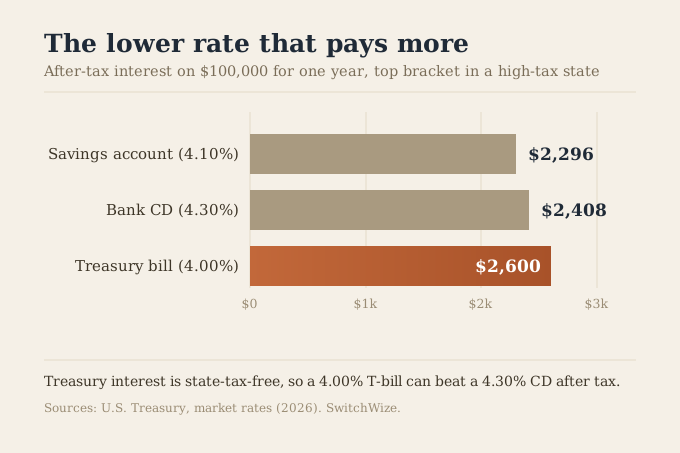
- Taxes can flip the ranking. Treasury interest is state-tax-free, so for a high earner in a high-tax state a 4.00% T-bill can beat a 4.30% CD after tax.
- When rates look set to fall, laddering CDs or Treasuries across staggered maturities locks in today's rates so your whole balance does not reset at once.
Ask most people where they keep their savings and you get one answer: "the bank." That is the mistake in miniature. Safe money is not a single product to pick once; it is a spectrum of vehicles, each suited to a different job, and the cost of putting all your cash in the wrong spot is quiet but real. Leave long-term money in a low-rate checking account and inflation eats it. Lock up money you need next month in a five-year CD and you pay a penalty to get it back. Ignore how the interest is taxed and you can pick the lower-yielding option while thinking you chose the higher one. This playbook fixes all three by doing one thing: matching each dollar to its timeline and its tax. This page is reviewed by the SwitchWize Editorial Team; the 2026 figures are sourced below with dates. The following sections break down the spectrum of safe investments for cash across different timelines.
The reframe: three timelines, not one account
The organizing idea is simple and it dissolves most of the confusion: sort your cash by when you will need it, then match each bucket to the right vehicle. There are three buckets.
- Instant access (days to months). Your emergency fund and near-term bills. This money must be liquid and safe, so it belongs in a high-yield savings account or money market fund, both near 4% in 2026. You are not trying to maximize yield here; you are keeping the money available.
- Known date (roughly one to five years). A tax bill, tuition, a down payment on a house you will buy in three years. Because you know roughly when you need it, you can lock it in a Treasury bill or CD that matures on schedule, earning a similar or better rate while it waits.
- Long horizon (five years and beyond). Money you will not touch for years. Here you can accept less liquidity for more yield or inflation protection: longer CDs, a Treasury ladder, I bonds, or a multi-year guaranteed annuity.
Get the buckets right and everything else is optimization. The rest of this playbook walks each one, and flags the two places where savers most often leave money on the table.
Instant-access money: liquid and safe, not locked
The first bucket is the easiest to get wrong by overthinking it. Money you might need at any moment should never be locked up chasing a slightly higher rate, because the penalty or delay to reach it can wipe out the gain. In 2026 a high-yield savings account or a money market fund yields around 4% while remaining fully liquid, per Terry Savage and market data. That is your home for the emergency fund and any bill due within a few months. The job of this money is to be there, not to win a yield contest. Compare the liquid options side by side:
Compare estimated after-tax annual income across three common cash choices using an entered money-market-fund state-exemption percentage.
Use the fund's tax information for the applicable tax year; eligibility and state thresholds vary.
MMF After-Tax Income
$1,695
Use this result as one input in your broader Money Map, not as a one-off number.
What to do
Plan your next move
Pre-tax estimates. For illustration only — not financial advice.
Known-date money: where the tax detail pays off
This is the first place savers routinely pick the wrong winner, and it comes down to taxes. Treasury bills and notes carry an advantage no bank CD has: their interest is exempt from state and local income tax, per the U.S. Treasury. For a saver in a high federal bracket living in a high-tax state, that exemption can flip the ranking.
Consider $100,000 for one year. A 4.30% CD pays $4,300, taxed by both the IRS and your state; at a combined 44% rate that leaves about $2,408. A 4.00% T-bill pays $4,000, but only the IRS touches it; at a 35% federal rate that leaves about $2,600. The lower headline rate wins after tax, by nearly $200. The lesson is not that Treasuries always win, a bank's promotional CD can still come out ahead, but that you must compare after-tax yields for your own bracket and state, not the rates on the sign. For money you know you will need on a schedule, ladder the maturities so cash comes free when you need it:
Long-horizon money: yield, inflation, and the ladder
The third bucket is where you can afford to give up liquidity for something better, and where the second big lever lives: reinvestment risk. If you park long-term money in a single short CD and rates fall, your whole balance resets to a lower rate when it matures. A ladder, staggered maturities across one to five years or more, resets only one rung at a time while the longer rungs keep paying today's higher rate, per Yahoo Finance. When rates look set to decline, as they often do after a peak, locking in the long rungs is exactly the protection you want.
For this bucket you also have two tools the shorter buckets do not. I bonds pay a composite rate near 4.03% in 2026 and are built for inflation protection, but they are bought only through TreasuryDirect and cannot be redeemed in the first 12 months, so they are a long-horizon holding, not an emergency fund. And multi-year guaranteed annuities (MYGAs) from A-rated insurers have paid roughly 5.65% to 6.30% for 5-year terms, higher than most CDs and tax-deferred, in exchange for less liquidity and insurer rather than FDIC backing. Weigh inflation protection against a fixed lock:
Compare simplified after-tax I Bond, CD, and savings scenarios with an approximate early-redemption penalty.
Find your bracket at irs.gov
Varies by state, many states have 0%
Enter an APY you have verified; savings rates can change.
Enter the APY and term from a comparable CD offer.
Enter the TreasuryDirect composite rate applicable to the bond; it resets every six months.
I-Bond After-Tax Value
$11,291
Use this result as one input in your broader Money Map, not as a one-off number.
What to do
Compare Savings Options
Pre-tax estimates. For illustration only — not financial advice.
The honest counterargument
None of this means Treasuries always beat CDs or that everyone needs a ladder. If you are not in a high tax bracket or you live in a state with no income tax, the Treasury advantage shrinks or disappears, and a simple high-yield savings account may be all you ever need. Laddering adds complexity that is not worth it for small balances or for money you genuinely cannot predict. MYGAs and I bonds carry liquidity limits that make them wrong for anyone who might need the money sooner than planned. And chasing the last few basis points across accounts can cost more in time and attention than it returns.
But the exceptions refine the framework rather than break it. The core discipline, sort by timeline, then compare after tax, is what separates savers who quietly earn more from those who leave money on the table by defaulting to one account. Safe money should be boring, but boring is not the same as thoughtless. A few minutes matching each dollar to its job is among the highest-return uses of your time in personal finance, precisely because the risk is so low.
Methodology
Figures are the 2026 amounts: high-yield savings and T-bill yields around 4%, the I bond composite rate near 4.03%, and 5-year MYGA rates of roughly 5.65% to 6.30% from A-rated carriers. The after-tax example assumes $100,000 for one year, a 35% federal rate, and a 9% state rate (a 44% combined rate on fully taxable interest versus 35% on state-tax-free Treasury interest); your result depends on your bracket, state, and the specific rates available. Treasury interest is exempt from state and local income tax; CD and savings interest is not. Rates change constantly; compare live yields before acting. MYGAs are backed by insurers and state guaranty associations, not the FDIC, and carry surrender charges. Nothing here is individualized financial, tax, or investment advice.
How we source this. Yield levels come from Treasury and market data, the state-tax exemption from U.S. Treasury rules, and MYGA and I bond figures from rate trackers and TreasuryDirect, all cited with dates. See our methodology and editorial team. We take no payment for organic rankings.
Sources
- Terry Savage and market rate data on 2026 T-bill and CD yields and the state-tax exemption on Treasury interest.
- Yahoo Finance on CD ladder versus bond ladder and reinvestment risk in a falling-rate environment.
- TreasuryDirect and rate trackers on the 2026 I bond composite rate and the 12-month redemption lock, and 5-year MYGA rate ranges from A-rated carriers.
Figures are current for 2026 and move with the market. This page is informational, not financial, tax, or investment advice. Free to cite with attribution to SwitchWize.
What to Do Now
Frequently Asked Questions
Where should I keep my cash in 2026?
Are Treasury bills better than CDs?
What is a CD or Treasury ladder and when should I build one?
Are I bonds a good place for my emergency fund?
What is a MYGA and how does it compare to a CD?
The 5-minute money briefing
One email per week. New rates, fed moves, and what to actually do about them.
No spam. Unsubscribe anytime.
Answer a few questions about your situation and goals. Money Map points you to the highest-value next step across savings, mortgage, cards, and debt.
Editorial review
What changed since the last update
Was this guide helpful?
Found an inaccurate, outdated, or missing claim? Report a correction. We verify reports against the relevant source before changing a guide or ranking.
