- The psychological payoff of checking your net worth is not about the size of the number. It is about being able to see the trend move.
- Avoiding your own numbers does not make the anxiety go away. It just stops the anxiety from being informed by reality.
- A cheap, repeatable way to check in, not a bigger number, is what actually separates people who feel secure about money from people who stay anxious for decades.
I spent years managing bank balance sheets for a living. Deposits, funding costs, interest-rate risk. I have looked at more net worth statements, corporate and personal, than most people will see in their lifetime. So when I recently saw someone online admit they get real happiness from checking their net worth number, my first reaction wasn't "that's odd." It was: that's the most normal thing I've read in months, and almost nobody says it out loud.
The post was blunt about it. Watching the number compound felt better than they expected, and it made them a little uneasy to admit. Not because they were spending it. Because looking at it, on its own, produced something close to relief.
That is not vanity. It is not greed. It is a nervous system doing exactly what it is supposed to do when it gets evidence that a threat is receding.
Quick answer
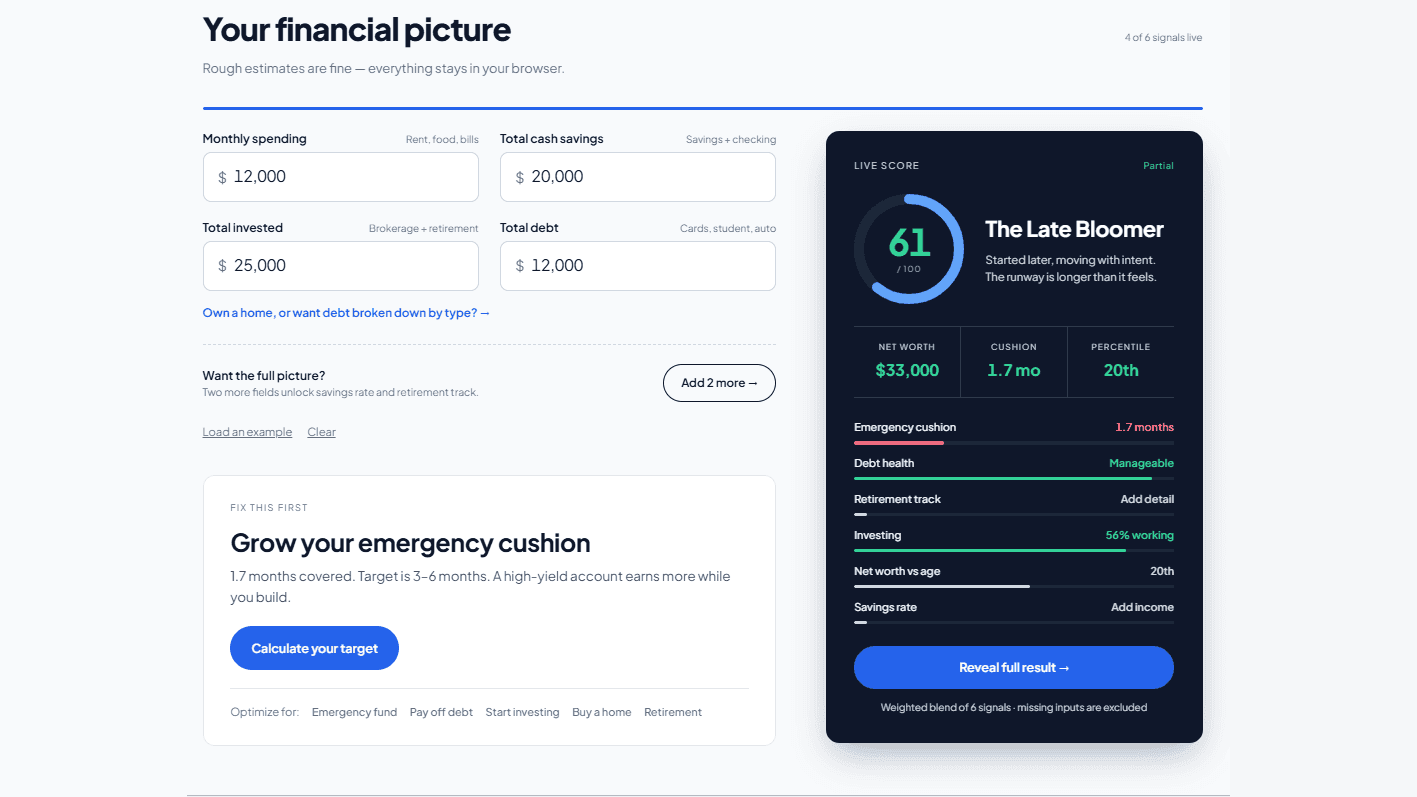
Checking your net worth works because the payoff comes from watching a trend move, not from the size of the number itself. A small number that is rising produces more felt relief than a larger number that hasn't moved in years, because your brain reads a shrinking gap between "I'm worried" and "I'm fine" as evidence a threat is receding. The habit only survives if checking is cheap and repeatable: a spreadsheet you dread opening won't survive contact with real life. A free tool that scores your cash, investments, and debt today in about sixty seconds will. Run the numbers once with the SwitchWize Money Map or the Financial Health Score, then check again in three months and watch what actually moved.
The number isn't the reward. Watching it move is.
Here is the part that surprised me even after years of doing this professionally: the psychological payoff isn't really about the size of the number. It's about the visibility of the trend. A $40,000 net worth that grew $3,000 this quarter produces more felt safety than a static $200,000 that hasn't moved in two years, even though the second number is objectively larger. Progress you can see is processed by your brain differently than a number that just sits there.
This is not a new idea in behavioral finance, but it gets buried under a lot of jargon about "loss aversion" and "reference points." Stripped of the jargon, it says something simple: uncertainty is what your body treats as danger, and a number going up, even slowly, is proof that the danger is shrinking. That's why checking it feels good. You're not admiring your own wealth. You're getting a small, repeated signal that things are working.
The problem is almost nobody sets up a way to get that signal cheaply. Most people's honest mental model of their own finances is a vague, low-resolution feeling, not a number. They have a bank balance they glance at and a 401(k) statement they open twice a year, usually with dread. There's no single moment where the picture resolves into a score they can watch move over time. So the habit described above, the quiet compounding satisfaction of checking in, never gets a chance to form. Not because people don't want it. Because there's friction between "I am curious how I'm doing" and "I now have an actual number in front of me."
The habit is the intervention, not the outcome
If you work in banking long enough, you start to notice that the people who are financially fine are rarely the ones who earn the most. They're the ones who look. Regularly, unemotionally, the way you'd check a weather app. Not because they enjoy the ritual, but because looking is what turns "I think I'm behind" into "I'm actually three months ahead of where I thought," or occasionally the reverse, which is also useful to know before it becomes a crisis instead of a course correction.
The people who avoid looking aren't avoiding a number. They're avoiding an unresolved feeling. And unresolved feelings about money don't go away when you stop checking. They just stop being informed by reality and start being run entirely by anxiety, which is worse.
This is why I don't think that admission was odd at all. Checking your net worth and feeling something when it moves is the system functioning correctly. The actual failure mode is the version where someone never checks, carries a permanent low hum of financial dread, and has no evidence either way to update it with.
The two numbers behind the one number
Net worth itself is deliberately simple arithmetic: net worth = assets - liabilities. Get the two halves right and the single number takes care of itself.
- Counts as a liability
- Credit card balances
- Counts as a liability
- Auto loans and personal loans
- Counts as a liability
- Remaining mortgage balance
- Counts as a liability
- Student loans and medical debt
One lever inside that number is boring but real. Cash sitting in a checking account earning close to nothing, instead of a top savings account currently paying 4.20%, is a net-worth drag you can fix in an afternoon with no lifestyle change required. It won't move the number as much as paying off a card or investing consistently, but it's the cheapest fix on the list.
What checking in should cost you
It should cost you about sixty seconds, not a spreadsheet.
That's the gap the SwitchWize Financial Health Score was built to close. You put in a handful of numbers (cash, investments, debt, income if you want the fuller picture) and it scores your emergency cushion, your debt load, your investing pace, and your net worth trajectory against people your age. Not a credit score. Not a sales funnel. A single number and a plain-English read on where you're solid and where you're not, in less time than it takes to read this paragraph twice.
It's free, takes about a minute, and nothing you type ever leaves your browser. If you'd rather see the line-by-line math instead of a scored summary, the net worth calculator walks through assets minus liabilities directly.

What I'd push back on gently is treating that number as either a trophy or a verdict. It's neither. It's an instrument reading. The value isn't in the specific digits, it's in doing it again in three months and seeing whether the trend moved the direction you want. That's the actual source of the feeling described above, and it's available to anyone, not just people who already have a big number to admire.
How to actually check, without making it a chore
The right method depends less on discipline and more on picking a setup that survives the third or fourth time, not just the first.
- Best way to check
- SwitchWize Financial Health Score: sixty seconds, no login, nothing to maintain
- Best way to check
- Add a net-worth line to your existing spreadsheet or budgeting app, updated monthly
- Best way to check
- Use a bank-linked aggregator so balances pull automatically instead of manual entry
- Best way to check
- Choose a fixed cadence, quarterly works well, so checking is scheduled instead of an emotional decision
- Best way to check
- Check again anyway. One reading is not a verdict; only the trend across readings means anything
- Suggested cadence
- Monthly
- Suggested cadence
- Quarterly
- Suggested cadence
- Twice a year, on a fixed calendar date so it isn't an emotional decision
You are not strange for liking to watch your net worth go up. You'd be strange if you didn't. What separates people who build real financial security from people who stay anxious about money for decades usually isn't income. It's whether they built themselves a cheap, repeatable way to look.
Sixty seconds, no account, no judgment either direction. See where you actually stand, or check yourself against average net worth by age first if you want the benchmark before the number.
What to Do Now
Sources
Net-worth benchmarks by age and income draw on the Federal Reserve's Survey of Consumer Finances (federalreserve.gov/econres/scfindex.htm), the standard government dataset for household balance sheets in the United States. The link between financial tracking habits and reported well-being is a recurring theme in the CFPB's financial well-being research (consumerfinance.gov/data-research/financial-well-being-survey-data).
Frequently Asked Questions
Why does checking my net worth feel satisfying?
How often should I check my net worth?
What if my net worth number doesn't look good?
What should I do after reading Why Checking Your Net Worth Feels So Good?
Answer a few questions about your situation and goals. Money Map points you to the highest-value next step across savings, mortgage, cards, and debt.
Editorial review
What changed since the last update
Was this guide helpful?
Found an inaccurate, outdated, or missing claim? Report a correction. We verify reports against the relevant source before changing a guide or ranking.

Adeesh Setya is Head of Financial Research & Principal at SwitchWize, with 25+ years of experience in deposits, treasury management, banking products, and financial services. He previously served as Treasurer at Merrill Lynch Bank USA and Morgan Stanley Bank USA, where he managed bank funding, deposits, and interest-rate risk. He writes on Federal Reserve policy, the general marketplace for banking products, and what they mean for savers and consumers.
Available for on-record interviews, background briefings, and custom data cuts.
research@switchwize.com