Ramp wants to help businesses get more work done with AI. Revolut wants to make AI part of everyday money management. Both are building on financial relationships they already have.
SwitchWize | Sourced analysis | October 18, 2026
In one week in May, Ramp spent $1.5 million on AI, according to co-founder and co-chief executive Eric Glyman. The company that helps businesses control spending had an expensive problem of its own.
Ramp’s response was to build tools that helped employees get more value from AI and see what their work cost. On October 13, it announced Glass, a shared AI workspace, drawing on what it had learned internally.
Revolut is working on a different problem. Millions of people already use its app to manage money. It wants AI to help them do more of that work through a conversation, rather than by moving through menus.
Both companies see a way to grow beyond the services that first made them successful. Ramp can sell businesses help with the work that leads to spending. Revolut can make its financial services easier to use and give customers more reasons to stay.
Neither has to build the world’s best general-purpose AI to pursue that business. But both have to answer a harder question: what will customers pay them to do when powerful AI assistants are available elsewhere?
Ramp turns its own AI problems into products
Ramp already has a large group of potential customers. In an October company update, Glyman and co-founder Karim Atiyeh said 85,000 businesses used Ramp. They said the company had passed $2 billion in annualized revenue over the summer and had positive cash flow. Annualized revenue projects a year from a recent rate of sales; it is not a completed year’s revenue, and cash flow is not the same as net profit.
The next opportunity is to become useful earlier in the working day, before an expense reaches the finance team.
Glass is designed to solve a familiar frustration: one employee finds a useful way to work with AI, but everyone else starts again from an empty chat.
Ramp says employees have made more than 6,500 updates to the information Glass uses. In one example, a saved process extracts feature requests from customer calls. Ramp says it increased the number captured from about 300 a month to 20,000. Other processes organize the requests and notify customers when features become available. These are Ramp’s internal results, not independently verified findings.
That is the promise to a business buying the software: good work becomes easier for colleagues to repeat, rather than staying in one person’s chat history.
Ramp Router handles another part of the problem. Launched publicly in August, it lets developers access and compare different AI models through one connection. A team can weigh answer quality, speed, reliability and cost before choosing what to use.
For example, a business might reserve a more expensive model for difficult work and use a cheaper one for routine tasks. It still needs to check the results. Switching models can change how well the work is done and how data is handled.
Ramp says moving its own work onto Router reduced its AI bill by 30%. That is a company claim, not a promise that every customer will save the same amount.
The commercial logic is straightforward. If Ramp helps a company save more time and money than the software costs, the company has a reason to pay for it.
Pricing remains part of the unanswered question. The Glass pages reviewed invite early-access requests but do not establish a standalone public price. Router’s routing service is free through 2026, although customers pay for model usage. Router also does not require a Ramp card or business account.
Ramp can still be useful when employees choose another assistant
Glass is not Ramp’s only route into AI work. An employee can connect an outside assistant such as Claude or ChatGPT to Ramp. The assistant works under the permissions of the user who authorized the connection.
For eligible Agent Card purchases, Ramp’s documentation describes existing funding limits, merchant restrictions and approval policies. The employee can choose the assistant while the business keeps its spending rules and financial records in Ramp.
That gives Ramp a second opportunity: help finance teams manage work done by several assistants, even if Glass is not the workspace every employee chooses. It also gives Ramp a reason to keep those connections easy to use.
There is evidence of interest outside its own workforce. In April, Ramp reported that more than 2,500 businesses had connected an assistant since January. Among users connecting weekly, 52% pulled spending breakdowns and 12% batch-approved transactions or reviewed policy exceptions. Activities overlap. The figures describe Ramp’s reported user group, not all businesses, and do not establish autonomous payment volume or profit.
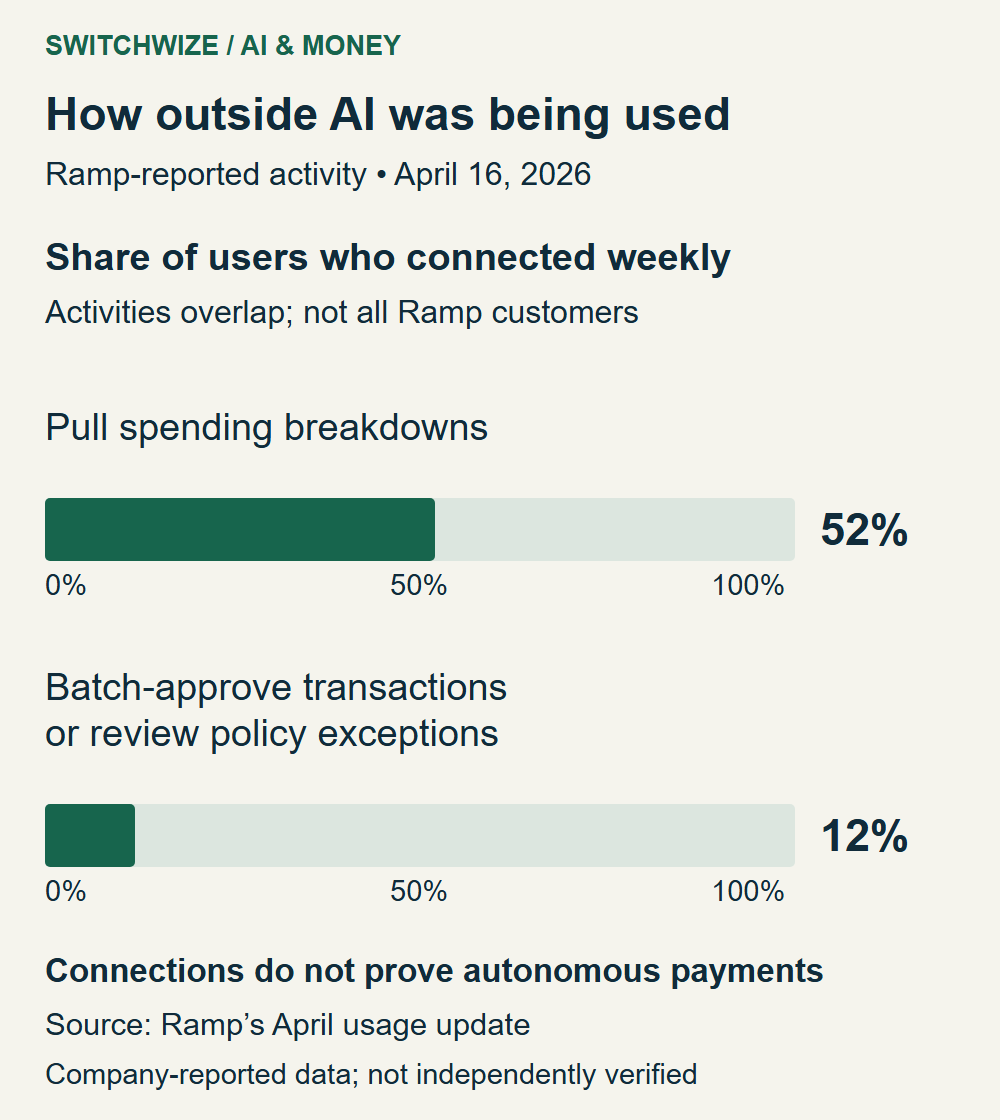
Source: Ramp’s April 16 usage update. Company-reported activity among weekly connected users; not independently verified.
Revolut wants AI to become part of the customer’s financial life
Revolut starts with a different relationship. Its customers already use its app for payments, transfers and other financial services. In August, it said it served more than 80 million retail customers.
It also has an established profitable business. Revolut reported £4.5 billion in revenue and £1.3 billion in net profit for 2025. Those results give context to its AI investment; they do not tell us what its AI products earn.
Its AIR assistant began rolling out in the UK in April. Revolut describes an assistant that can explain spending, help manage subscriptions, set card controls and assist with travel tasks, including buying an in-app eSIM for mobile data. It says third-party AI partners do not retain personal information or use it to train their external models.
The appeal is convenience. A customer should be able to ask for help with a financial task without first learning where every setting sits in the app.
Behind the assistant, Revolut is also developing PRAGMA, a model that learns patterns in financial activity. It is designed for tasks such as identifying fraud and credit risk, rather than general conversation. The company reports improvements on historical tests; those results do not establish savings or better decisions across everyday customer use.
These efforts could help Revolut in several ways. A useful assistant might reduce support work, encourage customers to use more services or make a paid plan more attractive. Each is a possible business benefit, not a demonstrated result across its customer base.
Revolut does not need to keep every interaction inside its own assistant. Its crypto exchange, Revolut X, already supports connections to outside AI tools. Customers can use them for information and permitted trading tasks while the account remains at Revolut X. The company tells users to review and approve orders; its stated disclaimer for third-party AI is not a ruling on every customer’s legal rights.
That is a useful sign of how outside assistants and financial providers can work together. It is specific to crypto trading, not proof of equivalent access to everyday banking or general shopping.
Paying is possible. Buying the right thing is harder.
In September, Visa announced a live payment test in France involving a Revolut card and Cleverbridge. Visa’s test agent initiated the purchase, Visa Payment Passkey authenticated it and the existing merchant checkout processed it.
The test showed that an AI-initiated purchase could work with existing payment infrastructure. It was not a launch of a widely available shopping service. It also did not establish how an assistant would handle a more complicated request, such as finding the right flight.
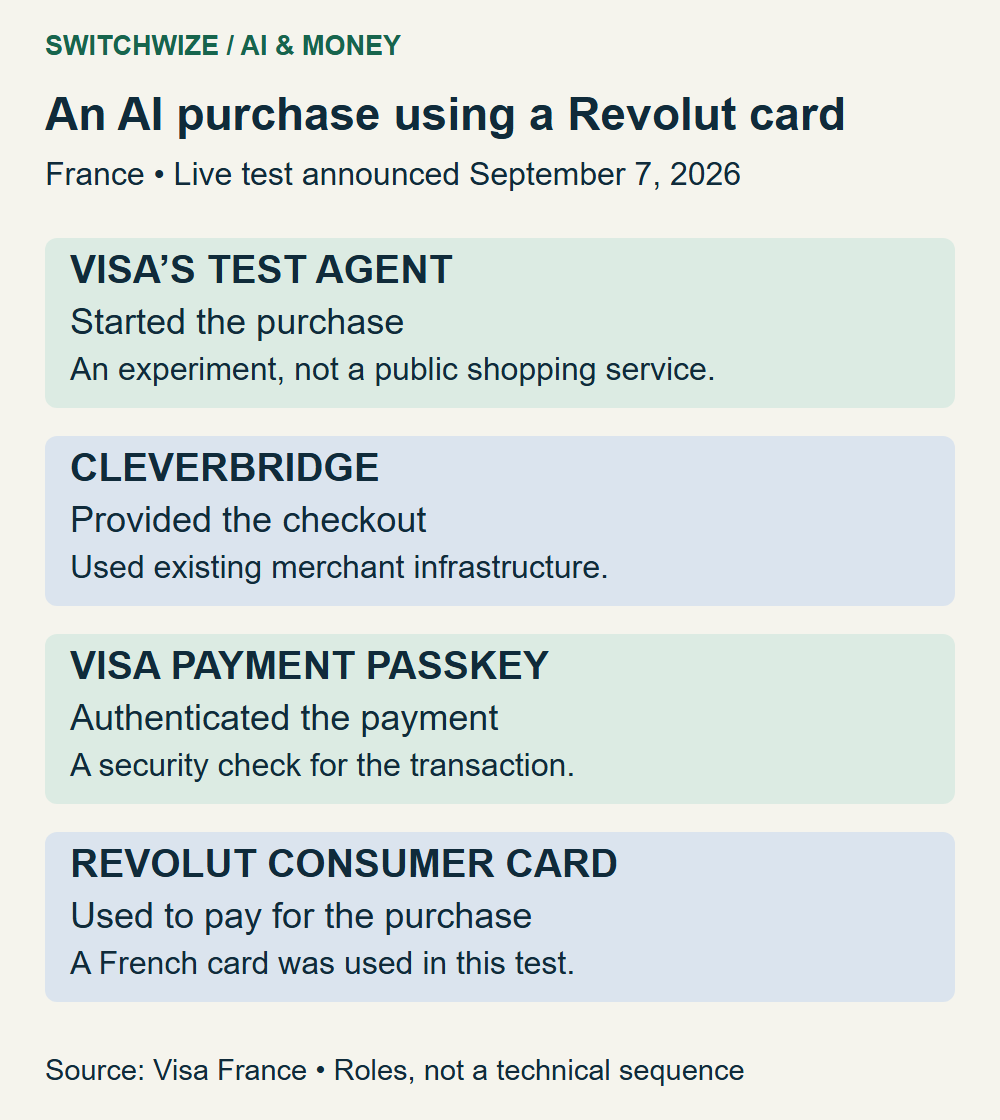
Source: Visa’s September 7 announcement. Roles in one live experiment, not a complete technical sequence or evidence of mass adoption.
There is a practical problem beyond getting a payment approved. In a hypothetical booking, a customer asks an assistant for a refundable flight under £300 that arrives before 6 p.m. A payment check might confirm the airline and the price without establishing that the fare is refundable or the flight arrives in time.
Ramp tells purchasing agents to inspect the cart before requesting payment credentials. That is different from a financial system independently checking every travel requirement. AP2, a public payment protocol, describes signed records of instructions and purchases, but a record alone does not prove that every instruction was correctly checked.
Customers will need help with the whole purchase, including mistakes. Visa’s UK guidance says chargeback recovery is not guaranteed. Who resolves an AI error depends on the circumstances, agreements and applicable protections.
For Ramp and Revolut, reliable checking and support could become reasons to choose their service. Having the card or account alone is not enough.
More AI activity does not automatically mean more profit
The revenue question is particularly clear in Revolut X. Outside assistants can help customers place trades, but the exchange’s UK fee schedule shows why trading volume alone can mislead.
For a hypothetical $1 million of taker orders, gross fees would range from $900 at the 0.09% rate to zero at the zero-fee tier. The intermediate rates produce $400 at 0.04% and $300 at 0.03%. Taker orders fill against existing orders; maker orders have a zero fee. Each scenario holds its applicable rate constant, with eligibility determined by the account’s prior 30-day volume. These calculations exclude other services and operating costs. They are not Revolut’s reported earnings.
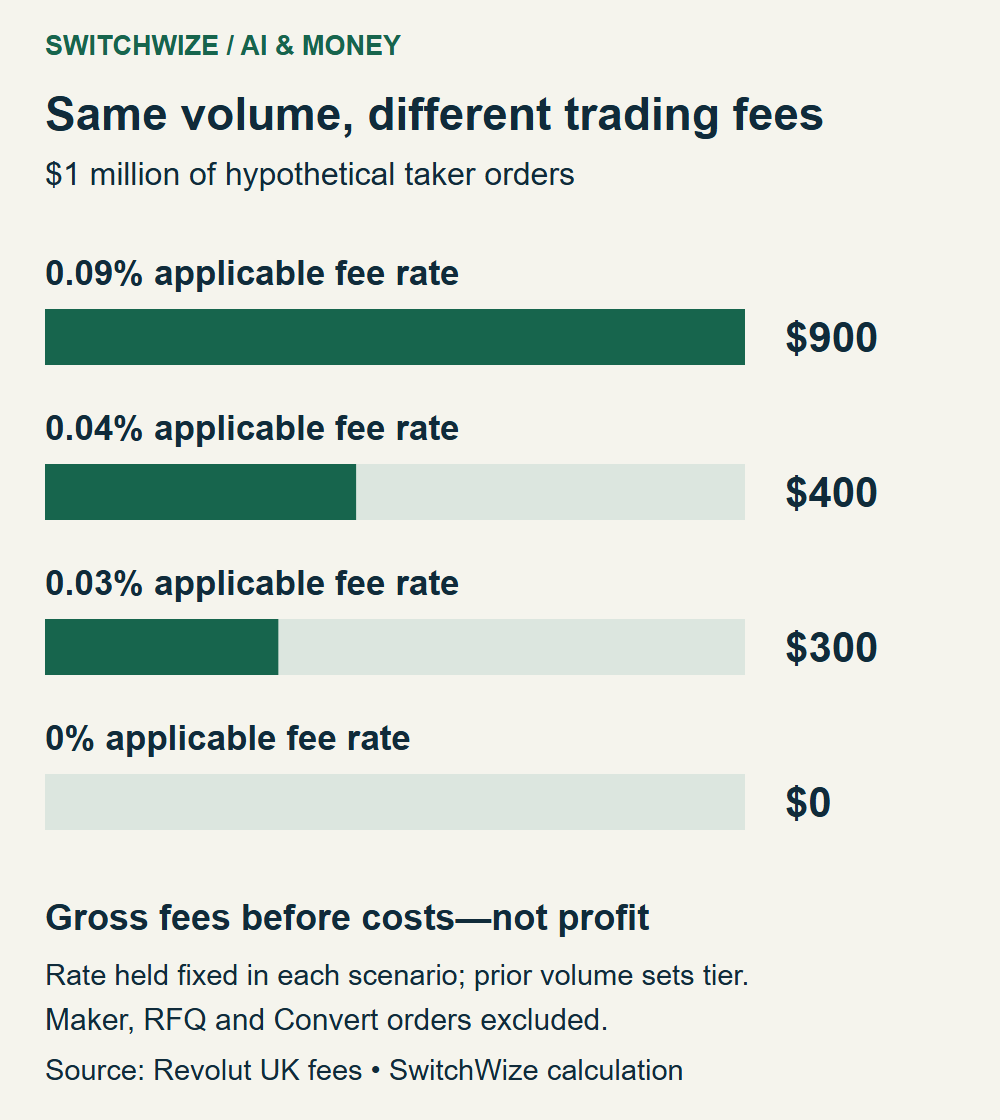
Our calculation using Revolut’s published UK order-book rates. Fixed-rate scenarios; maker orders, RFQ and Convert excluded.
That leaves a real business challenge. AI could generate activity while producing little fee income to cover its cost. More trading could also raise customer fees without improving investment results. Neither outcome is established here, but both are reasons to judge the service by more than transaction volume.
Ramp faces its own version of that test. A lower AI bill is useful only if employees still get the work done correctly. Software, setup, human checking and correcting mistakes all belong in the cost calculation.
The competition will come from partners too
Ramp and Revolut have useful customer relationships, but they are not the only companies building payment controls for AI.
Stripe documents payment credentials restricted by seller, amount, currency and expiry. Visa describes payment tools for outside agents, with availability varying by market and deployment. An AI company can work with these providers instead of building financial infrastructure itself.
This cuts both ways. Ramp and Revolut can remain useful when a customer chooses an outside assistant. But that assistant may also make it easier to choose a competing financial service. Visa has warned that payment providers can lose proximity to customers as purchasing moves into other platforms.
The service must also justify its recommendations. Would Ramp’s assistant recommend a competitor’s cheaper software if it saved the business money? Would Revolut’s assistant point a customer to a better account elsewhere? Those questions concern incentives, not allegations about either company’s current conduct.
What would make these plans work?
For Ramp, the next evidence should come from businesses that keep using its AI tools and can show savings after all costs. For Revolut, it should come from customers who complete useful tasks, receive good support and choose more of its services for a clear reason.
A sensible measure is the cost of a task completed correctly: AI and software charges, human checking and the cost of correcting mistakes. A successful payment is only one part of that result.
Ramp’s expensive week explains why businesses need that discipline. Revolut’s existing financial business explains why a useful assistant could be valuable even without a separate AI fee.
Ramp’s opportunity is to sell tools that save businesses more than they cost. Revolut’s is to make financial services useful enough that customers choose to use them more often. Both can work with outside assistants. What they still need to prove is that customers get better results—and that providing those results earns a profit.
Sources
Company results are attributed in the text. The supporting document comparison, calculations and method are retained with this draft. No purchases, trades or independent product tests were performed for this article.
- Ramp: connecting outside assistants
- Ramp: agent payments
- Ramp: user and standalone agent identities
- Ramp: Agent Card Checkout instructions
- Ramp: manage connected AI tools
- Revolut X: outside AI assistants — June 26, 2026
- Revolut X: API permissions — Ireland help page
- Stripe: shared payment tokens — agents documentation
- Visa: Intelligent Commerce for agents — developer use case
- AP2: current public protocol documentation
- Ramp: reported outside-assistant use — April 16, 2026
- Visa: embedded-payment strategy — June 16, 2026
- Revolut: AIR launch — April 9, 2026
- Revolut: research announcement — August 25, 2026
- Ramp: Glass announcement — October 13, 2026
- Visa UK: chargeback guidance
- Revolut UK: crypto exchange fee schedule
- Ramp: company update — October 14, 2026
- Ramp: Router launch — August 19, 2026
- Router: pricing and access FAQ
- Revolut: 2025 financial results — March 24, 2026
- Visa: Revolut and Cleverbridge payment test — September 7, 2026