
The short answer: FDIC insurance covers eligible deposits after an insured bank fails. It does not by itself solve nonbank app failures or withdrawal interruptions.
Deposit insurance and access to cash answer different questions. Before using an app for essential bills, trace where the money goes and who can return it.
By Jay Rege · November 4, 2026
Your banking app stops letting you withdraw. The bank holding the deposits is still open. Does deposit insurance immediately solve the problem?
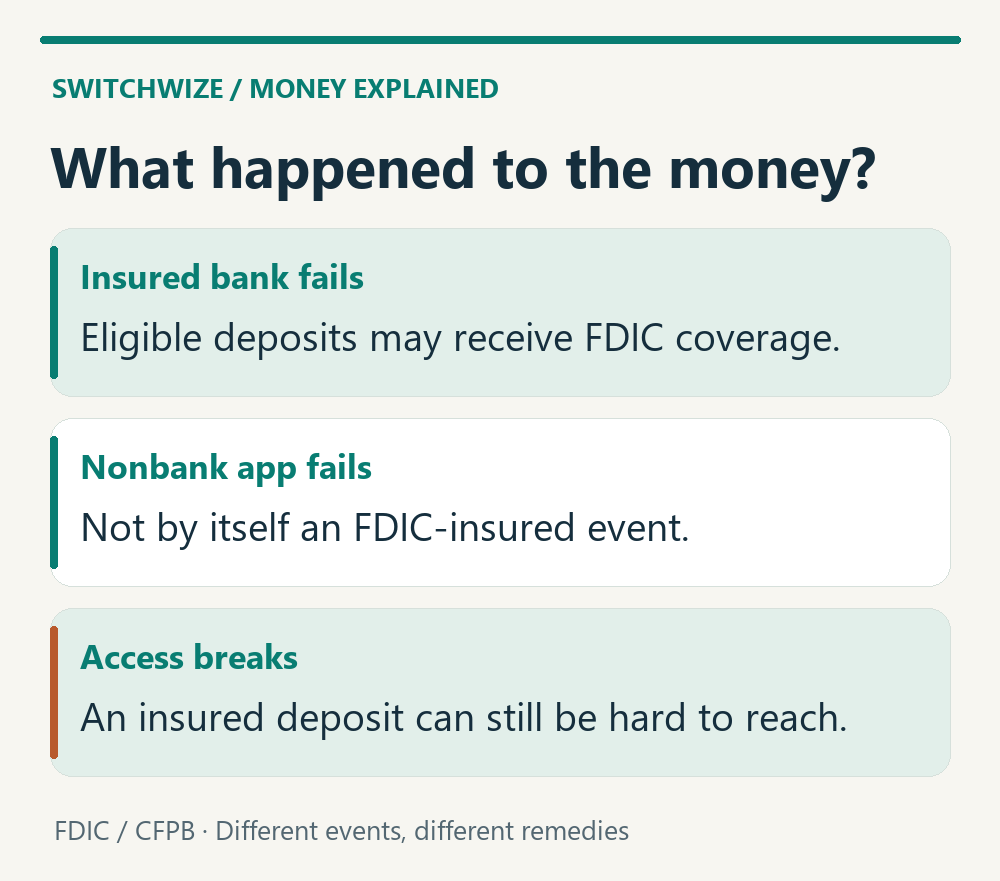
Not necessarily. FDIC insurance protects eligible deposits when an insured bank fails. It does not insure a nonbank app against bankruptcy, a broken connection or a dispute about customer records.
The distinction can be easy to miss on a phone screen. A bank's name and an insurance statement may appear beside a balance. But the company operating the app, the bank holding deposits and the company maintaining the records may be different organizations.
For money needed to pay rent or buy medication, it is worth asking two questions separately: would a covered bank failure leave my deposit insured, and how could I get my money if the app stopped working?
Identify the bank behind the balance
A nonbank company can arrange for customer funds to be held at an insured bank. Under qualifying arrangements, insurance can pass through to the underlying owners. The conditions matter, including the ownership and recordkeeping requirements. A logo alone does not establish that a particular balance qualifies.
The standard insurance limit is $250,000 per depositor, per insured bank, per ownership category. It is not automatically a new $250,000 allowance for each app used to reach that bank.
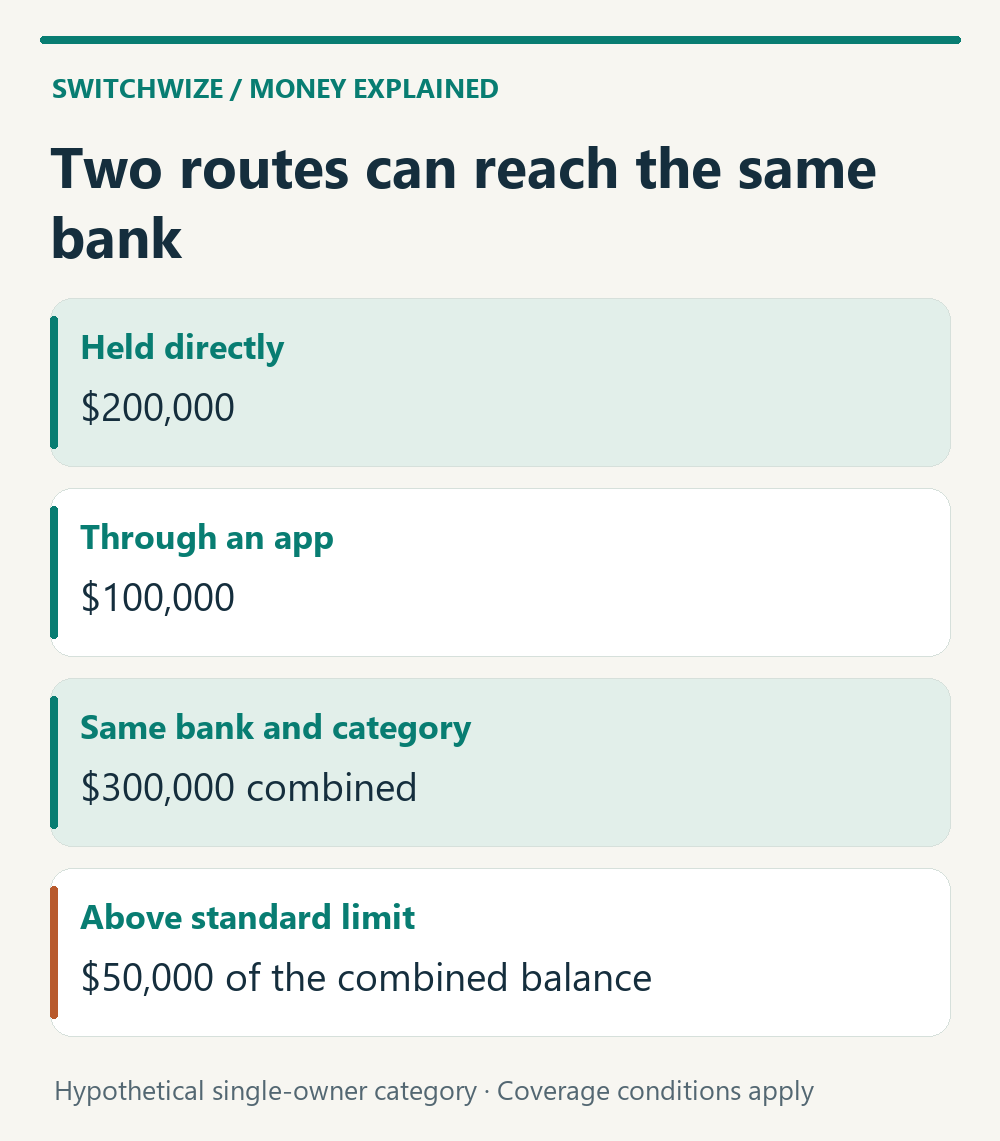
Consider a simplified hypothetical case. Someone holds $200,000 directly at a bank and another $100,000 through an app at that same bank. If both are eligible deposits in the same person's single-account ownership category, they total $300,000 at that bank. The standard $250,000 limit leaves $50,000 above the limit. Separate ownership categories or allocations to other banks can change the answer; the example assumes neither.
Ask which bank actually holds your money, whether the arrangement has more than one bank, when deposits are placed and how you can see their allocation. Keep statements showing the relevant legal names. Two different app brands can still lead to the same bank.
An app failure does not trigger a bank-failure payout
The CFPB's analysis of payment apps explains that balances stored through nonbank services can have different protections from money held directly in an insured account. Coverage depends on the product and arrangement; not every app balance is a deposit.
The FDIC's 2024 discussion of custodial-account recordkeeping described consumers losing access for months after the failure of Synapse, a nonbank intermediary. That is a historical example of an access problem. It is not a claim that every fintech arrangement has the same weakness, or that all affected balances remain unresolved today.
The lesson is about the event that activates protection. If the insured bank has not failed, a problem at another company does not by itself activate FDIC insurance. Resolving customer ownership, balances and withdrawal instructions may require work elsewhere in the chain.
This is not an argument that a physical branch is essential. Direct banks can also experience outages, and an app can offer excellent service. The issue is whether the customer has a clear claim, accurate records and a workable route to obtain funds when the normal interface fails.
Check how access works before depending on it
Ask the provider what happens if its app is unavailable. Can the bank identify you directly and service the account, or must requests go through the nonbank company? Who maintains the ownership records? Where would you report a missing transfer? A named partner bank does not by itself establish that you can walk into its branch and withdraw.
Answers may be in the account agreement, deposit-placement terms and support guidance. If the answer is unclear, treat it as an uncertainty when deciding how much essential cash to place there. Do not replace a missing answer with an assumption of instant access.
A small test transfer can show how a normal withdrawal works today. It cannot establish what would happen in a bankruptcy or a future outage. Use it to learn the process, not to certify the entire arrangement as safe.
The strongest providers should be able to explain the chain in ordinary language: who owes the customer money, where deposits are held, which conditions must be met for coverage and which company handles withdrawals.
Keep a second way to pay essential bills
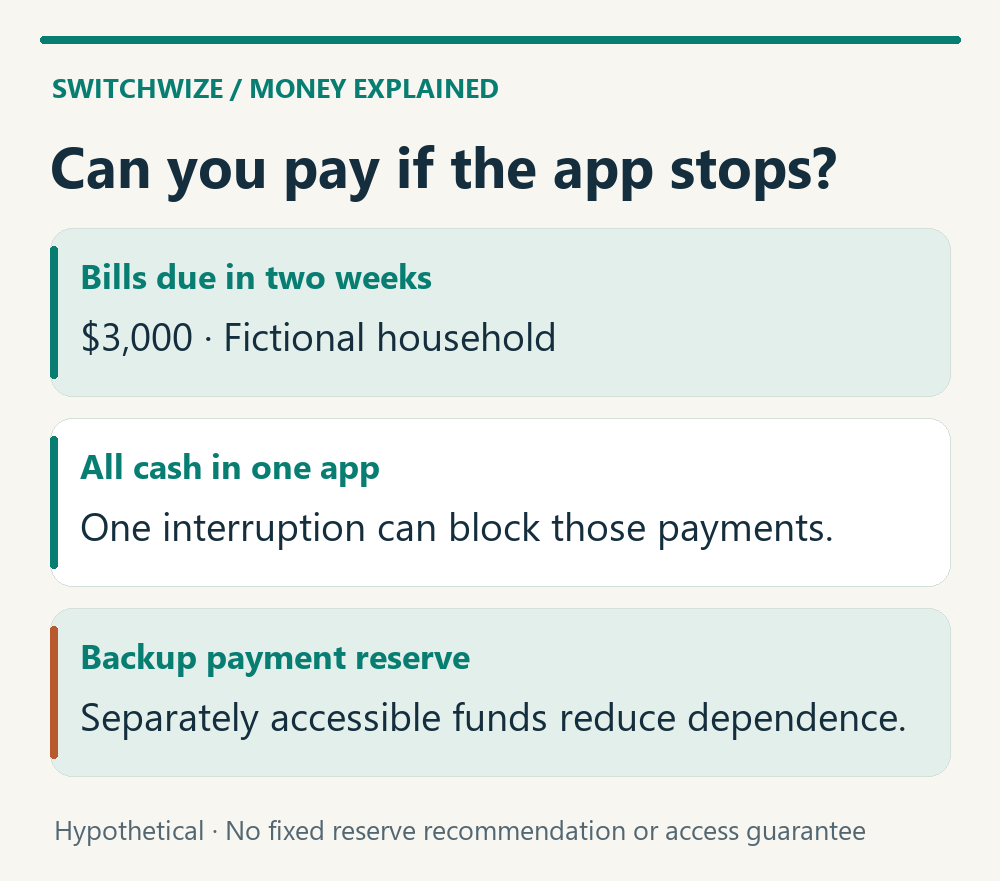
Suppose a fictional household needs $3,000 for essential bills during the next two weeks. It keeps $20,000 through a single app and has no usable cash elsewhere. An access interruption can still cause a $3,000 payment problem even if the household eventually recovers all $20,000.
Holding an appropriate amount in a separately accessible account can reduce that dependence. The right amount depends on bills, income timing and other resources. It should not be turned into an arbitrary rule that everyone needs several bank accounts or a fixed number of months at each.
There are costs to splitting money: more passwords, transfer delays and possible balance requirements. Choose a backup you can actually maintain. If two services rely on the same bank or access provider, they may not provide the independence you expect.
Before moving essential cash for a better rate, ask the provider to explain how you would get it back without its app. Then compare that answer with the payment deadlines your household cannot miss.
Sources
FDIC: banking through third-party apps; FDIC: insured deposits and ownership categories; CFPB: payment-app deposit protection; FDIC: 2024 custodial-account recordkeeping proposal and Synapse context.
Checked November 4, 2026. U.S. bank-deposit arrangements, not crypto assets or money-market mutual funds. Coverage depends on the actual legal arrangement and FDIC requirements. Historical materials explain the mechanism; the 2024 proposal is not represented as a current final rule. Figures and household are hypothetical. No withdrawal, provider-failure test or individual coverage determination was performed.