Short answer
Our pick is Revolut among these five for a main U.S. everyday-money app by 2031. Its reported primary-bank users grew 45% in 2025, versus 30% retail-customer growth. Those are global results; final U.S. approvals and sustained U.S. adoption remain important tests.
Revolut reports that the number of people choosing it as their primary bank rose 45% in 2025.
That is the number we would start with—not its valuation, downloads or AI announcements.
The race between X, Revolut, Coinbase, Stripe and ChatGPT is usually described as a contest to build the next super app: one place to shop, pay, save and manage everyday life. But getting someone to try an app is different from persuading them to trust it with their salary and bills.
Our pick is Revolut. Among these five, we think it is best placed to become the main app Americans use to manage everyday money over the next five years.
That is a forecast, not a finding that it already leads in America. By winning, we mean building a lasting relationship across an account, everyday payments and other money services. We do not mean the highest valuation, the largest audience or one app replacing the entire internet. Existing banks, Apple and other competitors are outside this five-company comparison; any could prevent all five from dominating the U.S.
Revolut has evidence of a functioning financial business and growing customer commitment abroad. Its rivals have credible advantages, but they still need to show how those advantages become a broader everyday money relationship.
There is one substantial condition: Revolut must finish its U.S. banking approvals and turn its overseas experience into an American service people choose to use. That is a large execution risk, not a paperwork detail.
How the five companies compare
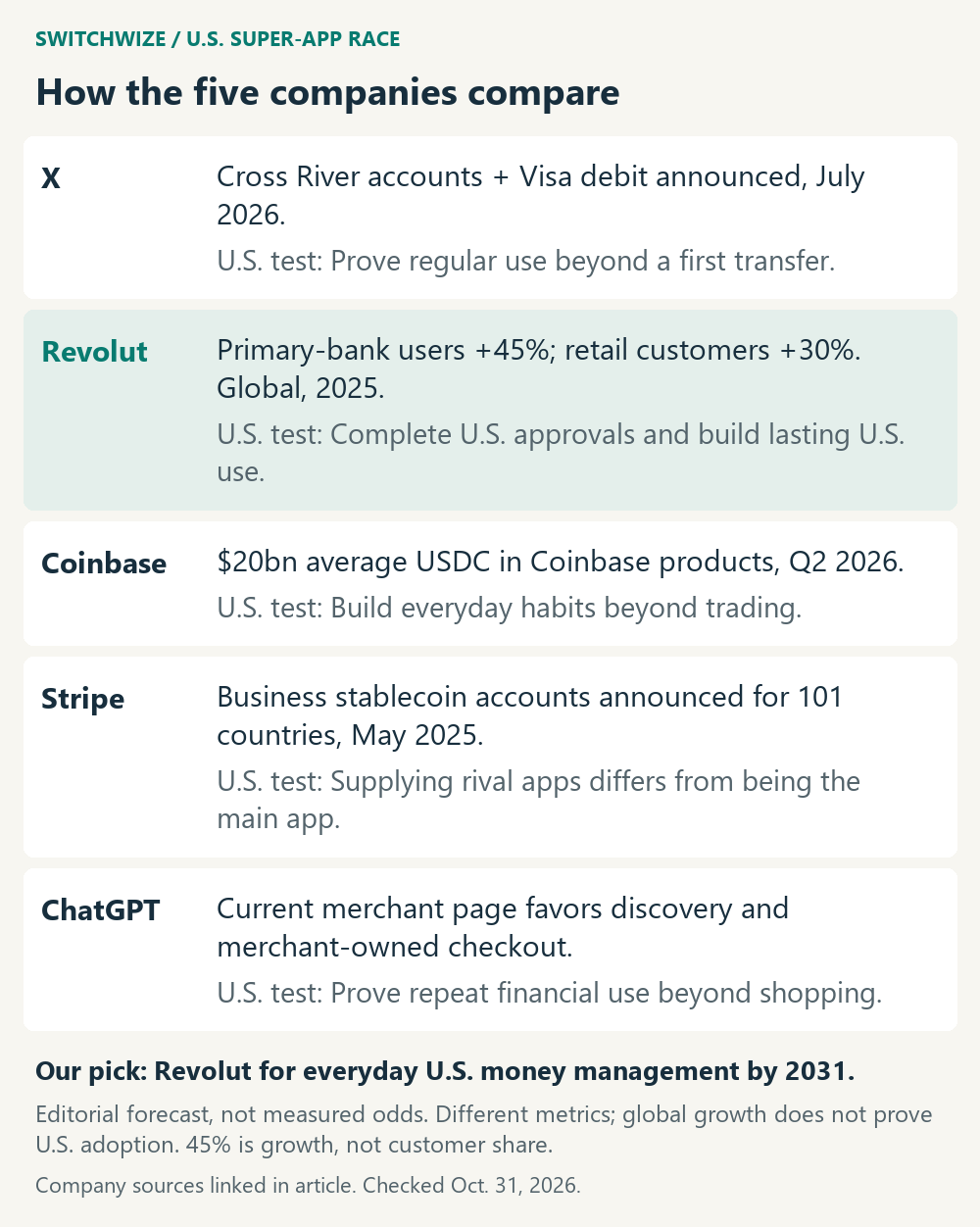
The table separates what each company already brings from what it still has to prove. The figures measure different things; they are not a ranking of market share.
Revolut has evidence of customers doing more than trying the app
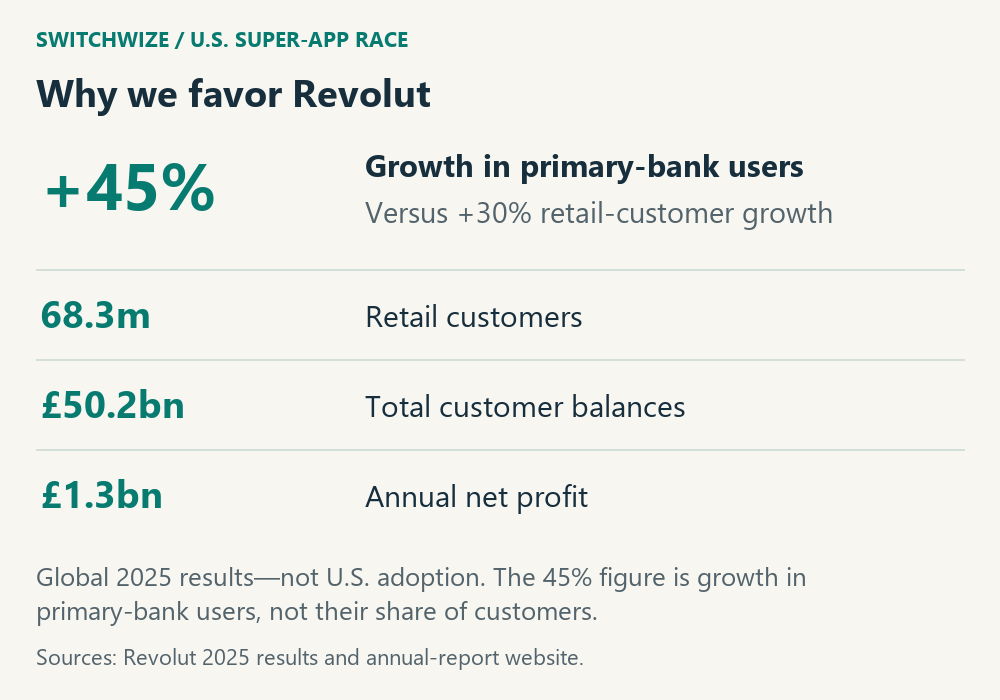
At the end of 2025, Revolut reported 68.3 million retail customers worldwide, £50.2 billion in total customer balances and £1.3 billion in annual net profit. These are global group figures, not U.S. figures. Customer balances should not be read as U.S. bank deposits.
The balances and profit matter for different reasons. Balances show that customers have placed money with the business. Profit shows that its existing operation can earn money after expenses. Neither guarantees customer satisfaction or a profitable American expansion.
The primary-bank measure comes closer to the question we are asking. Revolut's annual-report website says the number choosing it as their primary bank increased 45% year over year.
That does not mean 45% of customers use it as their main bank. The cited page does not state how many do, so we cannot calculate their share of all customers.
The useful comparison is 45% versus 30%: reported primary-bank users grew faster than the total retail customer base in 2025. For this race, that is a more relevant signal than customer growth alone. It does not tell us the absolute level of primary use, establish U.S. adoption or prove why customers changed their behavior.
Revolut also demonstrates how a financial app can expand into adjacent daily tasks. Its report describes mobile services in the UK and Poland, loyalty rewards and travel-related payments. Availability varies by country; these are not promises of an identical U.S. app.
This is why we favor it: it is already working on the harder part of the race—getting people to use a financial relationship more deeply. Adding an AI assistant could improve that service. It does not have to create the relationship from nothing.
America is the biggest reason our pick could be wrong
On September 3, Revolut announced conditional OCC approval for a proposed U.S. national bank. It said remaining approvals were needed and described a planned 2027 launch. Conditional approval is not final approval or a completed bank launch.
Its U.S. personal terms identify Lead Bank as the holder of funds in the relevant card-account program. Deposit insurance depends on the applicable limits and requirements. A new charter, if completed, would change the operating arrangement; it would not automatically persuade Americans to switch.
Consider a hypothetical customer who already has a salary deposit, rent payment and credit card arranged through existing providers. A new app has to offer enough benefit to justify changing those arrangements. A cleaner screen alone may not do it.
Nor does growing quickly abroad prove that customer protection will keep pace. Revolut Bank UAB's 2025 financial report discloses a €3.5 million Lithuanian anti-money-laundering fine imposed in April 2025. The bank says it took immediate action to address the findings. That concerns a European bank entity and specific controls—not a finding about the proposed U.S. bank. It is evidence that execution and supervision deserve attention alongside growth.
We would reconsider our pick if U.S. approvals or launch plans stall, if primary-account growth fails to translate into sustained U.S. use, or if service and control problems undermine trust. Global customer totals cannot substitute for that evidence.
X has the clearest route from conversation to payment
X's case is easy to understand. You already communicate with someone inside the app. Paying them there could be convenient.
Cross River's July 27, 2026 announcement describes interest-bearing accounts, a Visa debit card and payment capabilities embedded in X. The bank provides the regulated banking infrastructure. X does not need to own a bank to offer a useful financial service.
That makes X a credible challenger. Its challenge is the next step: turning a convenient payment into a regular money habit.
An initial transfer and a salary deposit represent different levels of commitment. The announcement does not establish how many users have made that jump. It also does not tell us how many keep using Money after the first transaction.
If X reports sustained account funding, recurring payments and customers choosing it for their regular banking, its case becomes much stronger. We are not assuming those outcomes merely because the social app has an audience.
Revolut's reported primary-bank growth gives us a relevant signal today. X could overtake it, but the banking partnership alone does not demonstrate that transition.
ChatGPT could become the place you decide without becoming your main account
ChatGPT offers the strongest challenge to our definition of the winner. What if you keep your bank but stop opening its app because an assistant handles the useful work?
That would matter. An assistant that helps compare providers and act on your instructions could influence where money goes without holding it.
But we should judge the current service, not its most ambitious possible future. OpenAI's current merchant page says it is moving away from standalone Instant Checkout toward product discovery and merchant-owned checkout. It says purchases finish on merchants' websites or apps and that there are no fees on purchases that start in ChatGPT.
That updates the September 2025 launch announcement, which described in-chat checkout and a merchant fee. Some help and developer pages still describe eligible checkout integrations. The documents are not fully aligned; we should not present the old launch model as a universal current service.
The change matters to this race. Helping someone find a purchase is not the same as becoming the service they rely on for their money.
ChatGPT could still change our verdict. We would need evidence of people repeatedly managing financial tasks through it across providers, with clear permissions and dependable handling of mistakes. Shopping discovery alone does not establish that.
Coinbase has a wider financial ambition than a crypto wallet
Coinbase's July 2026 earnings release describes an “everything exchange” spanning crypto, equities, derivatives, prediction markets and other assets. Product availability and eligibility differ. It would be a mistake to judge the company solely by the original crypto-trading app.
It also reported average USDC held in Coinbase products of $20 billion in the second quarter. That is a stablecoin-balance measure, not evidence of $20 billion in insured bank deposits or everyday household banking.
Coinbase has a separate route into spending. Shopify's June 2025 announcement names Coinbase and Stripe as partners in USDC payments on Base, the network built by Coinbase. Eligible merchants can receive local currency while customers pay from supported wallets.
That partnership is evidence of practical payment work. It is not proof that ordinary shoppers will make Coinbase their main financial app.
Coinbase also makes a distinction users need to understand: a custodial exchange account and a self-custody wallet are different products. Recovery methods and responsibility for access differ. A broader audience will need those choices to be understandable, not merely available.
For our pick to change, we would want to see spending and broader everyday financial use become recurring habits, rather than infer them from trading activity or stablecoin holdings.
Stripe could earn more business without winning the app race
Stripe is the awkward candidate in a consumer super-app comparison because much of its opportunity lies in serving businesses.
It is not entirely invisible to consumers. Link, its digital wallet, saves payment details for participating checkouts and supports purchases through eligible agents. Stripe's May 2025 announcement also described stablecoin-powered financial accounts for businesses in 101 countries. Those are business accounts, not a universal consumer banking service.
Stripe has worked with OpenAI on commerce technology and with Shopify and Coinbase on stablecoin payments. Those are separate arrangements, not a working transaction involving all five companies.
This leaves Stripe with an attractive strategic option: provide useful services to several companies competing for the shopper. It need not become the customer's main app to gain business.
But that does not establish that Stripe will earn the most profit. Partner announcements do not disclose all the fees, costs and risks. OpenAI's original protocol also allowed merchants to retain other payment processors.
We favor Revolut for the consumer relationship. We regard Stripe as a strong supplier to the race. Those are different judgments, and neither is an investment recommendation.
An assistant can change your shopping without changing your bank
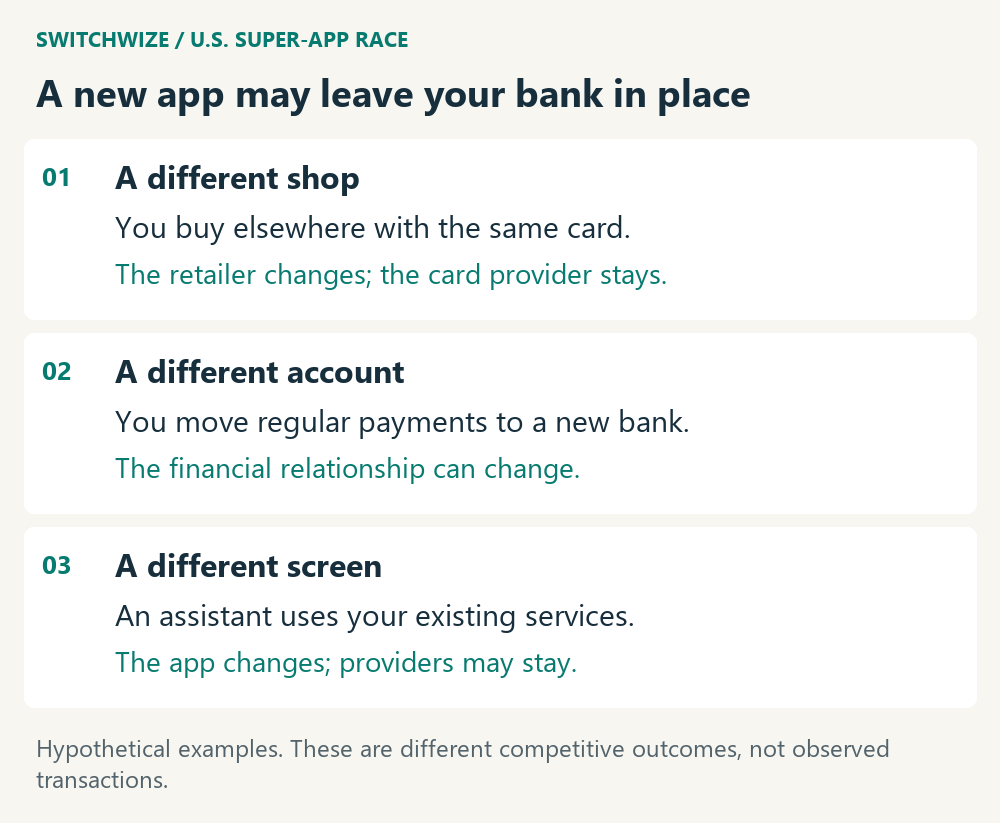
Imagine an assistant finds a better shop and you pay with your existing card. The shop may lose a sale; the card provider may keep the payment. If the assistant instead helps you change accounts, the financial provider could lose the relationship too. These are hypothetical examples of different competitive outcomes.
That is why control of the first screen does not settle who wins your financial business. We need to know what changes underneath it.
The strongest argument for Revolut is that money already held, regular payments and useful adjacent services could give people reasons to stay. The strongest argument against it is that an independent assistant could make choosing other providers easier—or an existing bank could improve enough that customers stay put.
Our position is therefore clear but testable: Revolut is our pick among these five for America's main everyday money app by 2031. The missing evidence is U.S. adoption, not another global download milestone.
The next time one of these companies announces a new AI feature, ask for a harder number: how many customers now use it as their main account, what share of its customers that represents, and how many stay. Revolut has supplied a growth rate. To justify our forecast, it needs to show the American relationship behind it.
Sources
October 31, 2026. Editorial forecast among five companies, not a measured probability or investment recommendation. Global figures do not establish U.S. adoption. No interviews or hands-on transaction tests; product terms can change.
Revolut: Annual report · 2025 results · U.S. approval · U.S. terms · AML disclosure.
X and OpenAI: X Money · Current merchant page · 2025 checkout launch · Shopping help.
Coinbase, Shopify and Stripe: Q2 results · Shopify partnership · Wallet custody · Link · Business accounts.