
Americans have no shortage of ways to pay for things. Credit cards offer rewards. Digital wallets make checkout almost effortless. Zelle and Venmo move money between people. The Federal Reserve found that consumers made an average of 47 payments a month in 2025, including 16 by credit card and 15 by debit card. Those habits have remained remarkably stable despite years of financial innovation.
Buying something often means moving between several apps. Someone discovers a product on a social network, researches it elsewhere, visits a merchant's website and pays through another service. A professional attracts a customer through a post, then sends an invoice through a separate application. The payment works; everything leading to it is disjointed.
That is the opening for X.
With X Money, a creator economy, real-time public conversation and Grok, the company is assembling pieces of a larger commercial platform. X Money began rolling out in July, offering interest-bearing accounts, person-to-person transfers and a Visa debit card through its banking partnership with Cross River. The super-app ambition, long associated with Elon Musk, goes further: connecting discovery, commerce and financial services in one experience.
The opportunity isn't another way to pay. It is to shorten the distance between an online conversation and a transaction.
China's WeChat shows why that can work. WhatsApp's much more modest payments success in India shows why social reach alone won't make it happen.
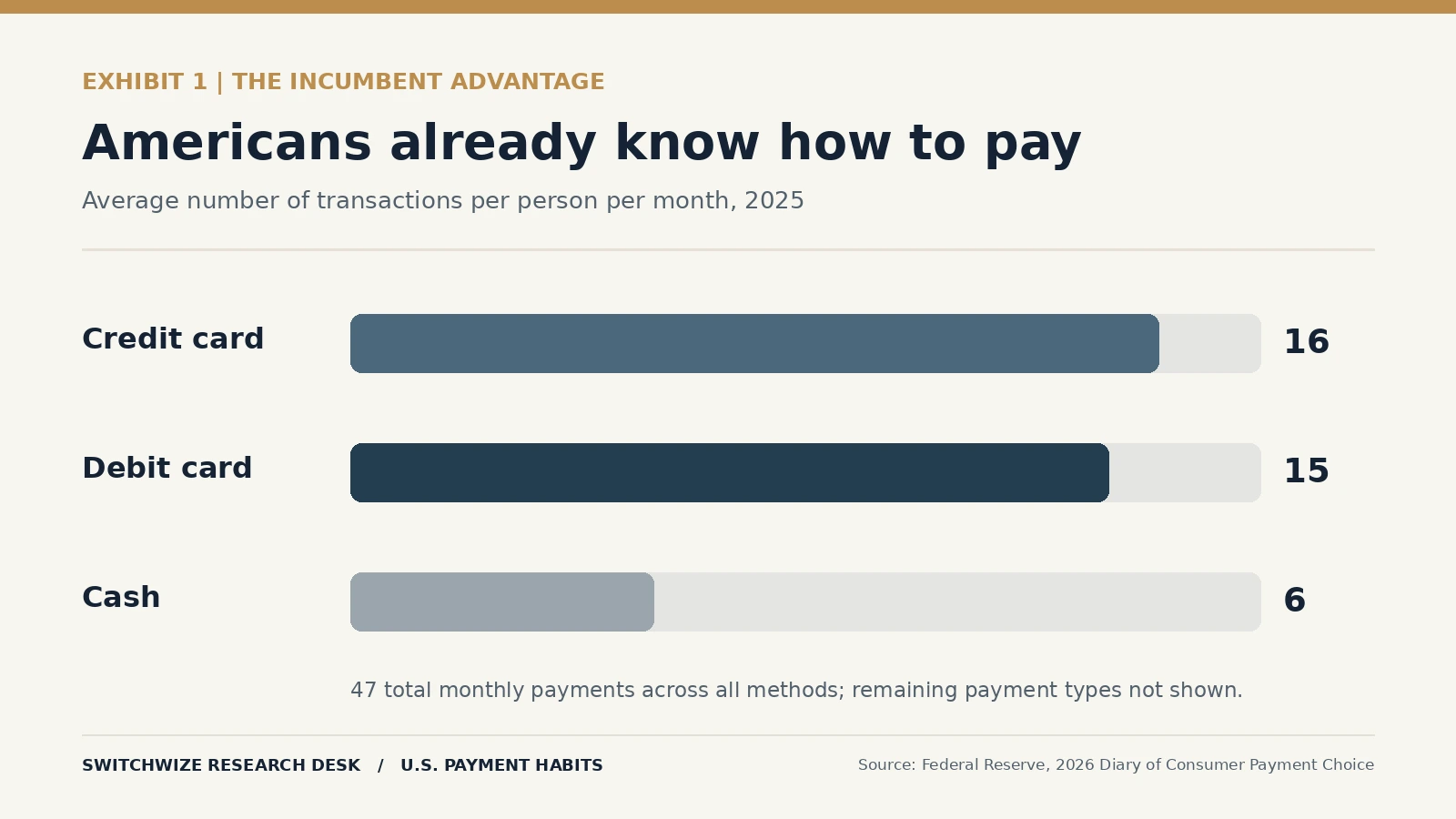
U.S. monthly payments in 2025
- Credit card
- 16 payments
- Debit card
- 15 payments
- Cash
- 6 payments
Federal Reserve, 2026 Diary of Consumer Payment Choice. Total monthly payments: 47; these selected methods do not sum to the total.
How WeChat made payments a social habit
WeChat's breakthrough began with a holiday custom. In 2014, Tencent let users exchange digital red envelopes during the Lunar New Year, turning a familiar gift into a social activity. About 16 million were sent that year. In 2015, the number reached one billion, according to Brookings and IMD.
The feature did something more important than generate transfers: It persuaded people to connect bank accounts to an application they already used every day. Merchants followed. QR-code payments were inexpensive to accept, and WeChat gradually made it possible to shop, order food, arrange services and pay without leaving the app.
Tencent says its Mini Programs, small applications operating inside Weixin, facilitated more than eight trillion yuan in merchandise transactions in 2024. Weixin and its international counterpart, WeChat, had more than 1.4 billion combined monthly active users in the first quarter of 2026.
Alipay reached a similar destination from the other direction. It began with shopping and payments, then extended into savings through Yu'e Bao, a money-market product that made it convenient to keep unspent funds connected to the commercial ecosystem.
Neither company won simply by bundling financial features. Each made money movement a natural continuation of an activity customers already wanted to perform. China's comparatively limited legacy of credit-card use gave mobile payments room to change habits quickly.
America is different. Its card networks, banking applications and payment products are deeply established. Recreating WeChat's feature list would not reproduce the circumstances that made WeChat successful.
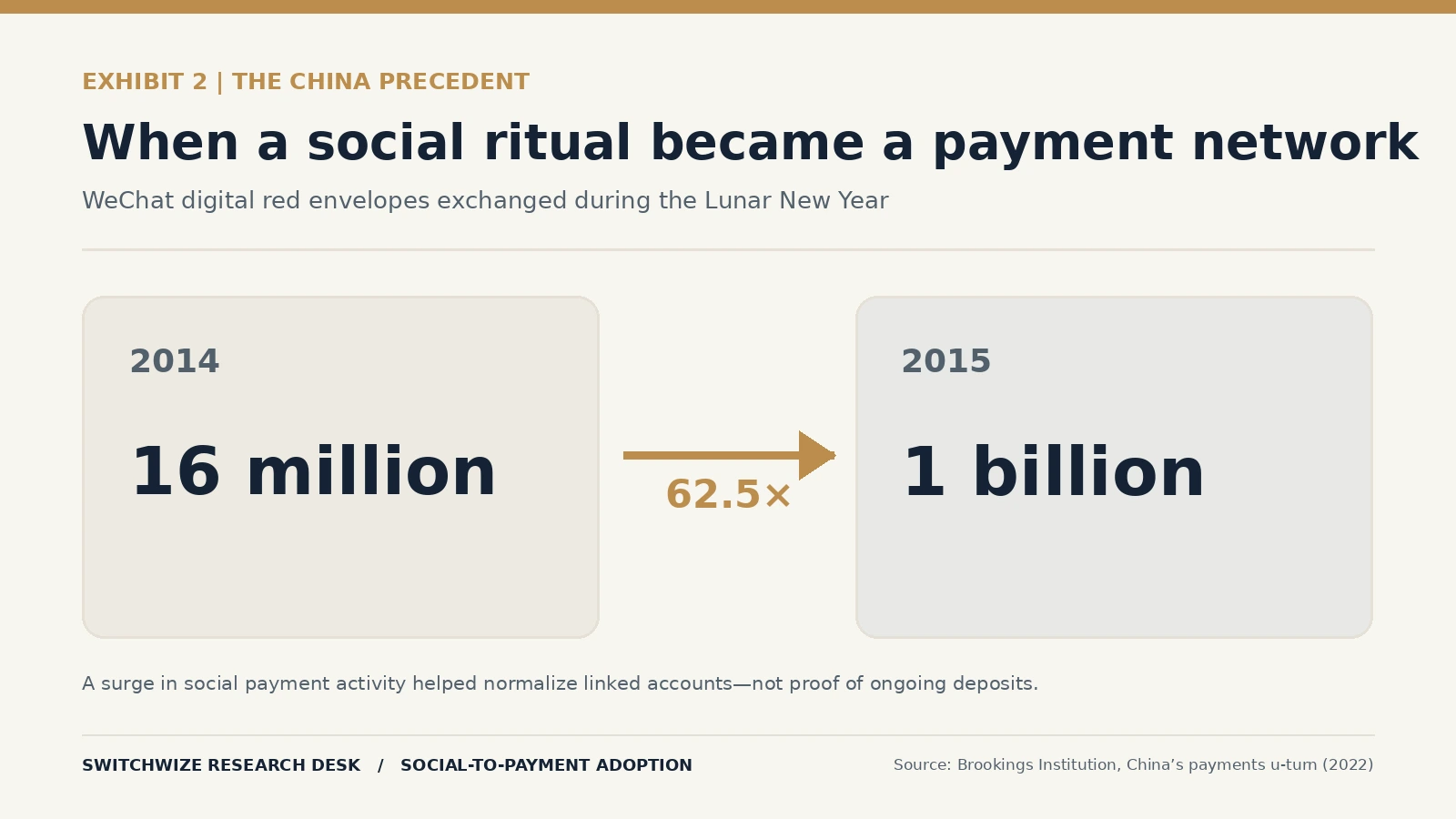
WeChat red envelopes
- 2014
- 16 million
- 2015
- 1 billion
- Increase
- 62.5 times
Historical counts reported by Brookings. These are red envelopes sent, not unique users or revenue. They do not establish ongoing deposits.
Why WhatsApp Pay trails India’s leaders
If distribution were sufficient, Meta would already have an enormous payments business in India. WhatsApp is used by hundreds of millions of Indians and is indispensable to personal and small-business communication. Yet Business Standard reports that its payment service handled 167.89 million transactions in July 2026, against 23.66 billion for India's Unified Payments Interface overall: roughly 0.7% of the market. PhonePe and Google Pay together handled close to four-fifths of UPI transactions.
WhatsApp Pay is growing: Its July volume more than doubled from a year earlier. And regulation mattered. India imposed onboarding limits during the service's early expansion, only removing them at the end of 2024. Still, the remaining distance to the market leaders is striking.
UPI is an open network. Customers can pay between participating bank accounts using competing apps. WhatsApp therefore offered a convenient button, but often not a materially better transaction. Nor did a conversation with a shopkeeper necessarily give the customer a reason to switch payment providers. PhonePe and Google Pay show that businesses can thrive on shared rails; what matters is giving people a reason to make one app their habit.
A social network reduces the cost of reaching a customer. It does not automatically create a reason for that customer to transact. That is the warning for X.
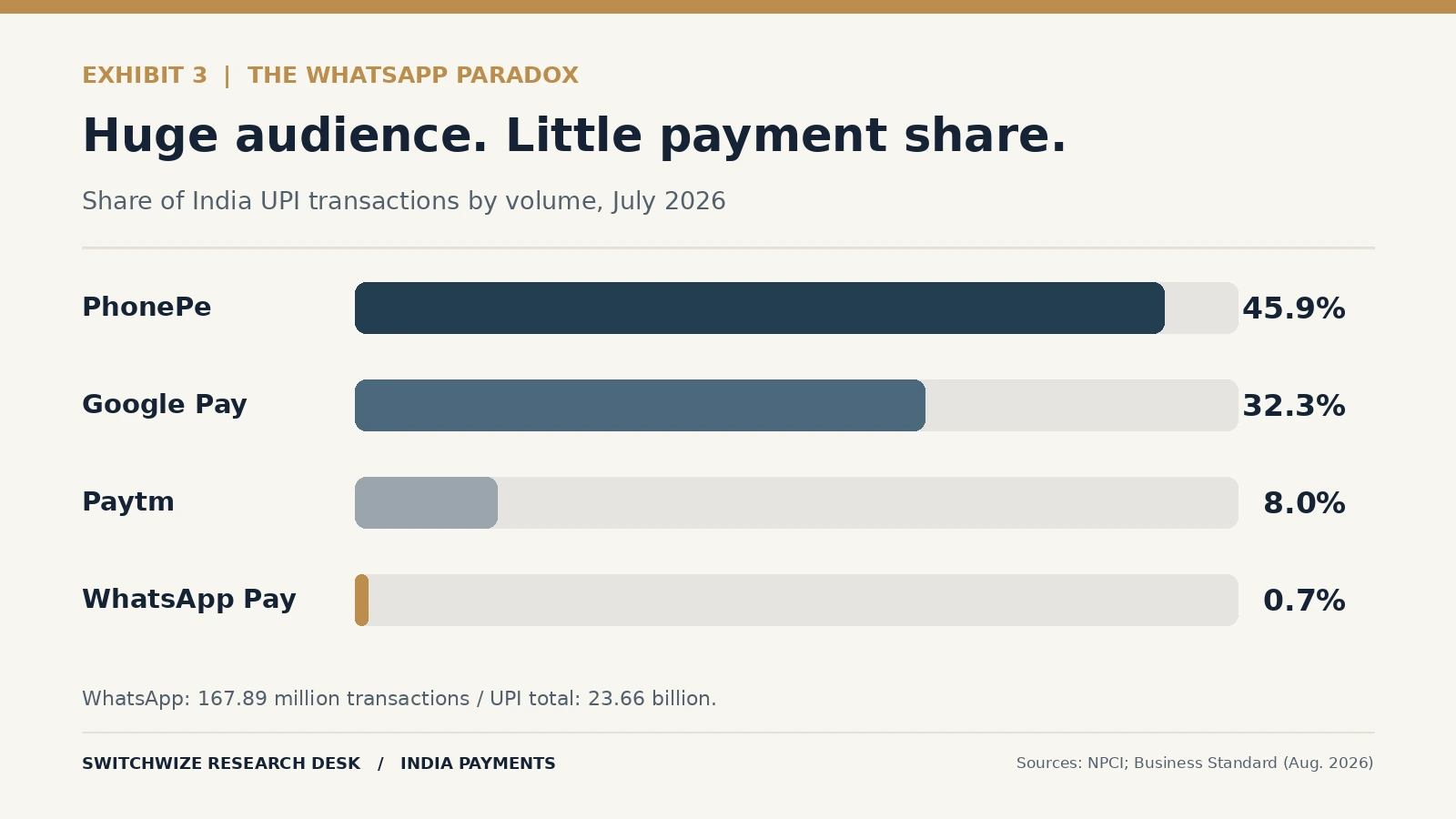
UPI transaction share, July 2026
- PhonePe
- 45.9%
- Google Pay
- 32.3%
- Paytm
- 8.0%
- WhatsApp Pay
- 0.7%
Shares are calculated from NPCI’s July 2026 app counts and total of 23,658.35 million transactions. Selected apps do not sum to 100%.
How X connects discovery to payments
WhatsApp is largely a place to maintain relationships. X is also a place to discover them. Investors follow companies and analysts. Readers find writers. Customers encounter products, entrepreneurs and independent professionals. Public conversations can create commercial interest before anyone has decided where to spend money.
X already possesses several pieces that could connect interest to a transaction. It has a large public network where people discover ideas and businesses, an established creator-subscriptions and rewards system, and now a banking partnership. X Money's rate schedule even treats certain creator payouts as qualifying deposits, a concrete link between content and financial services. Its advertised yield can reach 6% for eligible customers, but the rate is variable, and promotional economics are unlikely to create a lasting advantage by themselves.
In September, Interactive Brokers announced that X's Cashtags could take an investor from a discussion about a stock to a brokerage trading page. The trade occurs with the broker, not on X. That distinction is useful. X can own the moment of discovery without having to own every regulated financial service behind it.
Grok supplies another potential piece: a conversational tool that could help users evaluate a purchase, compare options or understand a financial decision. The fully integrated journey, from discovery through checkout and after-sale service, is not yet an established X product. But the ingredients are more substantial than a payment button attached to a social feed.
The most promising customers aren't necessarily people looking for a new checking account. They are people already doing business because of something that happened on X.
Build commerce first. Let banking follow.
Consider an independent researcher who publishes an analysis on X. Readers discover the work there, but purchasing a full report may require a separate website, payment service and subscription system. Or consider a consultant who finds customers through public posts and direct messages, then sends invoices elsewhere.
X should make those transactions simpler. Start with verified creators and small businesses selling content, expertise, event access and digital products. Give them dependable checkout, invoicing, subscriptions, refunds and transaction records. Let customers pay using existing cards and bank accounts as well as X Money.
This sounds less ambitious than building an everything app. It is more likely to work. It connects money to an existing reason to use the platform, rather than asking users to move their money in the hope that useful things will eventually appear.
It would also give X a way to distinguish itself from WhatsApp. Meta's problem was not simply a lack of proprietary payment rails; it was the difficulty of changing payment habits when alternatives were already satisfactory. X should try to create commercial transactions that are easier precisely because discovery and payment are connected.
Success would invite a larger move. If creators and merchants begin receiving regular income through the platform, some will have a reason to retain balances, make payments and eventually use more conventional banking services. Commerce creates a reason to receive money; repeated commerce creates a reason to keep using the account.
But X cannot skip the less glamorous work. Real merchants need identity verification, dependable dispute resolution and clear rules for refunds. Financial accounts need reliable access even if a social profile is restricted. A popular social handle is not proof that a seller is trustworthy. That gap between attention and financial trust may be the platform's hardest operational problem.
Why X should support other financial providers
The Chinese super-app model rewards keeping activity within one ecosystem. In the United States, that could be a handicap. Consumers have good reasons to keep savings at one institution, borrow from another and pay with a rewards card from a third. Forcing them to abandon those advantages would give X a formidable customer-acquisition problem.
A better approach is to let people retain their financial relationships while X makes the services easier to connect. A customer could discover a product on X, ask Grok to compare offers, pay with an existing card and receive an invoice or refund through the same commercial interface. Where X Money is genuinely better, customers could choose it. Where another bank or service is better, the platform should let them use that instead.
There is a catch. An AI assistant good enough to compare financial products may also make it easier to move money away from X. The software that makes a super-app useful could also make it easier to leave.
X should embrace that risk. A financial assistant that reliably helps customers, even when it recommends a competing provider, could earn something more durable than deposits attracted by promotional yields: the right to be the place where people start a decision.
X’s advantage isn’t that it can replicate every bank, wallet or marketplace. It is that conversations and purchase intentions already emerge on its platform.
Watch repeat purchases and returning buyers
Opening X Money accounts is not the same as building a super-app. Nor would a large deposit balance, attracted by a high promotional rate, prove that customers had changed their behavior.
Watch what merchants and customers actually do: How many verified sellers receive payments for activity that originates on X? How many buyers return? How often do businesses use the service for recurring income? Do customers keep using it when financial incentives normalize? And are disputes handled well enough that merchants and consumers trust the system with larger transactions?
China showed that payments can become part of a social habit. India showed that a vast messaging audience does not guarantee a payments franchise. America adds a third condition: Consumers will not readily sacrifice financial products that already serve them well.
X's opportunity is therefore not to recreate WeChat on American soil. It is to build a service that makes the distance between discovering something and doing something about it much shorter, while leaving consumers free to use the financial providers they trust.
If X can do that, money may follow the conversations. Trying to move the money first is the harder bet.
Related analysis
Compare X Money with Revolut to see how their financial businesses differ. Our X Money rate review explains the deposit and subscription conditions. The X Money savings comparison shows how those conditions change consumer returns.
Sources and calculation notes
- Federal Reserve Financial Services, 2026 Diary of Consumer Payment Choice, published May 2026; payment observations are from 2025.
- Brookings, China’s payments u-turn, historical red-envelope counts.
- Tencent, June 2026 offering circular, combined Weixin/WeChat users at March 31, 2026; 2025 offering circular, Mini Program merchandise value in 2024. Merchandise value is not Tencent revenue.
- NPCI, July 2026 UPI app statistics and UPI product statistics. Independently checked October 12, 2026: PhonePe 10,857.91 million, Google Pay 7,649.82 million, Paytm 1,903.87 million and WhatsApp 167.89 million; total UPI volume 23,658.35 million. Business Standard, August 16, 2026, provides contemporary reporting.
- WhatsApp share: 167.89 million ÷ 23,658.35 million × 100 = 0.71%, rounded to 0.7%. All chart shares use the same denominator and round to one decimal place.
- X Money product disclosures, rate schedule, Original Content Rewards, Cross River partnership, and Interactive Brokers Cashtags announcement, checked October 12, 2026.
Proposed checkout, merchant and AI features are the Research Desk’s analysis. They are not announcements by X or personalized financial advice.