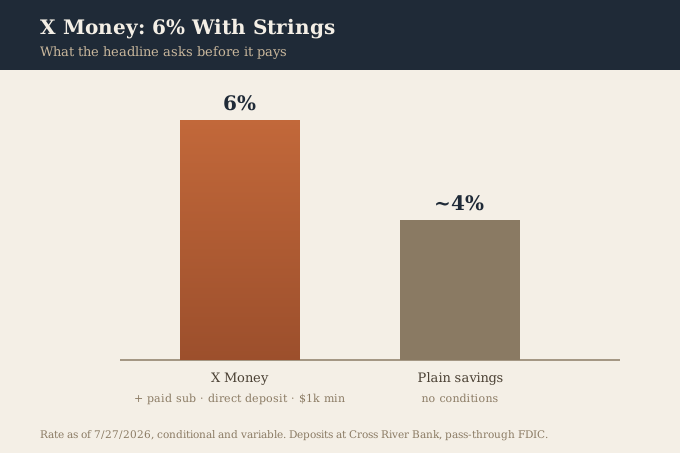
- X Money's 6% APY is a real advertised rate, but it is gated behind a paid X Premium subscription, a qualifying direct deposit, and a roughly $1,000 minimum, and the rate is variable.
- Deposits sit at Cross River Bank (Member FDIC) insured to $250,000, with up to $10 million via a pass-through cash-sweep for eligible users; X Payments itself is not a bank.
- Net the subscription cost against the interest before moving cash, and weigh the underlying bank's strength; a plain high-yield savings account asks nothing of you for a rate near 4%.
When a savings rate leads with a number most banks cannot touch, the number is rarely the whole story. X Money, the payments product rolled out to X Premium subscribers in July 2026, launched with a headline that did exactly this: 6% APY, a Visa debit card, and up to $10 million in FDIC coverage. For savers used to a national average near 0.40%, that lands like a challenge to every bank they use. Savings rates on this page were last verified recently. Our X Money 6 percent APY review 2026 breaks down what conditions apply to earn that headline rate.
The rate is real. It is also conditional in ways that change the math, and the insurance works differently from a normal bank account. Both are worth understanding before any cash moves.
The rate is real, and it is gated
The 6% is not a teaser in the sense of expiring on a fixed date, but it is not a plain rate on your balance either. Based on the launch terms, earning it generally requires three things at once:
- A paid X Premium subscription (the plan tiers carry monthly or annual fees).
- A qualifying direct deposit into the account.
- A minimum balance in the range of $1,000, with the top rate applying above that.
And like any advertised yield, it is variable: X can change it. None of this makes 6% fake. It makes it a rate you qualify for and maintain, rather than one you simply receive.
The insurance is real, and it is pass-through
The $10 million coverage figure is accurate but works through a structure worth naming. Deposits are held at Cross River Bank, Member FDIC, insured to the standard $250,000. Eligible users are enrolled in a cash-sweep program that spreads balances across a network of partner banks, keeping each slice under the per-bank limit to reach up to $10 million in aggregate coverage.
Two details matter. First, X Payments LLC is not itself an FDIC-insured bank; the coverage comes from the banks holding the money. Second, pass-through coverage applies only when specific conditions are met, which is standard for sweep programs but means the protection is contingent, not automatic. This is the same distinction that separates a fintech app from a chartered bank: know exactly which entity holds your cash and under what terms.
The diligence the headline skips
A high rate at a new provider deserves ordinary scrutiny, not suspicion, but not blind trust either. The underlying partner bank carries regulatory history that has drawn public questions, and the published fee schedule does not fully enumerate charges like outgoing wires or replacement cards. Neither is disqualifying on its own. Both are reasons to read the terms rather than the headline.
X Money vs a plain high-yield savings account
- X Money 6%
- ~6% (conditional)
- Plain high-yield savings
- ~4%
- X Money 6%
- Yes
- Plain high-yield savings
- No
- X Money 6%
- Yes
- Plain high-yield savings
- No
- X Money 6%
- Pass-through via network banks
- Plain high-yield savings
- Direct FDIC at one bank
- X Money 6%
- Yes
- Plain high-yield savings
- Yes
The math that decides it
The honest test is the net yield. Take the interest 6% would earn on your actual balance, then subtract the annual subscription cost. Compare that to what a free high-yield savings account near 4% earns on the same balance with no subscription and no direct-deposit requirement.
On a small balance, the subscription can eat most or all of the advantage, and the effective yield can fall below the free 4% option. On a large balance, the subscription is a smaller drag and the 6% can genuinely win. The number that matters is not the headline; it is interest earned minus what you pay to earn it.
Sources
- X Money, product page and deposit-insurance disclosure (APY accurate as of 7/27/2026, subject to change).
- Reporting on X Money's launch, rate conditions, and the Cross River Bank arrangement, TheStreet and MoneyWise.
Rates and eligibility vary by subscription tier and are subject to change; confirm current terms on X Money's own disclosures before opening an account. This is general educational information, not a recommendation.
What to Do Now
Frequently Asked Questions
Is X Money's 6% APY real?
Is X Money FDIC insured?
Is X Money safe to put my savings in?
Does the X Premium subscription eat into the 6% return?
Act on this: today's top savings


Ranked by SwitchWize's composite score. We may earn a referral fee, and it never changes the ranking order.
Editorial review
What changed since the last update
Was this guide helpful?
Found an inaccurate, outdated, or missing claim? Report a correction. We verify reports against the relevant source before changing a guide or ranking.

Adeesh Setya is Head of Financial Research & Principal at SwitchWize, with 25+ years of experience in deposits, treasury management, banking products, and financial services. He previously served as Treasurer at Merrill Lynch Bank USA and Morgan Stanley Bank USA, where he managed bank funding, deposits, and interest-rate risk. He writes on Federal Reserve policy, the general marketplace for banking products, and what they mean for savers and consumers.
Available for on-record interviews, background briefings, and custom data cuts.
research@switchwize.com