
In our previous article, we examined whether X could become America's answer to WeChat. The central question was whether a social network could turn its audience into a functioning ecosystem for payments and commerce.
There is another company pursuing much the same ambition, but from the opposite direction.
Revolut began as a low-cost foreign-exchange and payments service. Over the past decade, it has expanded into banking, investments, business payments, travel services and telecommunications. Its September 3 disclosure reported more than 80 million customers globally.
X began with a social network. It is adding money transfers, interest-bearing accounts, debit cards and connections to investment platforms.
Reuters reported on October 9 that Revolut CEO Nik Storonsky said the company intends to expand beyond financial services into a broader range of technology products. He also described how Revolut is developing AI models using transaction data generated across its platform.
Both companies want a larger place in consumers' everyday lives. But they are starting with different advantages, and their financial models are at very different stages.
Revolut’s financial results
In its FY2025 results published March 24, 2026, Revolut reported:
- $6.0 billion in revenue, up 46%.
- $2.3 billion in pretax profit.
- $1.7 trillion in transaction volume.
- 68.3 million retail customers at year-end.
- $67.5 billion in total customer balances.
Its pretax margin, profit before tax divided by revenue, reached 38%. USD figures are company-provided conversions; growth rates use GBP results.
These are substantial results for a company that started with an inexpensive foreign-exchange card.
The composition of revenue is equally revealing.
Card payments generated approximately $1.3 billion. Interest contributed another $1.3 billion. Subscriptions added $936 million, wealth services $876 million and foreign exchange $800 million.
Interest accounted for about 22% of revenue: $1.3 billion ÷ $6.0 billion, using rounded disclosures. Selected business lines do not sum to total revenue.
Revolut has built a business in which customers can generate revenue through several activities: making payments, exchanging currencies, maintaining balances, subscribing to premium services and investing.
Its business accounts are growing, too. Revolut Business had 767,000 customers at the end of 2025 and processed $365 billion in transactions during the year.
The company does not need customers to spend hours browsing its application. They can generate transactions simply by using Revolut cards and financial accounts in their everyday lives.
A financial relationship can generate recurring activity even when the customer is not actively engaging with the app.
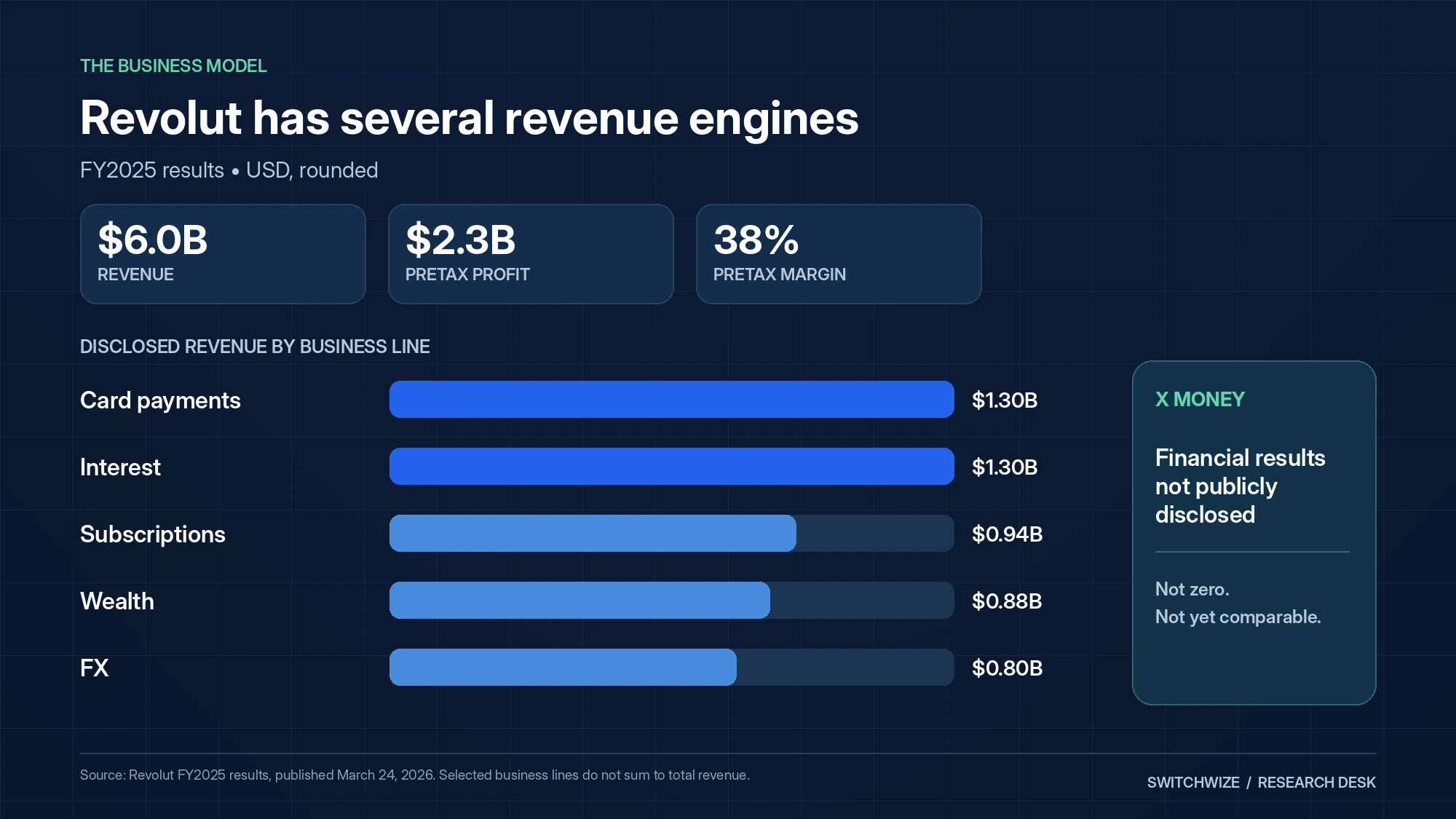
Revolut FY2025 results
- Group revenue
- $6.0 billion
- Pretax profit
- $2.3 billion
- Pretax margin
- 38%
- Card payments
- $1.30 billion
- Interest
- $1.30 billion
- Subscriptions
- $936 million
- Wealth
- $876 million
- Foreign exchange
- $800 million
- X Money comparable results
- Not publicly disclosed in the reviewed sources
Source: Revolut FY2025 results, March 24, 2026. Company-provided USD conversions. Selected lines do not sum to total revenue. Undisclosed does not mean zero.
X starts with a social audience
X has a different advantage: people already come to the platform to discover information, follow companies, discuss investments and interact with creators.
The opportunity is to turn some of that activity into financial transactions.
X Money began rolling out in the United States in July. It offers interest-bearing accounts, direct deposit, peer-to-peer transfers and a Visa debit card.
The service advertises up to 6% annual percentage yield (APY) and up to 3% cashback. Its rate schedule lists 4% standard APY and 6% for Premium+ or qualifying deposits. The deposit route requires at least $1,000 in eligible ACH PPD deposits or X creator payouts during the previous 34 days. ACH PPD is the payment classification used for eligible direct deposits. Rates are variable; New York residents receive no interest. Cashback has separate subscription, deposit and purchase-eligibility rules.
The accounts are provided through Cross River Bank and other participating financial institutions. X Payments itself is not an FDIC-insured bank.
Two developments since launch are more strategically interesting than the headline interest rate.
X’s Original Content Rewards help page says U.S. payouts are made through X Money.
That gives creators a built-in reason to use the financial service. Instead of acquiring every customer through advertising or promotional incentives, X can connect the financial product to an existing economic activity.
Interactive Brokers announced on September 15 an integration with X Cashtags, allowing eligible U.S. users to move from a discussion about a stock or cryptocurrency to a participating brokerage.
The trades are executed through brokerage partners, not X Money itself. Nevertheless, the path between discovering an investment and acting on it has become shorter.
These steps point toward a business model in which financial activity emerges from interactions already taking place on the platform.
The question is how much of that activity X can retain.
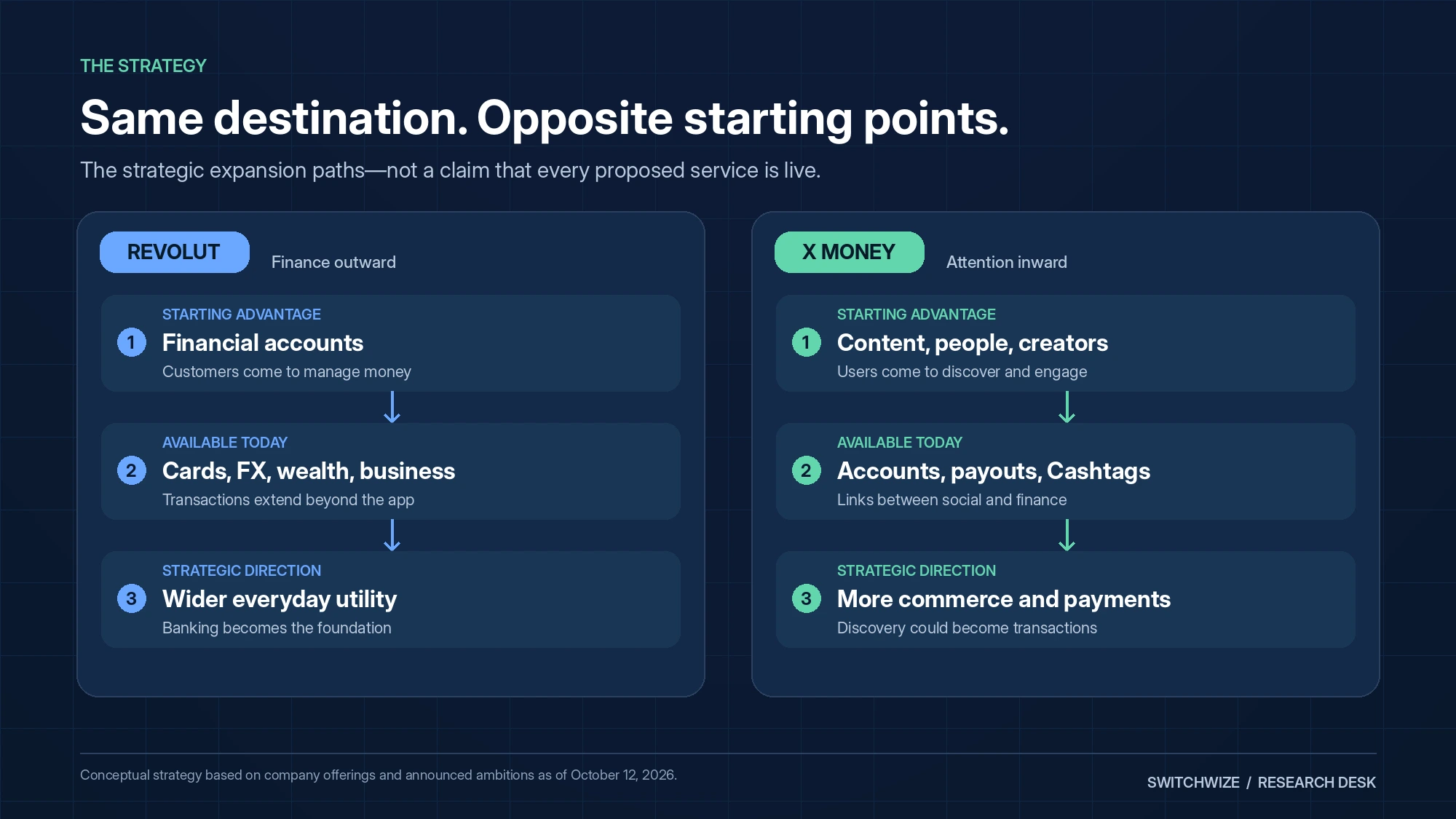
How the platforms expand
- Revolut’s starting point
- Financial accounts
- Revolut’s existing services
- Cards, foreign exchange, wealth and business payments; availability varies by market
- Revolut’s proposed direction
- Wider everyday services
- X’s starting point
- Content, people and creators
- X’s existing links to finance
- X Money accounts, U.S. creator payouts and partner Cashtags
- X’s proposed direction
- More commerce and payments
Conceptual strategy based on reviewed offerings and announced ambitions through October 12, 2026. Proposed services are not established capabilities.
How X could turn discovery into purchases
Consider a simple example.
A Revolut customer receives a paycheck, pays bills, buys groceries, exchanges currency before a holiday and invests part of the remaining balance.
Revolut can participate in several of those activities through one financial relationship.
Now consider an X user who follows a creator, discovers a product, asks questions about it and decides to make a purchase.
X already has a role in the discovery process. Its ambition is to participate in the payment as well.
Banks and payment companies generally become involved once the customer has decided to spend money. Social platforms can influence what customers decide to buy in the first place.
But influence does not guarantee a transaction.
A user who researches a product on X might still purchase it on Amazon, pay with an Apple wallet and fund the purchase through an account at JPMorgan Chase.
Each company has participated in a different part of the customer's decision.
For X to capture more financial activity, it needs to reduce the distance between discovery and purchase while giving both consumers and merchants reasons to transact through its platform.
That is a more demanding task than adding a payment button.
The limits of X Money’s incentive math
X Money's 6% advertised yield and 3% cashback are attractive benefits. They may also be expensive to sustain.
A $10,000 balance earning 6% APY would produce approximately $600 in interest over a year, assuming the rate remained unchanged.
A customer spending $12,000 annually on eligible purchases at 3% cashback would receive another $360.
Together, those benefits would total about $960 a year before subscription fees and taxes, assuming full-year eligibility.
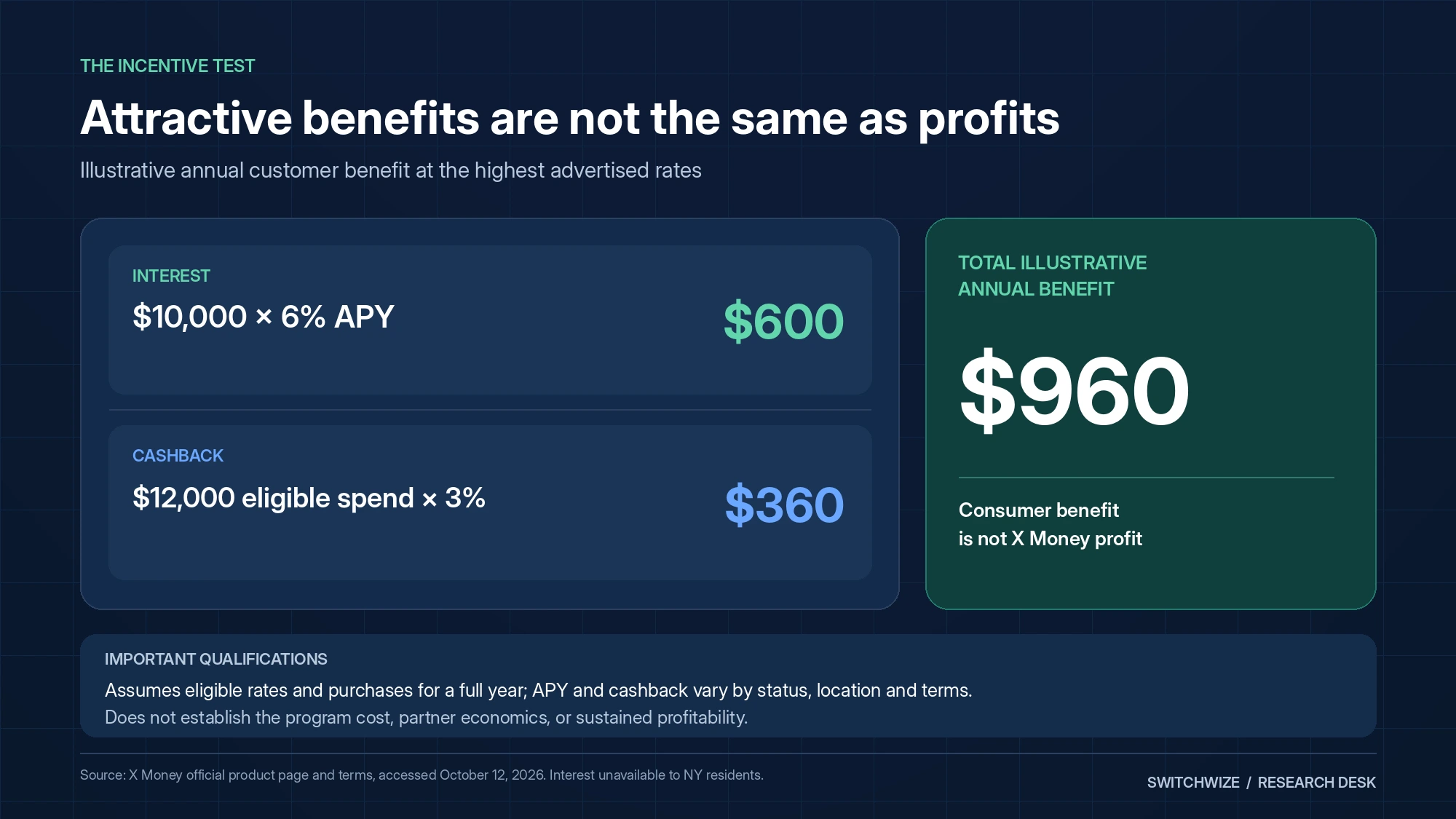
Illustrative annual customer benefit
- Interest: $10,000 × 6% APY
- $600
- Cashback: $12,000 eligible purchases × 3%
- $360
- Total before fees and taxes
- $960
Assumes a full year at the highest advertised eligible rates. Before subscription fees and taxes. New York residents receive no interest. Cashback eligibility and terms apply. Customer benefit does not establish X Money profit, partner economics or program cost.
This is a gross illustration before subscription fees and taxes. It assumes unchanged rates, a constant $10,000 balance and full-year eligibility. It is not a forecast or an estimate of X’s program cost.
Deposit earnings, payment revenue, merchant arrangements, subscriptions or promotional spending must ultimately support the benefits. X has not disclosed sufficient information to assess the profitability of these offers or how the economics are shared with its banking partners.
This does not mean the strategy is unsustainable. A promotional offer can make sense if it attracts customers who remain active and profitable over time.
But the distinction between acquiring a customer and earning money from that customer matters.
Revolut provides a useful benchmark because its financial performance is already visible.
Its reported revenue comes from several services, with substantial payment volumes and pretax profit.
Comparable X Money financial results were not found in the reviewed sources.
Until they are, claims that X will dominate consumer payments remain forecasts rather than conclusions supported by operating evidence.
Banking licenses and financial partners
Revolut has spent years obtaining banking licenses and developing the infrastructure needed to operate across multiple markets.
In March 2026, its UK bank began operating after completing the regulator’s restricted startup phase.
In its September 3 announcement, Revolut reported conditional approval from the U.S. Office of the Comptroller of the Currency for a national bank. Further approvals are required before its proposed U.S. bank can open, with the company targeting 2027.
These licenses create opportunities to offer more banking products directly, including deposits and lending, while providing greater control over the financial relationship.
They also bring capital requirements, regulatory oversight and operating responsibilities.
X has chosen a different approach.
Its partnership with Cross River Bank allows it to provide banking services without becoming a bank itself.
That offers a faster route to market, but X remains dependent on financial partners for important parts of the product and its economics.
Neither approach guarantees success.
Revolut must demonstrate that its international model can compete effectively in the United States. X must persuade people who use a social platform to trust it with recurring payments, income and meaningful balances.
Those are different challenges, and neither should be underestimated.
What the AI assistants can do
Both companies see artificial intelligence as an important part of their future.
In its April 9 announcement, Revolut introduced AIR, an AI assistant that can answer questions about spending, provide investment information, help manage subscriptions and perform certain account-related tasks.
Its advantage is access to financial context within the Revolut ecosystem.
If a customer asks where their money went last month, Revolut can draw on relevant account transactions.
X's Grok has a different opportunity.
It can help users understand topics being discussed on the platform, research companies and discover products or services.
Connecting that experience to financial transactions could eventually make X more useful for commerce.
But there is an important distinction between what is possible and what has been launched.
Revolut has introduced AI capabilities connected to specific financial tasks. X has brought payment and brokerage-related features into its broader platform, but a fully autonomous Grok-powered financial assistant that independently executes payments and investments is not an established public capability.
The larger question is whether AI makes customers more willing to entrust a platform with their money, or simply makes it easier to move between several financial providers.
Owning the AI conversation does not necessarily mean owning the financial relationship.
Measures of a recurring financial business
The two businesses are not yet competing on equal terms.
Revolut has a large international financial customer base, established revenue and a growing collection of banking licenses.
X has a major social platform and a relatively new U.S. financial offering.
Over the next two years, five measures will provide a clearer picture of their progress:
1. Primary account adoption. How many users receive recurring income and pay ordinary bills through each platform?
2. Transaction frequency. How often do people actually use the financial services, rather than simply engage with the app?
3. Retained balances. Do customers keep money in their accounts after introductory benefits or other incentives have changed?
4. Merchant adoption. Can the platforms capture purchases from businesses, not just transfers between users?
5. Sustainable revenue. How much income remains after rewards, transaction costs, fraud losses and partner fees?
These are more useful measures than registered accounts or social-media impressions.
They tell us whether a platform has built a recurring financial business rather than simply adding another feature.
What each company still needs to prove
Revolut has shown that a digital financial platform can become a large, profitable business. It now wants to move further into technology and everyday services.
X has shown that a social platform can bring together information, communities and creators. It now wants to turn more of those interactions into commerce and financial transactions.
But neither company has yet recreated the full commercial ecosystem that made WeChat successful in China.
Revolut has deeper financial relationships but does not control where most consumer purchases originate.
X has a role in discovery and social interaction but has not yet demonstrated the same depth of financial relationships or comparable financial profitability.
For now, Revolut is much further ahead as a financial business. X may have an advantage in the part of commerce that comes before a payment: helping people discover what they want to buy.
The outcome will depend less on which company adds the most features and more on which can establish habits that customers choose to maintain.
The test of a super app is not how much activity takes place inside it. It is how much of that activity becomes recurring, economically sustainable business.
Sources and further reading
- Revolut, FY2025 Financial Results, March 2026
- Reuters, Revolut's Ambition Beyond Banking, October 9, 2026
- Revolut, AIR AI Assistant, April 2026
- X Money, Official Product and Terms
- Cross River, X Money Banking Partnership, July 2026
- Interactive Brokers, Cashtags Integration, September 2026
SwitchWize Research Desk. Independent analysis based on publicly available disclosures through October 12, 2026. Illustrative financial calculations are not forecasts. Product availability, rates and eligibility may change.
For consumer account decisions, our X Money review and subscription break-even analysis separate the advertised rate from its conditions and costs.