- Card balances grew at a 14.5% yearly pace in September 2026, the Federal Reserve said on November 6. Revolving credit reached $1,368.5 billion.
- One month can mislead. Balances fell at a 4.4% pace in August, and July through September together grew 4.1%, about the same as earlier in 2026.
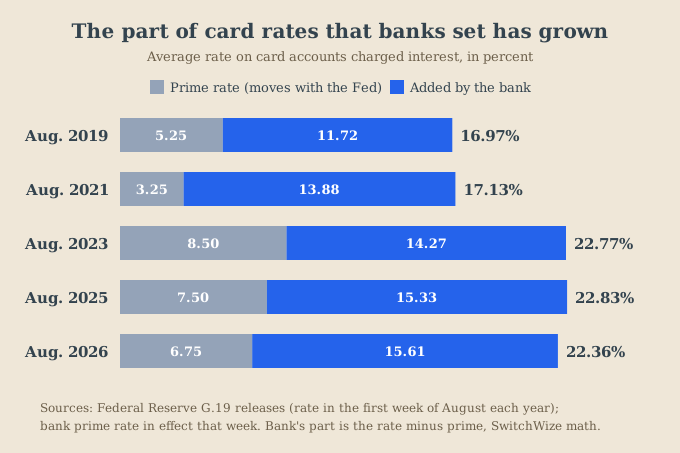
- The bigger change is the rate. Banks charged 22.36% on card accounts with a balance in early August 2026. Of that, 15.61 percentage points was the bank's own add-on above the prime rate, a base rate that moves with the Fed. In 2019 the add-on was 11.72 points.
- On a $5,000 balance, the part the bank sets now costs about $781 a year, up from about $586 in 2019. The Fed's September rate hike added about $12.50 a year.
Take a borrower we'll call Delphine. She is an illustration, not a real person. She is 38 and carries $5,000 on one credit card. In September her car needed $900 of work, and it went on the card. She pays a little more than the minimum each month.
Her balance is part of the national total the Fed tracks. The Federal Reserve said on November 6 that card balances grew fast in September. But one month of growth is not the main thing raising her bill.
What the Fed's September report showed
The Federal Reserve publishes a monthly report on consumer credit, called G.19. The November 6 report covered September.
Revolving credit, which is mostly credit card balances, grew at a 14.5% yearly pace in September. It reached $1,368.5 billion, up $16.3 billion from August. The figures are adjusted for normal seasonal swings, such as holiday shopping.
A yearly pace means the growth if September's change went on for 12 months. The actual one-month rise was about 1.2%. PYMNTS also reported the 14.5% figure.
Other debt, mostly car and student loans, grew at a 3.6% pace. All consumer credit grew at a 6.4% pace.
Why one month can mislead
Card balances swing a lot from month to month. In August, the same report shows, they fell at a 4.4% pace. In July they grew at a 2.4% pace.
Put the three months together and balances grew at a 4.1% pace in the third quarter. That is close to the first quarter, at 4.2%, and the second, at 4.9%. Over the full year to September, balances rose about 4.3%.
Big single months have happened before. In September 2021, revolving credit grew at an 11.8% pace, the Fed reported then. September's number is also a first estimate. The Fed often revises these figures in later reports.
There is one more limit. The Fed's balance figure includes people who pay their card in full every month. Some of September's rise may be spending that gets paid off, not debt that lingers.
Card rates are much higher than in 2019
The same G.19 report includes a survey of card rates at commercial banks, taken four times a year, in the first week of February, May, August and November. In August 2026, the average rate on card accounts charged interest was 22.36%.
In August 2019 it was 16.97%, the Fed reported then. On Delphine's $5,000, that gap is about $270 a year if her balance stays flat.
- Rate
- 16.97%
- Interest a year on $5,000
- about $849
- Rate
- 17.13%
- Interest a year on $5,000
- about $857
- Rate
- 22.77%
- Interest a year on $5,000
- about $1,139
- Rate
- 22.83%
- Interest a year on $5,000
- about $1,142
- Rate
- 22.36%
- Interest a year on $5,000
- about $1,118
The 2026 figure came before the Fed raised rates on September 16. Since then, SwitchWize has recorded a 0.25-point rise in the lowest listed rate on 54 cards it tracks. On $5,000, a quarter point is about $12.50 a year.
A card rate is the prime rate plus the bank's part
Most card rates have two parts. The first is the prime rate, a base rate banks use that moves with the Fed. The second is an amount the bank adds on top. Your card agreement calls it the margin.
The Fed controls the first part. The bank controls the second. So we split each year's average rate into those two parts. We took the Fed's average and subtracted the prime rate in effect that same week.
- Prime rate
- 5.25%
- Bank's part
- 11.72 points
- Bank's part a year on $5,000
- about $586
- Prime rate
- 3.25%
- Bank's part
- 13.88 points
- Bank's part a year on $5,000
- about $694
- Prime rate
- 8.50%
- Bank's part
- 14.27 points
- Bank's part a year on $5,000
- about $714
- Prime rate
- 7.50%
- Bank's part
- 15.33 points
- Bank's part a year on $5,000
- about $767
- Prime rate
- 6.75%
- Bank's part
- 15.61 points
- Bank's part a year on $5,000
- about $781
Prime is higher now than in 2019, by 1.5 points. The bank's part is higher by 3.89 points, more than twice as much. On $5,000, that is about $195 a year more going to the bank's part.
Our 2023 figure matches an outside count. The Consumer Financial Protection Bureau, a federal agency, found in 2024 that the average margin, the bank's part, reached 14.3 percentage points in 2023. It was 9.6 points in 2013, the agency said.
Why banks add more than they used to
Card debt has no house or car behind it. If a borrower stops paying, the bank usually cannot take anything back. The bank's part pays for that risk, plus its costs and profit.
The CFPB argued that the bank's part grew faster than risk did. It said the share of cardholders with low credit scores stayed fairly steady. It estimated that larger margins earned big card companies about $25 billion in extra interest in 2023.
Banks dispute that. The Consumer Bankers Association, a trade group for banks, said the CFPB's claim about steady credit scores "simply isn't true," CNBC reported.
Both sides can be partly right. Our split does not show why the bank's part grew. It shows only that it grew, and by how much.
What our numbers do not show
The Fed's rate is an average across many accounts at commercial banks. Your own rate depends on your card and credit history. Rates at credit unions and some card companies are not in this survey.
Our split uses one week's average rate and one prime rate. Some cards add a fixed rate, not prime plus a margin. The dollar figures assume a flat balance for a year. They also leave out interest charged on past interest, so the real cost runs a little higher.
The balance figures before 2026 are as the Fed first printed them. Later revisions can shift them.
Ways to lower what you pay
The Fed's next meeting is December 8 and 9. A hike would add about another $12.50 a year on $5,000. The bank's part already costs Delphine about $781 a year. Here are steps that work on that larger part.
- Ask for a lower rate. Some card companies will lower a rate when a customer asks. It costs nothing to call.
- Move the balance to a 0% card. A balance transfer card charges no interest for a set time. Most charge a fee of 3% to 5% of the balance. On $5,000, that is $150 to $250.
- Pay more than the minimum. Minimum payments are set low, so a balance can last for years. Our guide to the minimum payment trap shows the math.
You can compare card rates and 0% offers on our balance transfer cards page.
How Delphine cut her interest cost
Delphine called her card company first and asked for a lower rate. They said no. She then moved the $5,000 to a card with no interest for 15 months and a 3% fee. The fee was $150.
She now pays $344 a month, enough to clear the $5,150 before the 15 months end. At her old rate, the same $5,000 would have cost about $1,118 in interest over a year. She also put the old card in a drawer, so new charges do not land at 22%.
Sources
- Federal Reserve, Consumer Credit, G.19, released Nov. 6, 2026 (September 2026 data: revolving credit $1,368.5 billion, growth rates by month and quarter, card rate 22.36% for August 2026, 22.83% for August 2025)
- Federal Reserve, G.19 releases of Nov. 7, 2019 (card rate 16.97%), Nov. 5, 2021 (card rate 17.13%; September 2021 revolving growth 11.8%) and Nov. 7, 2023 (card rate 22.77%)
- Bank prime rate in effect the first week of August: 5.25% (2019), 3.25% (2021), 8.50% (2023), 7.50% (2025), 6.75% (2026), Federal Reserve H.15 series
- PYMNTS, Revolving Debt Jumps as Spending Strains Credit Cards, November 2026 (14.5%)
- Consumer Financial Protection Bureau, Credit card interest rate margins at all-time high, Dan Martinez and Margaret Seikel, Feb. 22, 2024
- CNBC, Credit card interest rates are at record highs, Feb. 23, 2024 (Consumer Bankers Association response)
- SwitchWize card tracking, APR changes recorded Sept. 18 to Nov. 8, 2026 (dataset)
Frequently Asked Questions
Did credit card debt go up in September 2026?
What is the average credit card interest rate in 2026?
Why are credit card interest rates so high?
How much does a $5,000 card balance cost a year?
What can I do about a high credit card rate?
The 5-minute money briefing
One email per week. The biggest changes in savings, money market, checking and CD rates.
Send me the weekly SwitchWize rate briefing: the biggest changes in savings, money market, checking and CD rates. Unsubscribe in one click. We never share your address.
Act on this: today's top cards


Ranked by SwitchWize's composite score. Some partner links may compensate SwitchWize.
Editorial review
What changed since the last update
Was this guide helpful?
Found an inaccurate, outdated, or missing claim? Report a correction. We verify reports against the relevant source before changing a guide or ranking.
