The short answer
- In November 2026 the average savings account paid 0.38% and top accounts averaged 4.32%, a 3.94-point gap.
- On $25,000 that gap is worth $985 a year before tax, in every state.
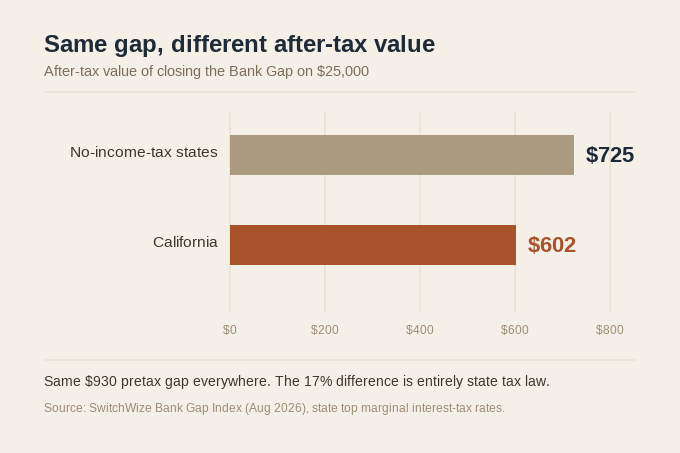
- State income tax decides how much you keep: about $768 in Texas or Florida, $637 in California.
The Bank Gap is the difference between what the average savings account pays and what the top accounts pay. It is one national number, because anyone in any state can open the same online accounts. What changes from state to state is how much of the extra interest you keep after tax.
This report ranks all 50 states by that after-tax value. See the live Bank Gap Index for this month's national figures. Figures last verified recently.
How big is the bank gap right now?
SwitchWize's Bank Gap Index for November 2026:
- November 2026
- 0.38%
- November 2026
- 4.32%
- November 2026
- 3.94 percentage points
- November 2026
- $985 a year
- November 2026
- About $768 a year
- November 2026
- About $637 a year
The gap has stayed near four points all year. It was 3.72 points in August and 3.86 points in October.
Why is the same gap worth different amounts in each state?
Savings interest counts as regular income. The federal government taxes it everywhere. Most states tax it too, at their own rates.
So moving to a better account gives every saver the same $985 before tax. A saver in a state with no income tax pays only federal tax on it. A California saver also pays up to 13.3% to the state.
Example (hypothetical numbers): You move $10,000 from an average account to a top account. The gap of 3.94 points adds $394 a year before tax. In the 22% federal bracket:
- State tax on interest
- 0%
- You keep
- $307.32
- State tax on interest
- 13.3%
- You keep
- $254.92
Both savers win by moving. The Texas saver simply keeps about $52 more of the same gain.
How much is closing the bank gap worth in every state?
The table applies a 22% federal bracket and each state's 2026 top income tax rate to the $985 pretax value on $25,000.
- State
- Alaska
- 2026 top income tax rate
- 0%
- After-tax value
- $768
- State
- Florida
- 2026 top income tax rate
- 0%
- After-tax value
- $768
- State
- Nevada
- 2026 top income tax rate
- 0%
- After-tax value
- $768
- State
- New Hampshire
- 2026 top income tax rate
- 0%
- After-tax value
- $768
- State
- South Dakota
- 2026 top income tax rate
- 0%
- After-tax value
- $768
- State
- Tennessee
- 2026 top income tax rate
- 0%
- After-tax value
- $768
- State
- Texas
- 2026 top income tax rate
- 0%
- After-tax value
- $768
- State
- Washington
- 2026 top income tax rate
- 0%
- After-tax value
- $768
- State
- Wyoming
- 2026 top income tax rate
- 0%
- After-tax value
- $768
- State
- Arizona
- 2026 top income tax rate
- 2.5%
- After-tax value
- $744
- State
- North Dakota
- 2026 top income tax rate
- 2.5%
- After-tax value
- $744
- State
- Ohio
- 2026 top income tax rate
- 2.75%
- After-tax value
- $741
- State
- Indiana
- 2026 top income tax rate
- 2.95%
- After-tax value
- $739
- State
- Louisiana
- 2026 top income tax rate
- 3%
- After-tax value
- $739
- State
- Pennsylvania
- 2026 top income tax rate
- 3.07%
- After-tax value
- $738
- State
- Kentucky
- 2026 top income tax rate
- 3.5%
- After-tax value
- $734
- State
- Arkansas
- 2026 top income tax rate
- 3.7%
- After-tax value
- $732
- State
- Iowa
- 2026 top income tax rate
- 3.8%
- After-tax value
- $731
- State
- North Carolina
- 2026 top income tax rate
- 3.99%
- After-tax value
- $729
- State
- Mississippi
- 2026 top income tax rate
- 4%
- After-tax value
- $729
- State
- Michigan
- 2026 top income tax rate
- 4.25%
- After-tax value
- $726
- State
- Colorado
- 2026 top income tax rate
- 4.4%
- After-tax value
- $725
- State
- Utah
- 2026 top income tax rate
- 4.45%
- After-tax value
- $724
- State
- Oklahoma
- 2026 top income tax rate
- 4.5%
- After-tax value
- $724
- State
- Nebraska
- 2026 top income tax rate
- 4.55%
- After-tax value
- $723
- State
- West Virginia
- 2026 top income tax rate
- 4.58%
- After-tax value
- $723
- State
- Missouri
- 2026 top income tax rate
- 4.7%
- After-tax value
- $722
- State
- Illinois
- 2026 top income tax rate
- 4.95%
- After-tax value
- $720
- State
- Georgia
- 2026 top income tax rate
- 4.99%
- After-tax value
- $719
- State
- Alabama
- 2026 top income tax rate
- 5%
- After-tax value
- $719
- State
- South Carolina
- 2026 top income tax rate
- 5.21%
- After-tax value
- $717
- State
- Idaho
- 2026 top income tax rate
- 5.3%
- After-tax value
- $716
- State
- Kansas
- 2026 top income tax rate
- 5.58%
- After-tax value
- $713
- State
- Montana
- 2026 top income tax rate
- 5.65%
- After-tax value
- $713
- State
- Virginia
- 2026 top income tax rate
- 5.75%
- After-tax value
- $712
- State
- New Mexico
- 2026 top income tax rate
- 5.9%
- After-tax value
- $710
- State
- Rhode Island
- 2026 top income tax rate
- 5.99%
- After-tax value
- $709
- State
- Maryland
- 2026 top income tax rate
- 6.5%
- After-tax value
- $704
- State
- Delaware
- 2026 top income tax rate
- 6.6%
- After-tax value
- $703
- State
- Connecticut
- 2026 top income tax rate
- 6.99%
- After-tax value
- $699
- State
- Maine
- 2026 top income tax rate
- 7.15%
- After-tax value
- $698
- State
- Wisconsin
- 2026 top income tax rate
- 7.65%
- After-tax value
- $693
- State
- Vermont
- 2026 top income tax rate
- 8.75%
- After-tax value
- $682
- State
- Massachusetts
- 2026 top income tax rate
- 9%
- After-tax value
- $680
- State
- Minnesota
- 2026 top income tax rate
- 9.85%
- After-tax value
- $671
- State
- Oregon
- 2026 top income tax rate
- 9.9%
- After-tax value
- $671
- State
- New Jersey
- 2026 top income tax rate
- 10.75%
- After-tax value
- $662
- State
- New York
- 2026 top income tax rate
- 10.9%
- After-tax value
- $661
- State
- Hawaii
- 2026 top income tax rate
- 11%
- After-tax value
- $660
- State
- California
- 2026 top income tax rate
- 13.3%
- After-tax value
- $637
About the top rates. Each rate is the highest bracket in that state's 2026 tax schedule. Several of them apply only to very high incomes. Massachusetts charges 5% on most income and 9% only on income above about $1 million. California's 13.3% includes a 1% surtax on income above $1 million. Maryland's top 6.5% bracket also starts at $1 million. Most savers in those states keep more than the table shows.
Is savings interest taxed by my state?
In most states, yes. Bank interest is added to your income on your state return. These nine states have no income tax on interest: Alaska, Florida, Nevada, New Hampshire, South Dakota, Tennessee, Texas, Washington and Wyoming.
Interest from U.S. Treasury bills, notes and bonds is different. Federal law bars states from taxing it. That makes Treasury bills and Treasury-only money market funds worth a look in high-tax states.
Should savers in high-tax states use a Treasury fund?
It is worth comparing. California, Hawaii, New York, New Jersey and Oregon sit at the bottom of the ranking because they have the highest top rates. In those states, a Treasury-only money market fund can keep more of its yield after tax. That can hold even when its stated rate is a bit lower.
There are trade-offs. A money market fund is an investment, not a bank deposit, so it is not FDIC-insured. Selling it usually takes until the next business day.
Our money market fund vs. high-yield savings guide works through the after-tax math. The Treasury money market fund setup guide shows how to hold one in an ordinary brokerage account. To run your own numbers, use the state tax impact on cash yield calculator.
What are the limits of this ranking?
This ranking uses a $25,000 balance and a 22% federal bracket. Your own balance scales the dollar figures up or down. The order of the states stays the same at any balance, because it depends only on tax rates.
It also uses each state's single top rate, not its full set of brackets. A saver below the top bracket pays less state tax than shown. Local income taxes, such as New York City's, are not included. Treat the table as a ranking of which states take more or less, not a personal tax figure.
Methodology
The national figures (0.38% average, 4.32% average of top accounts, 3.94-point gap, $985 on $25,000) come from SwitchWize's Bank Gap Index, November 2026 monthly snapshot. Each state's 2026 top income tax rate comes from SwitchWize's state tax dataset. The same data runs our paycheck and income tax calculators, and it is built from each state's published 2026 tax schedule. The after-tax value subtracts a 22% federal bracket and the state's top rate from the $985 pretax value. It does not reflect state deductions, lower brackets or local taxes.
How we source this. National rate-gap figures are SwitchWize's own tracked Bank Gap Index data; state tax rates are SwitchWize's own maintained dataset, cross-referenced against published state tax law. See our methodology and editorial team. This report was written by a former bank treasurer and reviewed by the SwitchWize Research Desk. We take no payment for organic rankings or citations.
Sources
Sources
- SwitchWize, Bank Gap Index: national savings-rate gap, monthly snapshot.
- State top marginal interest-tax rates: SwitchWize's own maintained state-tax dataset, cross-referenced against published state tax law.
- IRS, Topic No. 403, Interest received: bank savings interest is taxable income on a federal return.
- 31 U.S.C. 3124, exemption from state and local taxation: the federal law that bars states from taxing interest on U.S. Treasury obligations.
- FDIC, Understanding deposit insurance: what FDIC insurance covers at a bank.
Figures are current as of the November 2026 Bank Gap Index snapshot and change monthly as rates move. State tax rates change with state law. This page is informational, not tax or financial advice. Free to cite with attribution to SwitchWize.
Frequently Asked Questions
What is the Bank Gap?
Does the bank gap differ by state?
Which states get the most from closing the bank gap?
Which states lose the most to taxes?
Is savings interest taxed by my state?
How did SwitchWize calculate the after-tax value?
The 5-minute money briefing
One email per week. The biggest changes in savings, money market, checking and CD rates.
Send me the weekly SwitchWize rate briefing: the biggest changes in savings, money market, checking and CD rates. Unsubscribe in one click. We never share your address.
Act on this: today's top savings



Ranked by SwitchWize's composite score. Some partner links may compensate SwitchWize.
Editorial review
What changed since the last update
Was this guide helpful?
Found an inaccurate, outdated, or missing claim? Report a correction. We verify reports against the relevant source before changing a guide or ranking.

Adeesh Setya is Head of Financial Research & Principal at SwitchWize, with 25+ years of experience in deposits, treasury management, banking products, and financial services. He previously served as Treasurer at Merrill Lynch Bank USA and Morgan Stanley Bank USA, where he managed bank funding, deposits, and interest-rate risk. He writes on Federal Reserve policy, the general marketplace for banking products, and what they mean for savers and consumers.
Available for on-record interviews, background briefings, and custom data cuts.
research@switchwize.com