- Helping aging parents is two problems: paying for care that runs $74,400 to $127,750 a year, and doing it without draining your own retirement.
- Fund care in order: the parent's income, then their assets, then long-term care insurance, then Medicaid, with your contribution capped and last.
- Get the power of attorney and healthcare directive signed early, and understand the Medicaid five-year lookback before moving any assets.
The phone call comes, and suddenly you are managing not just your own finances but a parent's, under pressure and often in a crisis. The instinct is to write checks, to make it work, to spend whatever it takes. That instinct, unstructured, is how a parent's care quietly consumes an adult child's retirement. Helping aging parents well is a financial task with a right order and a few decisions that matter enormously, and this playbook lays them out. This page is reviewed by the SwitchWize Editorial Team; the figures are sourced below with dates. Understanding how to pay for aging parents care in the right sequence protects both their wellbeing and your financial future.
The numbers
Elder care is among the largest expenses a family will ever face:
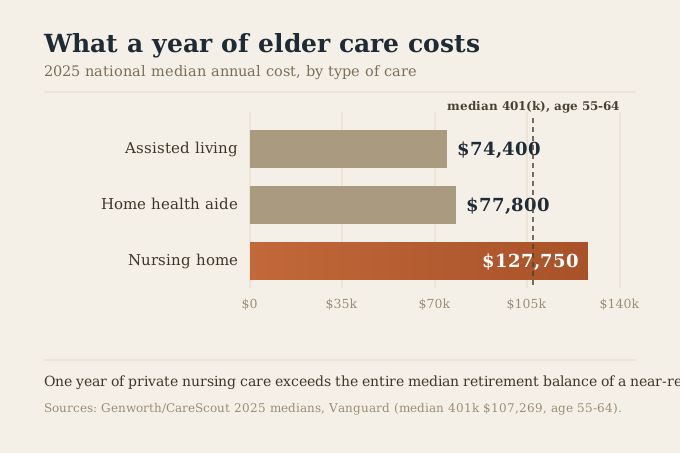
- Assisted living. About $74,400 a year ($6,200 a month) at the 2025 national median, per Genworth and CareScout.
- Home care. A home health aide runs roughly $77,800 a year.
- Nursing home. A private room is about $127,750 a year, a semi-private room about $111,000.
- The unpaid share. Family caregiving, done largely by adult children, was worth an estimated $1.01 trillion in 2024, per AARP.
The scale is the point. One year of private nursing care, about $127,750, exceeds the median 401(k) balance of a worker aged 55 to 64, roughly $107,269 per Vanguard. Extended care is not an expense a typical retirement can simply absorb, which is why the order in which it is funded matters so much.
- Value
- ~$74,400/yr
- Source
- Genworth / CareScout
- Value
- ~$77,800/yr
- Source
- Genworth / CareScout
- Value
- ~$127,750/yr
- Source
- Genworth / CareScout
- Value
- ~$1.01 trillion
- Source
- AARP
- Value
- 5 years (60 months)
- Source
- Federal / state
The reframe: two problems, funded in order
The mistake families make is treating this as one problem, "pay for Mom's care," when it is two: fund the care, and protect the caregiver's own finances. Solved together and out of order, the second problem quietly becomes a crisis, as an adult child drains savings and pauses their own retirement to cover costs that outrun any single household.
The solution is a funding order, a waterfall that draws on resources in sequence so the parent's care is covered and the caregiver's retirement is shielded until genuinely last. The stages below run from the parent's own money to public programs, with your contribution capped and deliberate.
The funding waterfall
Draw on each source before moving to the next:
- The parent's income. Social Security and any pension cover the base of ongoing care first.
- The parent's liquid assets. Taxable savings and investments fund the gap, drawn down in a tax-aware way.
- Long-term care insurance. If a policy exists, activate its benefits, understanding the daily caps and elimination period.
- Medicaid. For those who qualify after a proper spend-down, Medicaid covers long-term care, subject to the five-year lookback below.
- Capped family contribution. Only after the above, and only as a deliberate, limited amount that does not touch your own retirement.
The cash earmarked for near-term care should not sit idle. A parent's savings waiting to fund care can earn a competitive rate meanwhile:
Project long-term care cost after inflation, benefits, insurance, family support, current savings, protected reserves, and the monthly funding gap before retirement or caregiving decisions.
Enter a local care-cost estimate for the expected start of care; this tool then grows cost during the care period.
Total Projected Cost
$206,026
Use this result as one input in your broader Money Map, not as a one-off number.
What to do
Build this care plan in Money Map
Pre-tax estimates. For illustration only — not financial advice.
Protect your own retirement
This is the stage everyone skips, and it is the whole reason for the order above. Caregiving falls disproportionately on adult children, and the reflex to fund a parent's care by pausing your own retirement contributions or tapping your 401(k) surrenders years of compounding you will never get back. The state of American retirement savings is already thin; caregiving is one of the quiet forces that keeps it that way.
The protections are concrete. Cap any contribution you make at a number that does not touch your retirement accounts. Share the cost with siblings explicitly rather than by default. Explore tax breaks for supporting a dependent parent, and in some cases being formally paid as a caregiver. A parent would rarely want their care funded at the cost of their child's future.
Compare the full household impact of family caregiving against paid care, including lost income, benefits, out-of-pocket costs, respite budget, savings runway, and monthly funding gap.
Estimate employer health, retirement match, PTO, or other benefits lost by reducing hours.
Mileage, supplies, home safety items, meals, and other out-of-pocket costs.
Cash support from family, the care recipient, benefits, or reimbursements.
Gross Monthly Caregiving Cost
$2,550
Use this result as one input in your broader Money Map, not as a one-off number.
What to do
Build this in Money Map
Pre-tax estimates. For illustration only — not financial advice.
The documents and the Medicaid clock
Two moves have to happen early, before a crisis, and both are often missed. First, the legal documents: a financial power of attorney and a healthcare directive, signed while your parent still has capacity. Without them, a family may have to seek court guardianship, which is slow, costly, and public. Our power of attorney guide covers the essentials, alongside an updated will.
Second, the Medicaid five-year lookback. Medicaid covers long-term care only for those with limited assets, and it reviews the prior five years (60 months) of transfers, penalizing gifts made to qualify. Any protective planning, certain trusts or transfers, generally must happen at least five years before care is needed. That single rule is why the time to plan is years ahead, not in the emergency, and why an elder-law attorney is often worth the cost.
What varies
Costs and options differ widely. Care runs far higher in some states than others, and home care, assisted living, and nursing care serve different needs at different prices. Not every parent will need intensive nursing care; many age at home with modest support. Family dynamics, a parent's own wishes, and the presence or absence of insurance all reshape the plan.
None of that changes the framework. Whatever the specifics, funding care in order, protecting the caregiver's retirement, and getting the documents and Medicaid timing right are what separate a hard situation handled well from one that damages two generations. Adjust the amounts; keep the order.
Methodology
The care-cost figures are the 2025 Genworth and CareScout national medians, which vary significantly by state and setting. The unpaid-caregiving value is AARP's 2024 estimate. The Medicaid lookback is the federal five-year (60-month) rule, applied in nearly every state, with details that vary. The comparison to the median 401(k) balance uses Vanguard's figure for ages 55 to 64. Elder law and Medicaid rules are state-specific and change; an elder-law attorney and a financial planner are worth engaging for a specific situation. Nothing here is individualized legal, tax, or financial advice.
How we source this. Care costs come from Genworth and CareScout, the caregiving value from AARP, the balance comparison from Vanguard, and the Medicaid rules from federal and state law, all cited with dates. See our methodology and editorial team. We take no payment for organic rankings.
Sources
- Genworth and CareScout, 2025 Cost of Care data: assisted living, home care, and nursing-home medians.
- AARP, Valuing the Invaluable (2024 caregiving value): ~$1.01 trillion.
- Vanguard for the median 401(k) balance by age; federal and state Medicaid long-term-care lookback rules.
Figures are current as of mid-2026 and vary by state and setting. This page is informational, not legal, tax, or financial advice. Free to cite with attribution to SwitchWize.
What to Do Now
Frequently Asked Questions
How much does elder care cost in 2026?
In what order should I pay for a parent's care?
What is the Medicaid five-year lookback?
How do I pay for a parent's care without ruining my own retirement?
What documents do I need for an aging parent?
The 5-minute money briefing
One email per week. New rates, fed moves, and what to actually do about them.
No spam. Unsubscribe anytime.
Answer a few questions about your situation and goals. Money Map points you to the highest-value next step across savings, mortgage, cards, and debt.
Editorial review
What changed since the last update
Was this guide helpful?
Found an inaccurate, outdated, or missing claim? Report a correction. We verify reports against the relevant source before changing a guide or ranking.
