- The paradox: needs-based benefits disqualify anyone with over $2,000 in assets, so money left directly to a person with a disability can strip away their support.
- The way around it: an ABLE account lets them save up to $20,000 a year tax-free, and a special needs trust can hold unlimited assets without counting against benefits.
- Add a letter of intent and a guardianship plan for age 18, and direct wills and beneficiaries into the trust, not to the person.
Planning for a family member with a disability begins with a paradox that feels almost designed to punish care. You know the person will face a lifetime of extra costs, often reaching into the millions, and every instinct says to save for them and leave them well provided for. But the benefits they rely on, Supplemental Security Income and Medicaid, disqualify anyone with more than $2,000 to their name. So the ordinary act of saving for your child, done directly, can take away the support that makes their life work. The good news, and it is real, is that a set of tools exists for exactly this situation, and they let you provide generously without ever tripping the limit. This playbook is those tools. This page is reviewed by the SwitchWize Editorial Team; the figures are sourced below with dates. Special needs financial planning requires understanding these tools and how they work together to protect your family member's eligibility and future.
The reframe: the savings paradox, and the way around it
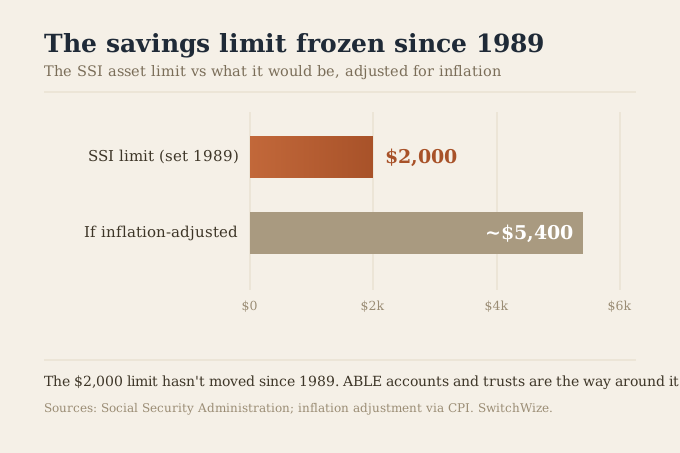
The core problem is a rule most families discover at the worst possible moment. SSI and Medicaid are needs-based, so they impose an asset limit of $2,000 for an individual. Exceed it and the person can lose benefits and services often worth far more than the money that triggered the loss. Money in the person's own name, an inheritance, a well-meaning gift from grandparents, a life-insurance payout naming them directly, all of it counts, and all of it can do harm.
The reframe is that the answer is never to leave a person with a disability with nothing. It is to route resources into vehicles the rules do not count: an ABLE account and a special needs trust. These exist precisely so that families can save and give freely for a loved one's benefit without disqualifying them. The rest of this playbook is how to use them.
The $2,000 trap
It is worth sitting with how arbitrary the number is. The $2,000 asset limit was set in 1989 and has never been adjusted for inflation. Had it kept pace, it would exceed $5,000 today. A person with a disability who saves a few thousand dollars, or inherits a modest sum, can be pushed over a line drawn more than three decades ago and left unchanged since.
That is the constraint every other tool works around. Understanding it is the foundation, because it explains why the normal advice, save in the child's name, name them as your beneficiary, is exactly wrong here, and why the specialized structures below are not optional refinements but the core of the plan.
The ABLE account
The first tool to set up is usually an ABLE account, a tax-advantaged account created so an eligible person with a disability can save without losing benefits. In 2026, up to $20,000 a year can go in, from the person, family, friends, or a trust, and it grows tax-free when used for qualified disability expenses like housing, transportation, education, and health care.
The crucial feature is that balances up to $100,000 do not count against the SSI asset limit, and ABLE funds are disregarded for Medicaid. That gives the person their own accessible savings, under their control where appropriate, without endangering eligibility. For many families it is the simplest, most immediately useful step.
The special needs trust
For larger sums, inheritances, and long-term provision, the central tool is a special needs trust (SNT). It holds assets for the person's benefit without those assets counting against eligibility, because legally the trust owns them, not the person. A trustee spends the money to supplement, not replace, government benefits, covering therapies, equipment, companionship, travel, and the many quality-of-life needs that SSI and Medicaid do not.
A third-party SNT, funded by parents, grandparents, and others, is the heart of special-needs estate planning. Relatives can leave inheritances or life insurance to the trust rather than to the person directly, providing generously without disqualifying them. Because SNTs are often funded with a life-insurance policy, sizing that coverage is part of the plan:
Estimate a flat-rate federal estate-tax and liquidity scenario from user-entered assumptions.
Current-year federal estate tax exemption per individual (confirm on irs.gov)
Enter assets actually available to the estate after ownership, beneficiary, debt, and administrative considerations
Flat-Rate Estate Tax Scenario
$2,000,000
Use this result as one input in your broader Money Map, not as a one-off number.
What to do
Compare brokerage accounts
Pre-tax estimates. For illustration only — not financial advice.
The letter of intent and guardianship
Two non-account pieces complete the plan. The first is a letter of intent: not a legal document, but an invaluable one, in which you describe the person's routines, preferences, medical needs, likes and dislikes, and your hopes for their care, so future trustees and caregivers can carry on as you would. It is the most personal and most overlooked part of the plan.
The second is legal decision-making at adulthood. When a person with an intellectual or developmental disability turns 18, parents lose automatic authority, so guardianship, conservatorship, or a less restrictive alternative like supported decision-making must be arranged in advance. Coordinate your will and every beneficiary designation to direct assets into the trust rather than to the person, so nothing passes to them directly by accident. Keep any near-term family cash reserved for care somewhere safe and earning:
A note on cost, and on getting help
The stakes are large because the costs are. Raising a child with a disability is estimated to require about 17.8% more income a year, out-of-pocket medical costs run at roughly twice the rate of other families, and a lifetime of care for some conditions reaches well into the millions of dollars. That is the scale these tools are built to handle, and it is why getting the structure right matters so much.
This is also an area where professional help pays for itself. Special-needs planning sits at the intersection of tax law, estate law, and public-benefits rules that vary by state and change over time, so a special-needs-planning attorney and a financial advisor experienced in this area are worth engaging. This playbook is a map for working with them, not a substitute.
Methodology
The $2,000 SSI asset limit is the current federal figure, unchanged since 1989; the inflation-adjusted comparison uses standard CPI adjustment and is illustrative. ABLE contribution and balance figures are the 2026 amounts, which are tied to the annual gift-tax exclusion and can change. Special-needs-trust and benefit rules are federal but interact with state Medicaid rules that vary. The cost-of-care figures are published estimates that vary widely by condition and circumstance. Nothing here is individualized financial, tax, or legal advice, and special-needs planning genuinely requires a qualified attorney.
How we source this. Benefit limits come from the Social Security Administration, ABLE figures from the ABLE program rules, trust mechanics from estate-planning practice, and cost estimates from published research, all cited with dates. See our methodology and editorial team. We take no payment for organic rankings.
Sources
- Social Security Administration, SSI asset limits ($2,000 individual, $3,000 couple), unchanged since 1989.
- ABLE National Resource Center, 2026 ABLE contribution limits and the $100,000 SSI exclusion.
- Estate-planning practice on special needs trusts, and published estimates on the added cost of raising a child with a disability.
Figures are current as of mid-2026 and vary by state and situation. This page is informational, not financial, tax, or legal advice. Free to cite with attribution to SwitchWize.
Frequently Asked Questions
Why can't I just leave money or savings to my child with a disability?
What is an ABLE account and how does it work?
What is a special needs trust?
How much does it cost to raise a child with a disability?
What documents do special needs families need beyond financial accounts?
The 5-minute money briefing
One email per week. New rates, fed moves, and what to actually do about them.
No spam. Unsubscribe anytime.
Answer a few questions about your situation and goals. Money Map points you to the highest-value next step across savings, mortgage, cards, and debt.
Editorial review
What changed since the last update
Was this guide helpful?
Found an inaccurate, outdated, or missing claim? Report a correction. We verify reports against the relevant source before changing a guide or ranking.
