- A new baby reorders your finances, and the internet's first instruction, open a 529, is out of order: protection comes before saving.
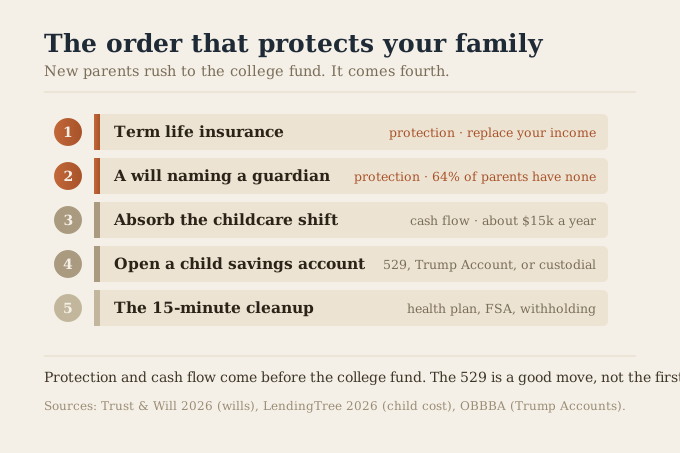
- The real first-year priority is term life insurance and a will naming a guardian, then absorbing the childcare cash shift, then a savings account.
- The 2026 numbers: raising a child to 18 runs about $303,418, childcare averages roughly $15,000 a year, and only 36% of parents with young children have a will.
The financial advice a new parent hears first is almost always the same: open a 529 and start saving for college. It is well meant, and it is out of order. A college fund does nothing if your income vanishes and your family has no way to replace it, and it does nothing about who raises your child if you cannot. Those are the risks that arrive the day the baby does, and they are the ones almost no first-year checklist leads with. This playbook fixes the sequence. It puts the money moves in the order that actually protects a family, with the 2026 numbers behind each one. This page is reviewed by the SwitchWize Editorial Team; the figures are sourced below with dates. Follow this new parent money checklist to prioritize protection and cash flow before any college savings account.
The reframe: protect before you save
Every dollar decision in the first year sorts into one of two jobs: protecting what you have, or building what you want. New parents are told to start building, a college fund, a savings habit, before they have protected the thing everything else depends on, which is the income and the guardianship. That is the error. Protection is not more virtuous than saving; it is more urgent, because the risks it covers are catastrophic and immediate, while the cost of starting the college fund three months later is trivial.
So the sequence below is deliberate. The first two moves are protection. The third stabilizes cash flow. Only the fourth is the savings account everyone wanted to start with. Followed in order, the plan is calm. Started in the middle, it leaves the biggest holes open.
Move 1: Term life insurance
If someone depends on your income, you need life insurance, and a new baby is the clearest version of that dependence. The job is simple: if you die, the policy replaces the income your family was counting on for the years until your child is grown. Term life insurance, which covers a fixed period such as 20 or 30 years, is the standard choice because it is inexpensive and matches exactly the window your family is financially dependent on you. A healthy parent in their 30s can often cover a large policy for the price of a streaming subscription or two a month.
A common starting point is roughly 10 to 12 times your annual income, then adjusted for savings you already have, debts like a mortgage, and big future costs such as childcare and college. Whole and universal policies exist, but for the core need, replacing income during the dependent years, term is almost always the right tool. Size it with our how much life insurance you need guide, then use the calculator.
Build an education-only DIME-style starting estimate including caregiving, final expenses, existing coverage, and survivor resources.
Funeral, medical, legal, and estate-settlement cash needs
Childcare or household services that survivors would need to replace, including for a non-working caregiver
Present-value estimate of survivor benefits or other resources you intentionally want to offset
Coverage Needed (net of existing)
$2,130,000
Use this result as one input in your broader Money Map, not as a one-off number.
What to do
Compare Term Life Quotes
Pre-tax estimates. For illustration only — not financial advice.
Move 2: A will that names a guardian
This is the move most parents skip and the one with the worst downside. Only about 36% of parents with minor children have a will, per Trust & Will's 2026 report, which means most families are leaving the question of who raises their child, if both parents cannot, to a court applying state default rules. A will lets you name a guardian and a backup yourself. It is the cheapest, highest-leverage estate move a new parent can make, and for a straightforward situation it does not require a lawyer.
While you are there, name or update beneficiaries on retirement accounts and the new life insurance policy, since those pass outside the will. If your situation is more complex, a home, blended family, or a child with special needs, a revocable trust may be worth the added step. For most new parents, though, a simple will naming a guardian is the whole job, and the what a will does guide covers it.
Move 3: Absorb the cash-flow shift
A baby's budget shock is not diapers. It is childcare, which averages roughly $15,000 a year nationally for center-based care in 2026, and closer to $17,000 for infants, often more than 20% of a family's income, per care-cost data. Over 18 years, the total cost of raising a child now runs about $303,418, even after tax credits, per LendingTree, and the biggest slice arrives early.
That means two adjustments. First, rebuild the monthly budget around the childcare line before it starts, not after. Second, enlarge your cash buffer: a household with a dependent should hold a bigger emergency fund than it did before, and any parental-leave gap needs its own dedicated cash. That near-term cash should not sit idle earning nothing.
The cash you are holding for leave, childcare, or a larger emergency fund can earn a competitive rate while it waits. These are current high-yield savings rates, live as of today, all at FDIC-insured banks:
Build a first-year baby cash target from one-time costs, monthly expenses, current savings, and an explicit contingency before the due date.
Nursery furniture, car seat, stroller, and other gear
Diapers, formula, childcare, and other ongoing expenses
Optional cushion for price changes and costs not captured in the two spending estimates.
Total First-Year Cost
$13,860
Use this result as one input in your broader Money Map, not as a one-off number.
What to do
Compare high-yield savings rates
Pre-tax estimates. For illustration only — not financial advice.
Move 4: Now choose a savings account
With protection and cash flow handled, the college fund finally earns its place, and in 2026 there are three main vehicles, each with a different job.
- 529 plan. Built for education. Contributions grow tax-free for qualified education costs, many states add a deduction, and unused balances can now roll to a Roth IRA within limits. The default for most college saving. See best 529 plans.
- Trump Account. New under the One Big Beautiful Bill Act. Children born 2025 to 2028 get a $1,000 federal seed, the account grows tax-deferred, and families can add up to $5,000 a year. Broader than education but with its own rules.
- Custodial account (UTMA or UGMA). Fully flexible, no spending restriction, but the child takes control at the age of majority, and it can weigh more heavily against financial aid.
The right choice depends on your goal, your state's tax benefit, and how much control you want to keep. Our Trump Account versus 529 versus custodial comparison lays out the tradeoffs, and the calculator projects a 529's growth.
Project a 529 balance against a future college-cost target, estimate a state-deduction scenario, and check current gift-tax and five-year superfunding guardrails.
Use this for a bonus, grandparent gift, or five-year 529 superfunding contribution.
Use the portion you want the 529 to cover, not necessarily the full published cost.
Enter 0 if your state gives no 529 deduction or credit.
1 = one donor, 2 = married couple or two donors using separate annual exclusions.
Projected 529 Balance at 18
$88,048
Use this result as one input in your broader Money Map, not as a one-off number.
What to do
Build this in Money Map
Pre-tax estimates. For illustration only — not financial advice.
Move 5: The 15-minute cleanup
The last move is a short list of updates that are easy to forget in the newborn haze. Add the child to your health insurance within the enrollment window, which is usually 30 to 60 days from birth. Check whether a dependent-care FSA fits, since it can shelter thousands in childcare costs pre-tax. Confirm your tax withholding reflects the new dependent and the child tax credit. And revisit disability insurance, which protects the far more likely event of a parent being unable to work, not just death. None of these takes long, and each closes a small gap the first four moves do not.
Methodology
This playbook sequences standard new-parent financial moves by urgency, putting catastrophic-risk protection ahead of long-horizon saving; the order is our editorial framework, not a legal requirement. The cost-of-raising-a-child figure ($303,418 to age 18) is LendingTree's 2026 analysis, and childcare averages are drawn from 2026 care-cost surveys; both vary widely by state and care type, so treat them as national benchmarks rather than your number. The will statistic is from Trust & Will's 2026 estate-planning report. Trump Account details reflect the One Big Beautiful Bill Act as implemented in 2026. Insurance and account choices depend on individual circumstances; nothing here is individualized financial, legal, or tax advice.
How we source this. Cost and childcare figures come from named 2026 studies, the will data from Trust & Will's 2026 report, and account rules from the underlying law and our maintained cluster guides, all cited with dates. See our methodology and editorial team. We take no payment for organic rankings. This is one of 18 life-event money playbooks — see the full list for whatever else is happening in your life right now.
Sources
- LendingTree, cost of raising a child study (2026): $303,418 to age 18.
- Care.com, 2026 cost of care report on childcare averages.
- Trust & Will, 2026 estate-planning report: share of parents with a will.
- Trump Account provisions under the One Big Beautiful Bill Act; see our maintained Trump Account versus 529 versus custodial guide.
Figures are current as of mid-2026 and vary by state and situation. This page is informational, not financial, legal, or tax advice. Free to cite with attribution to SwitchWize.
Frequently Asked Questions
What should new parents do with their money first?
How much does it cost to raise a child in 2026?
How much life insurance do new parents need?
What is a Trump Account and how does it compare to a 529?
Do new parents really need a will?
Answer a few questions about your situation and goals. Money Map points you to the highest-value next step across savings, mortgage, cards, and debt.
Editorial review
What changed since the last update
Was this guide helpful?
Found an inaccurate, outdated, or missing claim? Report a correction. We verify reports against the relevant source before changing a guide or ranking.
