- A single parent carries two-income household costs on one income (median income about $41,300 for single-mother families vs about $133,000 for married couples with children), so the plan must be built for that, not borrowed from advice for couples.
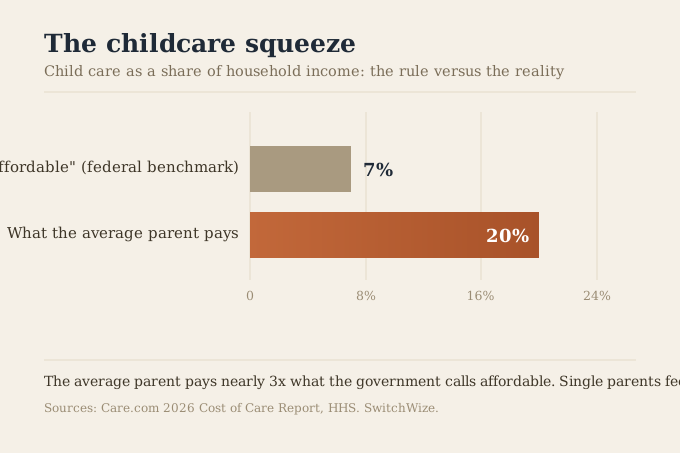
- Attack childcare first: it eats about 20% of income versus the 7% deemed affordable, and a 2026 Dependent Care FSA shelters up to $7,500 of it pre-tax, stacked with the childcare credit.
- One income makes an oversized emergency fund and term life plus disability insurance non-negotiable, and Head of Household filing plus the Child Tax Credit and EITC are worth thousands often left unclaimed.
Almost all personal-finance advice quietly assumes two adults: two incomes to draw on, two people to share the childcare, one to fall back on if the other loses a job. A single parent has none of that, and yet faces the same, or higher, costs of raising a child. The result is a household running two-income expenses on one income, where the median single-mother family with children earned about $41,300 in 2024, against about $133,000 for married-couple families with children. That structural squeeze is not a reason for despair; it is a reason to plan differently, around the specific pressure points that one-income parenting creates. This playbook does exactly that: it goes straight to childcare, income protection, and the tax breaks built for your situation, because those three are where the money actually is. This page is reviewed by the SwitchWize Editorial Team; the 2026 figures are sourced below with dates. Effective single parent money management starts with understanding these three pillars and how they compound your financial resilience.
The reframe: one income, two-income costs
The single fact that should shape everything is this: a single parent runs a household built for two incomes on one. In 2024 the median single-mother family with children earned about $41,300, and the median single-father family about $61,600, versus about $133,000 for married-couple families with children, per the Census Bureau's American Community Survey. That is not a budgeting failure; it is arithmetic. Costs designed to be split are being carried alone.
This reframe changes the priorities. For a two-earner couple, optimizing investments or credit card rewards might be the highest-value move. For a single parent, the highest-value moves are almost always the same three: cut the childcare bill, protect the one income, and claim the credits built for your household. The rest of this playbook takes them in that order, because that is the order of the money.
Attack childcare first, because it is the biggest bill
Childcare is usually the largest single expense, and the numbers are stark: the average parent spends about 20% of household income on it, nearly three times the 7% the federal government considers affordable, per the Care.com 2026 Cost of Care Report, with full-time infant care at a daycare center commonly running $15,000 to $20,000 a year. For a single parent, that bill lands on one income. See what it is doing to your budget:
Build a childcare cash-flow estimate across all children and compare it with monthly after-tax household income.
Include months billed to hold a place even when care is not used.
Total Monthly Childcare Cost
$1,200
Use this result as one input in your broader Money Map, not as a one-off number.
What to do
Compare high-yield savings rates
Pre-tax estimates. For illustration only — not financial advice.
The offset most single parents miss
Here is the highest-return move available to a working single parent, and it is routinely skipped: the Dependent Care FSA. For 2026 the limit rose to $7,500 per household, up from $5,000, under the OBBBA, per EBC. Because the money comes out before income and payroll tax, you pay for childcare you were going to pay for anyway with dollars that were never taxed, saving your full combined tax rate on the amount: roughly $1,800 to $2,500 a year on the full $7,500, depending on your bracket and state tax.
It stacks with the Child and Dependent Care Credit, which covers a share of up to $3,000 of expenses for one child or $6,000 for two or more. Starting in 2026, OBBBA raised that share to as much as 50% at lower incomes, stepping down as income rises, though FSA dollars reduce the expenses you can count for the credit, so the two must be coordinated rather than double-counted. The catch is that your employer must offer the FSA and adopt the higher limit, and it is elected only at open enrollment, so this is a move to plan ahead for. Model the pre-tax saving:
Decide how much to elect for a Dependent Care FSA after tax savings, employer contributions, plan fees, dependent-care credit tradeoffs, reimbursement timing, and uncovered childcare costs.
Use the current-year household election limit from your employer plan or irs.gov.
Employer dependent-care contributions usually count against the annual plan limit.
Many higher-income households use 20%; confirm eligibility and phaseouts before filing.
Cash set aside to front childcare bills while waiting for reimbursements.
Employee DCFSA Election
$5,000
Use this result as one input in your broader Money Map, not as a one-off number.
What to do
Build a family cash-flow plan
Pre-tax estimates. For illustration only — not financial advice.
One income means income protection is not optional
Now the risk math, which is where single-parent planning diverges most sharply from the standard advice. With two earners, the loss of one income is a serious blow but not a collapse. With one earner, the only paycheck is a single point of failure, and that reshapes two priorities.
First, the emergency fund should be larger. The usual three-to-six-month guideline assumes a fallback that a single parent often does not have, so aim for the higher end or beyond, six months or more of essential expenses, built in stages and kept in a high-yield savings account. Second, and most overlooked, protect the income itself. Term life insurance replaces your income for your children if you die, and for a single parent it is essential because there is no second earner to continue the household. Disability insurance matters even more, because you are far more likely to be unable to work for a period than to die young, and a disability stops the only paycheck while the parenting continues. Size the coverage your household would actually need:
Build an education-only DIME-style starting estimate including caregiving, final expenses, existing coverage, and survivor resources.
Funeral, medical, legal, and estate-settlement cash needs
Childcare or household services that survivors would need to replace, including for a non-working caregiver
Present-value estimate of survivor benefits or other resources you intentionally want to offset
Coverage Needed (net of existing)
$2,130,000
Use this result as one input in your broader Money Map, not as a one-off number.
What to do
Compare Term Life Quotes
Pre-tax estimates. For illustration only — not financial advice.
Claim the tax breaks built for your household
The tax code contains real money for single parents, and a surprising amount goes unclaimed. Start with filing status: most single parents should file as Head of Household, not Single, which brings a larger standard deduction ($24,150 versus $16,100 for 2026) and wider brackets, lowering the tax on the same income. On top of that sit credits that stack: the Child Tax Credit, worth up to $2,200 per qualifying child for 2026 (up to $1,700 of it refundable), the Child and Dependent Care Credit for childcare, and, at lower and moderate incomes, the Earned Income Tax Credit, a substantial refundable credit for working families.
A working single parent with childcare costs can often combine all four, Head of Household, the Child Tax Credit, the childcare credit, and the EITC, in the same year, worth thousands of dollars. Because eligibility depends on income and the number of children, run your own numbers or use software that checks each credit, since missing even one means leaving a real refund unclaimed. Two of the biggest are worth checking directly: the Child Tax Credit and the Earned Income Tax Credit.
The honest counterargument
Single-parent situations vary enormously, and no single playbook fits all of them. A higher-earning single parent may not qualify for the EITC and may find the childcare credit phased down, while a lower-income parent may lean more on public programs, child support, and family support than on FSAs and insurance. A Dependent Care FSA only helps if your employer offers it and you have taxable income to shelter. And the emotional and time pressures of solo parenting are real constraints that a spreadsheet cannot capture, which is exactly why automation and set-and-forget choices matter more here than anywhere else.
But the core structure holds across the range. One income carrying two-income costs means the leverage is concentrated in a few places: the childcare bill and its offsets, the protection of the single income, and the credits the tax code already provides. A parent who gets those three right, even while everything else stays imperfect, has done the highest-value financial work available to them, and given their children a far more stable foundation than the raw income figure alone would suggest.
Methodology
Figures: 2024 median family income for families with children of about $41,300 (single mother), $61,600 (single father), and $133,000 (married couple) from the Census Bureau's 2024 American Community Survey (table B19126), average childcare spending near 20% of income against a 7% federal affordability benchmark, daycare-center infant care of roughly $15,000 to $20,000 a year, and the 2026 Dependent Care FSA limit of $7,500 per household under the OBBBA. The Child and Dependent Care Credit applies to up to $3,000 of expenses for one child or $6,000 for two or more, reduced by FSA contributions. The 2026 Head of Household standard deduction ($24,150) and Child Tax Credit ($2,200, $1,700 refundable) are from IRS Revenue Procedure 2025-32. FSA savings estimates assume a 12% or 22% federal bracket, 7.65% payroll tax, and about 4% state tax. Credit eligibility and amounts depend on income and the number of children. Insurance and emergency-fund guidance are general planning norms, not individualized advice. Nothing here is individualized financial, tax, or legal advice.
How we source this. Childcare figures come from the Care.com 2026 Cost of Care Report and income figures from the Census Bureau, the FSA and credit figures from IRS rules and OBBBA analysis, all cited with dates. See our methodology and editorial team. We take no payment for organic rankings.
Sources
- Care.com, 2026 Cost of Care Report: childcare as a share of income (about 20% versus the 7% affordability benchmark) and center-based infant-care costs.
- EBC and tax-practitioner analysis of the 2026 Dependent Care FSA limit of $7,500 under the OBBBA, and the interaction with the Child and Dependent Care Credit.
- U.S. Census Bureau, 2024 American Community Survey 1-year estimates, table B19126 (median family income by family type with own children under 18), and IRS rules on Head of Household filing, the Child Tax Credit, and the EITC (Rev. Proc. 2025-32).
Figures are current for 2026 and set by rules and market costs that change. This page is informational, not financial, tax, or legal advice. Free to cite with attribution to SwitchWize.
What to Do Now
Frequently Asked Questions
How can a single parent afford childcare?
What is a Dependent Care FSA and how much does it save?
How big should a single parent's emergency fund be?
Does a single parent need life and disability insurance?
What tax breaks do single parents qualify for?
The 5-minute money briefing
One email per week. New rates, fed moves, and what to actually do about them.
No spam. Unsubscribe anytime.
Answer a few questions about your situation and goals. Money Map points you to the highest-value next step across savings, mortgage, cards, and debt.
Editorial review
What changed since the last update
Was this guide helpful?
Found an inaccurate, outdated, or missing claim? Report a correction. We verify reports against the relevant source before changing a guide or ranking.
