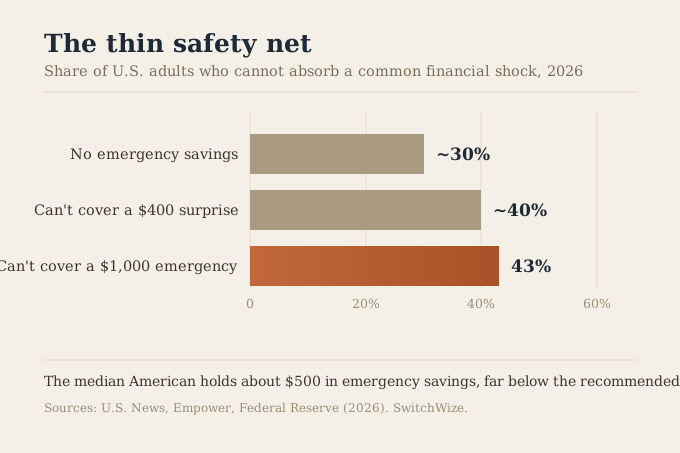
- Nearly one in three Americans has no emergency savings at all, and the median balance is about $500, a small fraction of the three-to-six-month cushion the standard advice calls for.
- Close to 40% could not cover a $400 emergency from savings, and about 43% could not cover a $1,000 one; the gap is structural, not careless.
- The way through is an order of operations: a $1,000 starter fund in a separate high-yield savings account, automated every payday, before the full target.
The emergency fund is the most recommended and least funded item in personal finance. Everyone has heard the advice, three to six months of expenses, and almost no one has met it. The result is a country where a single car repair or medical bill tips millions of households into debt, not because they were reckless, but because the buffer that was supposed to catch them was never there. This report lays out what American emergency savings actually look like in 2026, why the shortfall is better understood as structural than as a failure of willpower, and the practical sequence that turns an intimidating target into something a normal household can actually reach. This page is reviewed by the SwitchWize Editorial Team; the figures are sourced below with dates. The emergency savings statistics 2026 detailed below reveal the scope of this structural challenge across American households today.
The reframe: a structural gap, not a willpower gap
The instinct is to read these numbers as a story about discipline: if people just budgeted better, they would have a fund. That framing is mostly wrong, and it leads to advice that does not work. The median emergency-savings balance is about $500, and nearly one in three Americans has none at all. Those numbers are not evenly distributed by temperament; they are distributed by income and stability. The households most exposed to surprise expenses and income shocks are also the ones with the least room left after essentials, so the people who most need a buffer are the least able to build one. Notably, 73% of adults report at least doing okay financially overall, per the same Fed survey that produces the $400-expense figure below -- a reminder that "financially struggling in general" and "can't cover a specific $400 shock from savings" measure related but distinct things.
That is why the useful question is not "why won't people save?" but "what is the smallest step that actually changes the outcome?" The rest of this report answers that, because a fund does not have to be complete to be transformative. The moment a household has even a partial buffer, the next surprise stops automatically becoming debt.
What Americans actually have
Start with the distribution, because the averages hide the story. 37% of Americans could not cover a $400 emergency with cash or its equivalent, per the Federal Reserve's own Survey of Household Economics and Decisionmaking (SHED) -- pulled live from FRED, not a rounded figure transcribed from a secondary source -- and about 43% could not cover a $1,000 one, per U.S. News. The near-equality of those two figures is itself revealing: for a large share of households, the difference between a $400 shock and a $1,000 shock barely matters, because neither is affordable from savings.
Among the minority who do have a dedicated emergency fund, the median is about $5,000, but that figure was reported as roughly half the prior year's, per Empower. The buffer is not just thin; for many it is shrinking, as several years of higher prices pushed households to spend down what slack they had. Measure your own target against your essential expenses, not a round number:
Build an emergency-fund target from entered essential expenses and coverage months, including a zero-contribution safeguard.
How much you can set aside each month
Target Emergency Fund
$21,300
Use this result as one input in your broader Money Map, not as a one-off number.
What to do
Compare top emergency fund accounts
Pre-tax estimates. For illustration only — not financial advice.
The generation gap
Emergency savings also split sharply by age, which points to why the problem compounds. Boomers hold a median of about $2,000 in emergency savings, while Gen Z holds about $400, a five-fold difference. Some of that is simply time and income: older workers have had decades to accumulate and typically earn more. But it also means the youngest households, the ones with the least stable incomes and the thinnest credit histories, are entering their most financially fragile years with the smallest buffers, so an early setback is more likely to become debt that follows them.
The takeaway is not that young people are worse with money; it is that the safety net is weakest exactly where income volatility is highest. That combination is what turns ordinary surprises into lasting debt, and it is why building even a small fund early pays off out of proportion to its size.
The order of operations that works
The reason the standard advice fails is that it leads with the hardest number. Told to save three to six months of expenses, a household with $500 hears an impossible target and does nothing. The fix is to change the order:
- A starter fund first. Aim for $1,000 or one month of essential expenses, not the full cushion. This alone absorbs most common surprises, a car repair, a medical copay, a broken appliance, without borrowing.
- Then high-interest debt. Once a small buffer exists, attack credit card balances, since interest above 20% usually costs more than savings earn. The starter fund is what keeps a new surprise from undoing that payoff.
- Then the full cushion. With high-interest debt controlled, build toward three-to-six months, kept in a separate high-yield savings account near 4% so it stays liquid and roughly keeps pace with inflation.
The starter-fund-first sequence is behavioral as much as financial, because without any buffer the next expense becomes new debt, which is the exact cycle the fund is meant to break. Decide the fund-versus-debt split for your own numbers:
Decide where your next dollar should go: starter emergency fund, employer 401(k) match, high-interest debt, full emergency fund, or investing.
A starter buffer protects the next bill before aggressive debt payoff.
100% means dollar-for-dollar; 50% means fifty cents per dollar.
Percent of salary eligible for employer match.
Starter Buffer Gap
$2,000
Use this result as one input in your broader Money Map, not as a one-off number.
What to do
Build this plan in Money Map
Pre-tax estimates. For illustration only — not financial advice.
Set the target, then automate it
A fund only gets built if the saving is automatic, because a monthly decision to save loses to a monthly temptation to spend. The move that works is a fixed transfer on payday into a separate high-yield savings account, sized to a target you set once and then ignore. Automation is what lets a household reach a number that felt impossible when framed as a single lump sum, because a small, invisible transfer compounds into the buffer without ever requiring willpower in the moment. Pick a date and a dollar amount and let it run:
Estimate the monthly deposit needed for a goal using effective APY growth, current savings, and an already-funded safeguard.
Check your bank app or last statement
Required Monthly Savings
$784
Use this result as one input in your broader Money Map, not as a one-off number.
What to do
Find the best high-yield savings accounts
Pre-tax estimates. For illustration only — not financial advice.
The honest counterargument
The data has real limits, and it is worth stating them. Survey figures on emergency savings vary by how the question is asked, "do you have an emergency fund" is not the same as "could you find $400," and different surveys land on different numbers, so treat these as directional rather than precise. Some households rationally hold less cash because they have genuine alternatives, a well-managed line of credit, family support, or liquid investments they could tap, and for them a razor-thin savings balance is not the same crisis it is for someone with no fallback. And a $1,000 fund will not cover a job loss; the full three-to-six-month cushion exists for a reason.
But the caveats sharpen the conclusion rather than soften it. However you measure it, a large share of the country cannot absorb a small, common financial shock without borrowing, and the gap tracks income and stability more than it tracks discipline. The response that works is not exhortation to save more; it is a smaller first target, a separate account, and automation, which together turn an unreachable rule into a habit that quietly builds the buffer most people are told they should have but were never shown how to reach.
Methodology
Two figures on this page are live, not static citations: the share of adults who could not cover a $400 expense with cash (37%) and the share at least doing okay financially overall (73%) both come directly from the Federal Reserve's own Survey of Household Economics and Decisionmaking (SHED), added to FRED as a queryable series in June 2026 and fetched live by this report's underlying dataset -- not transcribed from a Bulletin PDF or a rounded third-party citation. Everything else is drawn from 2026 consumer-finance surveys and Federal Reserve household data: a median emergency-savings balance of about $500, nearly one in three adults with no emergency savings, about 43% unable to cover a $1,000 expense, a median of about $5,000 among those with a fund (reported as roughly half the prior year), and generational medians of about $2,000 for Boomers versus $400 for Gen Z. Survey methods and definitions differ, so the non-SHED figures are directional and rounded. The three-to-six-month guidance refers to essential expenses, not total spending. Nothing here is individualized financial advice.
How we source this. The $400-expense and doing-okay-financially figures come from the Fed's own live SHED series via FRED. Remaining emergency-savings figures come from published 2026 consumer surveys (U.S. News, Empower, Bankrate) and Federal Reserve household data, cited with dates. See our methodology and editorial team. We take no payment for organic rankings.
Sources
- Federal Reserve, Survey of Household Economics and Decisionmaking (SHED), via FRED: the live 37% who could not cover a $400 expense with cash, and the live 73% at least doing okay financially overall.
- U.S. News on the 2026 financial wellness survey: the share unable to cover a $1,000 emergency.
- Empower on emergency-savings research: the median balance of about $500 and the roughly $5,000 median among those with a fund.
- Bankrate and Federal Reserve household data on the share of Americans with no emergency savings and generational differences in emergency-savings balances.
- Machine-readable dataset: all figures on this page, with the two SHED-sourced figures updated whenever the Fed publishes a new wave.
Figures are drawn from 2026 surveys and are directional except where noted as a live Fed series. This page is informational, not financial advice. Free to cite with attribution to SwitchWize.
What to Do Now
Frequently Asked Questions
How much emergency savings does the average American have?
How much should I have in an emergency fund?
Why can't so many Americans cover a $400 emergency?
Should I build an emergency fund or pay off debt first?
Where should I keep my emergency fund?
The 5-minute money briefing
One email per week. New rates, fed moves, and what to actually do about them.
No spam. Unsubscribe anytime.
Answer a few questions about your situation and goals. Money Map points you to the highest-value next step across savings, mortgage, cards, and debt.
Editorial review
What changed since the last update
Was this guide helpful?
Found an inaccurate, outdated, or missing claim? Report a correction. We verify reports against the relevant source before changing a guide or ranking.
