- Handle the money in order: secure short-term cash first, since assets in a spouse's sole name can be locked in probate for a year or more.
- Claim Social Security survivor benefits strategically, and prepare for one of the two checks to stop.
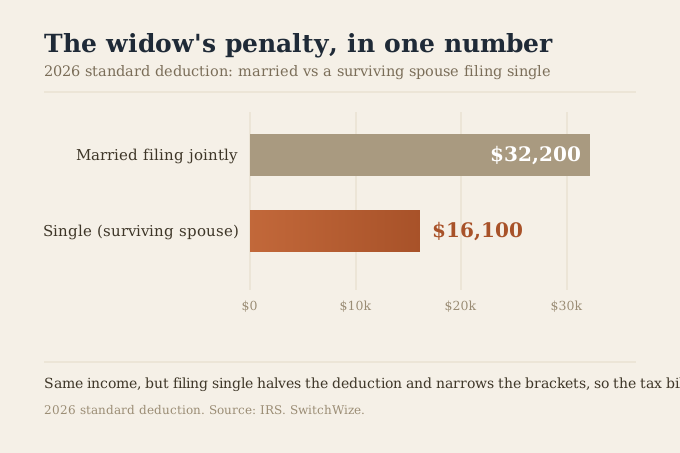
- Prepare for the widow's penalty: filing single next year halves the standard deduction and narrows brackets, so tax rises on the same income.
The period after losing a spouse is the worst possible time to make financial decisions, and it arrives with dozens of them. Some are genuinely urgent, many can wait, and a few are quiet traps that cost real money if handled wrong or in a rush. The kindest thing a guide can do is impose an order on that chaos, so the urgent things get done, the big things get delayed, and nothing important is missed. This playbook is that order. It is practical, not emotional, by design, because in the fog of grief a clear checklist is a form of relief. This page is reviewed by the SwitchWize Editorial Team; the figures are sourced below with dates. Use this surviving spouse financial checklist to work through each priority in order, without rushing decisions that can safely wait.
The reframe: financial triage, in order
Think of the financial side of a loss as triage: handle what is bleeding first, stabilize, and leave the reconstruction for later. The mistake is to try to fix everything at once, or worse, to make a large permanent decision, sell the house, move near family, in the first raw weeks. The steps below run from the genuinely urgent to the deliberately delayed. Working through them in order is what turns an impossible period into a manageable one.
First: liquidity and the probate lock
The first practical question is cash. Some of your money is immediately available and some is not, and the difference is how it was titled. Accounts held jointly, and accounts with you as the named beneficiary, pass to you directly and quickly. But assets in your spouse's sole name can be tied up in probate, the court process of settling an estate, which commonly runs well over a year. If too much of the household's cash sits in sole-name accounts, you can face a squeeze even while the estate is solvent.
So the first move is to secure short-term liquidity: identify what you can access now, order several death certificates (you will need them repeatedly), and make sure a few months of expenses are covered from available funds. Keep that cash somewhere safe and earning while the estate settles:
Estimate a flat-rate federal estate-tax and liquidity scenario from user-entered assumptions.
Current-year federal estate tax exemption per individual (confirm on irs.gov)
Enter assets actually available to the estate after ownership, beneficiary, debt, and administrative considerations
Flat-Rate Estate Tax Scenario
$2,000,000
Use this result as one input in your broader Money Map, not as a one-off number.
What to do
Compare brokerage accounts
Pre-tax estimates. For illustration only — not financial advice.
Claim Social Security survivor benefits, strategically
A surviving spouse is generally entitled to a survivor benefit based on the deceased's earnings record, averaging about $1,927 a month in 2026. Two things matter here. First, the household drops from two Social Security checks to one, so benefit income falls even as expenses hold. Second, there is often a strategy: you can sometimes claim one benefit, your own or the survivor benefit, now and switch to the larger one later, letting the bigger benefit grow. Because the optimal path depends on both earnings records and your age, this is worth analyzing rather than simply accepting the first benefit offered.
Compare claiming ages by projected lifetime value, then review the real-world factors that can change the answer.
Check ssa.gov/myaccount for your estimate
Choose a planning age for the comparison; this is not a longevity forecast.
Recommended claiming age
70.0
The highest projected lifetime value is claiming at 70, which is $91,200 more than claiming at 62 in this scenario.
What to do
You have 4 years until early claiming begins. Based on your planning age, claiming at 70 produces the highest projected lifetime value, $91,200 more than claiming at 62. Use the runway to decide whether you can afford to wait.
Pre-tax estimates. For illustration only — not financial advice.
The widow's penalty: the tax shift
This is the trap almost no one sees coming. In the year of death you can usually still file jointly. After that, unless a dependent child qualifies you for surviving-spouse status for up to two years, you file as a single, and the tax code treats a single very differently. The standard deduction drops from $32,200 to $16,100 for 2026, and the brackets are narrower, so the 22% and 24% rates begin at much lower income. The result is that the same income is taxed more, right when the household has also lost one Social Security check.
Knowing this in advance lets you plan for it: adjusting withholding, timing income and Roth conversions during the final joint-filing year, and budgeting for a higher tax bill. It is far cheaper to prepare for the widow's penalty than to be surprised by it at tax time.
Retitle, update, and delay the big decisions
With the urgent items handled, work through the updates over the following months. Retitle jointly held accounts and property into your name. Update beneficiaries on your own retirement accounts and life insurance, which likely still name your late spouse, and update your own will, powers of attorney, and healthcare directives. A clear net-worth statement helps you see where you now stand.
And delay the big, irreversible choices. Selling the home, relocating, and making large gifts or investments are best postponed for at least a year, both because grief impairs judgment and because some, like a home sale, carry timing rules that reward a deliberate decision over a rushed one. Stabilize first; restructure later.
A note on what varies
Every situation differs. The size and complexity of the estate, whether assets were titled to avoid probate, the presence of dependent children, the two spouses' earnings records, and state law all reshape the specifics. Some surviving spouses face a simple, mostly automatic transfer; others face a long probate and a complex estate.
What does not change is the value of order and of help. An estate attorney and a financial planner who works with survivors are worth engaging, and this playbook is a framework for working with them, not a replacement. Handle the urgent, delay the permanent, and give yourself time. Nothing important here has to be decided today.
Methodology
This playbook organizes the financial steps after a spouse's death by urgency; the sequence is our editorial framework, and specifics depend heavily on estate titling, state law, and family circumstances. The survivor-benefit figure is the 2026 Social Security average. The standard-deduction and bracket figures are the IRS's 2026 amounts for married-filing-jointly versus single filers; the surviving-spouse filing status has its own two-year rules tied to a dependent child. Probate timelines vary widely by state and estate. Nothing here is individualized legal, tax, or financial advice, and this is a situation where professional help is well worth the cost.
How we source this. Benefit figures come from the Social Security Administration, tax figures from the IRS 2026 amounts, and probate norms from estate-administration data, all cited with dates. See our methodology and editorial team. We take no payment for organic rankings.
Sources
- Social Security Administration, average survivor benefit for 2026 (about $1,927 a month).
- IRS, 2026 standard deduction and tax brackets: $32,200 married filing jointly versus $16,100 single, with narrower single-filer brackets.
- Estate-administration data on probate timelines, which average well over a year and vary by state.
Figures are current for 2026 and vary by state and situation. This page is informational, not legal, tax, or financial advice. Free to cite with attribution to SwitchWize.
What to Do Now
Frequently Asked Questions
What should I do financially right after my spouse dies?
How do Social Security survivor benefits work?
What is the widow's penalty?
Should I sell the house after my spouse dies?
What accounts and documents need updating after a death?
The 5-minute money briefing
One email per week. New rates, fed moves, and what to actually do about them.
No spam. Unsubscribe anytime.
Answer a few questions about your situation and goals. Money Map points you to the highest-value next step across savings, mortgage, cards, and debt.
Editorial review
What changed since the last update
Was this guide helpful?
Found an inaccurate, outdated, or missing claim? Report a correction. We verify reports against the relevant source before changing a guide or ranking.
