- Financially, divorce is the work of turning one shared money life into two separate ones, across six areas that each need untangling.
- The highest-stakes step is dividing retirement with a QDRO, which avoids the 10% penalty and immediate tax that a straight liquidation would owe.
- Separate credit and update beneficiaries: lenders and beneficiary forms do not follow the divorce decree, and skipping either can undo the settlement.
Whatever else a divorce is, in financial terms it is a specific and manageable task: turning one shared money life into two separate ones. That framing helps, because the financial side is the part of a divorce you can approach methodically even when the rest feels anything but. The mistakes that cause lasting harm are rarely the big contested ones; they are the quiet, procedural ones, an unfiled order, an unupdated form, a joint account left open, that surface years later. This playbook walks through the six areas that need untangling, in the order that protects you best. This page is reviewed by the SwitchWize Editorial Team; the figures are sourced below with dates. Use this divorce financial checklist to ensure nothing falls through the cracks during your separation.
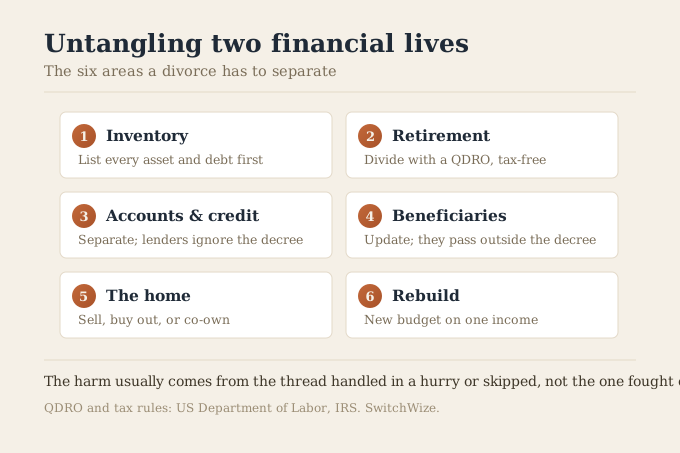
The reframe: divorce is a financial untangling
A marriage weaves two financial lives together: shared accounts, jointly owned property, commingled retirement, mutual debts, and beneficiary designations naming each other. A divorce has to reverse that weaving, thread by thread, and the goal is to do it completely, so that nothing shared is accidentally left connecting the two of you afterward. The six areas below are those threads. Work through them deliberately and the financial separation is clean; leave one half-done and it can quietly undo the rest.
Inventory everything first
Before anything is divided, everything must be mapped. Make a complete list of all assets and all debts, both jointly and individually held: checking and savings, investment and retirement accounts, the home and other property, vehicles, and every loan, credit card, and line of credit. You cannot divide fairly what you have not fully seen, and forgotten or hidden accounts are the source of most post-divorce surprises. A careful net-worth statement for the marriage is the foundation the settlement is built on.
See your net worth today, then project where it could be by your target age.
Checking, savings, money market, and other liquid cash
401(k), IRA, brokerage, HSA investments, and similar accounts
Home value minus mortgage balance; leave $0 if you rent
Cars, valuables, business equity, and other assets you would count
Credit cards, student loans, auto loans, personal loans, and mortgage balance not already netted into home equity
The age you want to project toward
New money invested in brokerage, retirement, or similar growth accounts
Long-term annual return assumption for invested assets and new contributions
Extra debt payoff or scheduled principal reduction that improves net worth
Projected net worth
$273,062
Projected net worth is $273,062, a $236,062 change from today.
What to do
Today you are at $37,000 and project to $273,062 by age 45. The path improves, but debt is still heavy, so make debt payoff part of the monthly wealth build.
Pre-tax estimates. For illustration only — not financial advice.
Divide retirement without a tax bomb
This is the highest-stakes technical step, and the one most worth getting right. Workplace retirement accounts, a 401(k) or pension, are divided using a Qualified Domestic Relations Order (QDRO), a court order instructing the plan to pay a portion to the former spouse. Done correctly, the transfer owes no tax and no penalty; the receiving spouse pays ordinary income tax only later, on withdrawal, per Department of Labor rules.
Skip or botch it and the cost is severe: without a QDRO, splitting the account can force a liquidation that owes a 10% early-withdrawal penalty (under age 59 and a half) plus income tax on the whole amount. IRAs use a different but similar mechanism, a transfer incident to divorce, which is also tax-free when handled properly. Because a QDRO error can trigger immediate tax, this is the step where professional help, from an attorney or a certified divorce financial analyst, usually pays for itself.
Separate accounts, credit, and beneficiaries
Three separations belong together. First, bank and investment accounts: open individual accounts and move direct deposits and autopayments. Second, and most overlooked, credit. A divorce decree divides responsibility between spouses, but it does not bind lenders, so a joint account an ex-spouse stops paying can still damage your credit and leave you liable. Pay off and close joint accounts where you can, refinance loans into one name, and build individual credit.
Third, beneficiaries. Designations on retirement accounts and life insurance pass outside both your will and the decree, so an ex-spouse still named can legally inherit even after the divorce is final. Update every beneficiary, plus your will, powers of attorney, and healthcare directives. Our guides on building credit and wills cover the mechanics.
The house decision
The family home is the asset people fight hardest to keep, and the one most likely to become a burden. Decide it on the numbers, not attachment. Run the mortgage, taxes, insurance, and upkeep against your new single income, and be honest about whether one person can carry it comfortably. The options are to sell and split the proceeds, for one spouse to buy out the other, or occasionally to co-own for a set period.
Timing can matter for taxes: selling a jointly owned primary home can exclude up to $500,000 of capital gain for a couple, versus $250,000 for a single filer, which sometimes argues for selling before the divorce is final rather than after.
Rebuild on one income
The final thread is forward-looking: rebuild your financial life for one income. Build a new budget around your actual post-divorce income and expenses, which are rarely half of the old ones, since two households cost more to run than one. Establish a new emergency fund in your own name, and reassess insurance, especially health coverage if you were on a spouse's plan, which a divorce qualifies you to replace through a special enrollment window.
Keep that new emergency fund and any settlement cash somewhere it earns while you stabilize. These are current high-yield savings rates, live as of today, all FDIC-insured:
Compare entered monthly spending with the 50/30/20 guideline and identify signed category differences.
Target Savings (20%)
$1,000
Use this result as one input in your broader Money Map, not as a one-off number.
What to do
Put your savings to work, compare savings rates
Pre-tax estimates. For illustration only — not financial advice.
Methodology
This playbook organizes the financial steps of a divorce by priority and consequence; it is general education, not legal advice, and divorce law and asset division vary significantly by state, particularly between community-property and equitable-distribution states. The QDRO and IRA transfer rules are federal. The capital-gains exclusion figures are the federal primary-residence exclusion amounts. Because the stakes and complexity are high, a divorce attorney and, for the financial side, a certified divorce financial analyst are worth engaging; this page is a framework for working with them, not a substitute.
How we source this. QDRO rules come from the Department of Labor and IRS, the capital-gains exclusion from federal tax law, and the credit and beneficiary points from standard practice, all cited with dates. See our methodology and editorial team. We take no payment for organic rankings. This is one of 18 life-event money playbooks — see the full list for whatever else is happening in your life right now.
Sources
- US Department of Labor, Qualified Domestic Relations Orders: how retirement plans are divided in divorce.
- IRS rules on transfers incident to divorce for IRAs, and the primary-residence capital-gains exclusion ($250,000 single, $500,000 married filing jointly).
- Standard practice on joint-debt liability and beneficiary designations passing outside the decree.
Figures are current as of mid-2026 and divorce law varies by state. This page is informational, not legal, tax, or financial advice. Free to cite with attribution to SwitchWize.
Frequently Asked Questions
How is retirement divided in a divorce without triggering taxes?
What is the first financial step in a divorce?
Am I responsible for joint debt after divorce?
Do I need to update my beneficiaries after divorce?
Should I keep the house in a divorce?
Answer a few questions about your situation and goals. Money Map points you to the highest-value next step across savings, mortgage, cards, and debt.
Editorial review
What changed since the last update
Was this guide helpful?
Found an inaccurate, outdated, or missing claim? Report a correction. We verify reports against the relevant source before changing a guide or ranking.
