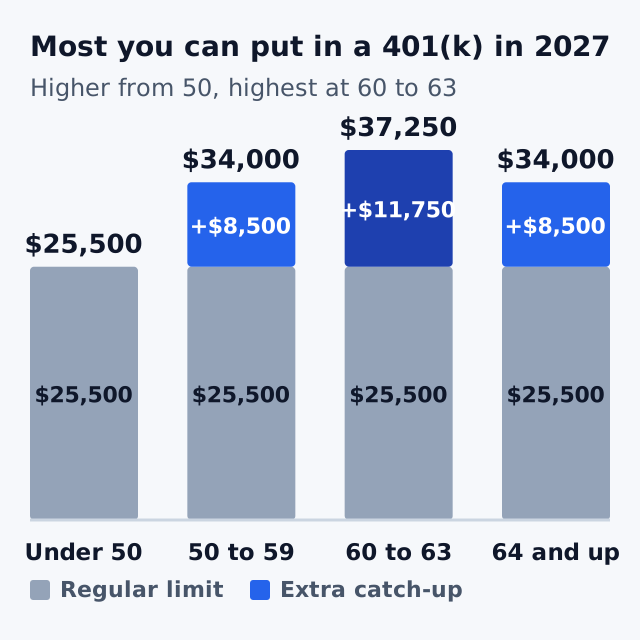
- In 2027 the most you can put in a workplace plan is $34,000 from age 50 and $37,250 at ages 60 to 63.
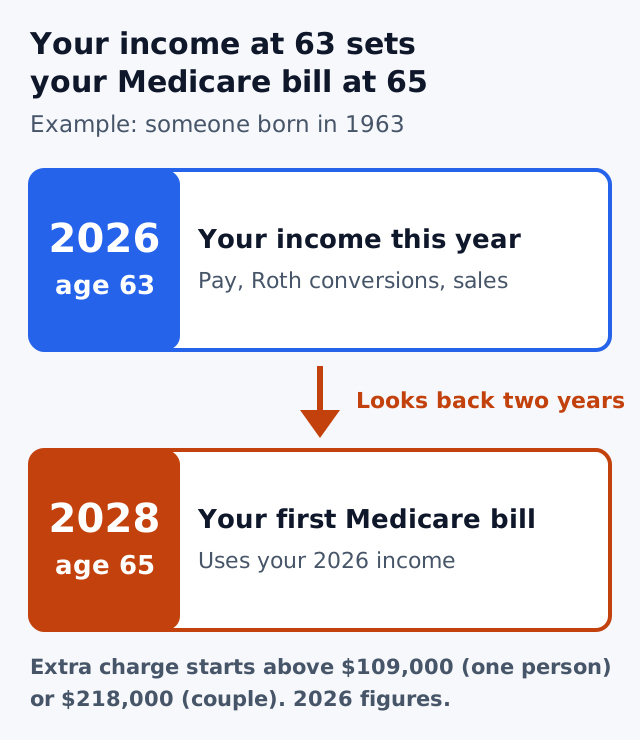
- Your income in the year you turn 63 can raise your Medicare bill at 65, so plan that year early.
- Signing up for Medicare late adds 10% for every full year of delay, for the rest of your life.
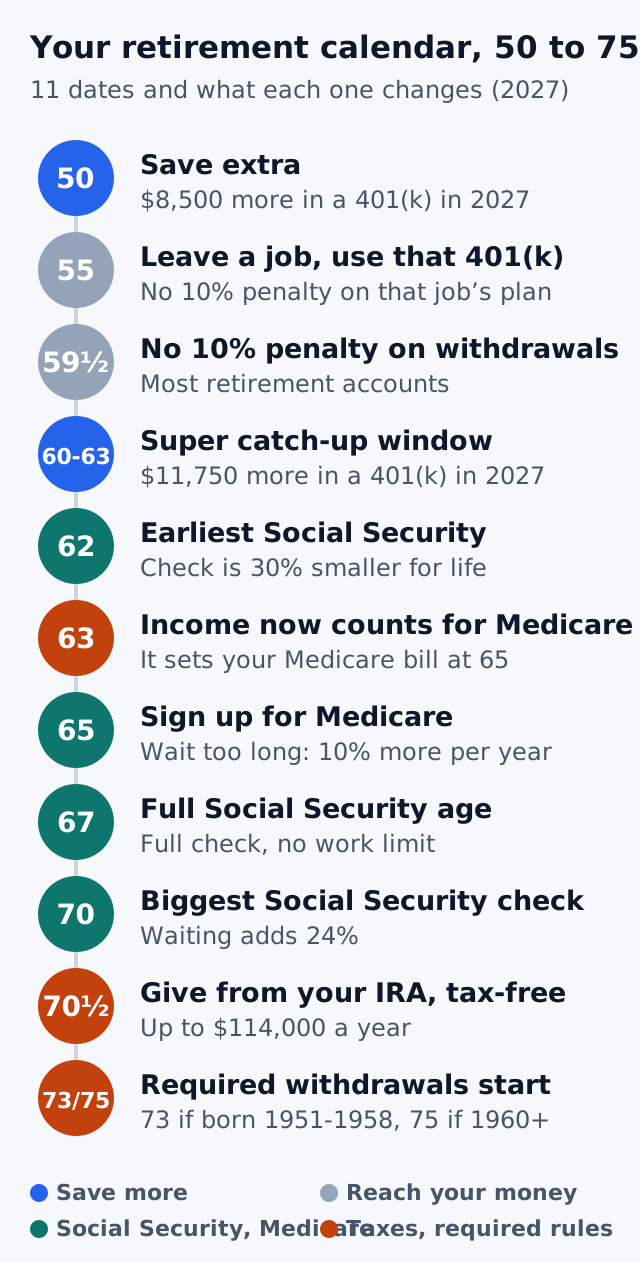
Short answer: the 11 ages that matter after 50 are 50, 55, 59½, 60 to 63, 62, 63, 65, 67, 70, 70½ and 73 or 75. In 2027 you can save up to $34,000 in a workplace plan from age 50. You sign up for Medicare around 65 and must start withdrawals at 73 or 75. Your income at 63 can raise your Medicare bill at 65.
After 50, your retirement accounts, Social Security and Medicare each run on their own calendar. Different laws set each one. They also affect each other, and that is where people lose money.
This guide lists the 11 dates and what each one changes. Every 2027 figure was checked on November 19, 2026 against the IRS, the Social Security Administration and Medicare. Where a number is not final, we say so.
Ages 50 to 63: you can save more
At 50, the limit goes up. In 2027 the regular limit for a 401(k), 403(b) or government 457 plan is $25,500. At 50 you can add $8,500, so the total is $34,000. An IRA allows $7,500 plus $1,100 from age 50, or $8,600.
At 60 to 63, it goes up again. For those four years the extra amount is $11,750 instead of $8,500, so you can put in $37,250. At 64 it drops back to $8,500. Only workplace plans get this window, not IRAs.
Higher earners must use Roth for the extra money. If your 2026 pay from the employer that runs your plan was above $155,000, your 2027 catch-up contributions must go in as Roth. The pay that counts is the Social Security wages box on your W-2. That means you pay tax now and withdraw the growth tax-free later. If your plan has no Roth option, you cannot make catch-up contributions at all. Use the mandatory Roth catch-up calculator to see the tax effect. Our 2027 401(k) limit guide has the full list.
At 55, a health savings account (HSA) gets $1,000 more. The 2027 limit is $4,500 for one person or $9,000 for a family. From 55 you add $1,000. Our 2027 HSA guide explains who qualifies.
Ages 55 to 59½: reach your money early
Most retirement withdrawals before 59½ carry a 10% penalty plus income tax. Two dates give you a way around it.
The Rule of 55. If you leave a job in or after the year you turn 55, you can take money from that employer's 401(k) without the 10% penalty. You still pay income tax. It works only for the plan at the job you just left. An IRA or an old employer's plan does not qualify.
Age 59½. At this age the 10% penalty ends for 401(k), 403(b), 457 and IRA withdrawals. Income tax still applies to pre-tax money. Count six months from your birthday. If you were born January 15, you turn 59½ on July 15. For Roth money, the growth is tax-free only if you are 59½ and the account is at least five years old. Our guide to the five ways to reach money before 59½ covers the rest.
Ages 62 to 70: Social Security and Medicare
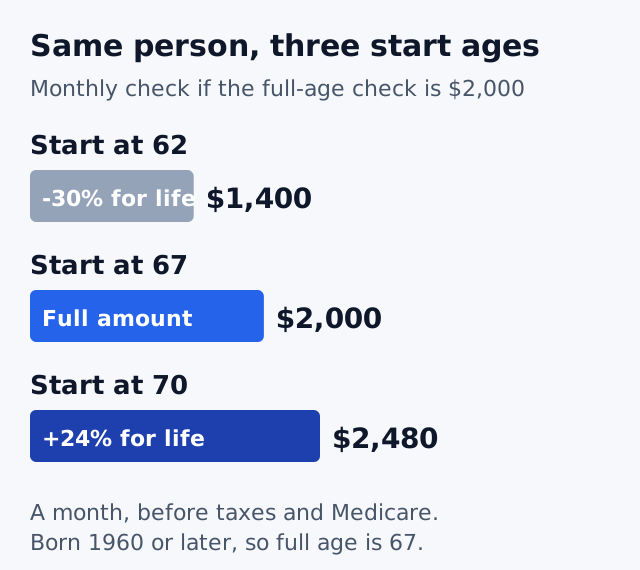
At 62, you can start Social Security, at a price. If your full retirement age is 67, starting at 62 cuts your check by about 30%, for life. If you still work and earn more than $25,560 in 2027, Social Security holds back $1 of benefits for every $2 above that. Earn $45,560 and $10,000 is held back. SSA raises your check later to make up for held-back months.
At 63, your income starts to count for Medicare. Medicare uses it to set your bill at 65. The section on four costly moves explains how.
At 65, sign up for Medicare. Your first window is seven months long: the three months before your birthday month, that month, and the three months after. Miss it without a valid exception and your Part B premium rises 10% for every full 12 months you waited. Part B covers doctor visits and outpatient care. In 2026 the standard Part B premium is $202.90 a month. Two years late adds about $40.58 a month, or about $487 a year, for as long as you have Part B. Once you are on Medicare you can no longer add to an HSA, but you can still spend what is in it. Our retirement transition checklist puts your Medicare, Social Security and withdrawal dates in one list.
Some people also get a new tax break at 65. For tax years 2025 through 2028, each person 65 or older can take an extra $6,000 deduction. It starts to shrink above $75,000 of income for one person or $150,000 for a couple. You lose 6 cents of it for each extra dollar, and it is gone at $175,000 for one person or $250,000 for a couple.
At 67, you reach full retirement age if you were born in 1960 or later. You get your full check and the work limit disappears. People born earlier reach it a few months sooner.
At 70, the check stops growing. Each year you wait past full age adds 8%, so waiting to 70 adds 24%. Nothing more is added after 70.
Ages 70½ to 75: give, then withdraw
At 70½, you can give to charity straight from your IRA. A qualified charitable distribution goes from your IRA directly to a charity. It does not count as taxable income. The 2027 limit is $114,000 a year per person. A one-time gift of up to $57,000 can go to a charitable remainder trust or a charitable gift annuity.
At 73 or 75, withdrawals become required. If you were born from 1951 to 1958, they start at 73. If you were born in 1960 or later, they start at 75. For people born in 1959, the final federal rule leaves the age unsettled, so ask your plan. If you skip a required withdrawal, the penalty is 25% of what you should have taken. It drops to 10% if you fix it quickly. Roth 401(k) accounts no longer have required withdrawals. Our required withdrawal planner estimates the amount.
Four moves that cost you at a later date
Each date is simple alone. These four moves cost money at a later date.
- It can cost you here
- A higher Medicare bill at 65 and 66
- It can cost you here
- You lose penalty-free access before 59½
- It can cost you here
- Excess contributions and a tax penalty
- It can cost you here
- Benefits held back above $25,560 of pay
Your income at 63 sets your Medicare bill at 65. Medicare checks your tax return from two years earlier. If you were born in 1963, your 2026 income, earned at age 63, decides your first Medicare bill in 2028. Above $109,000 of income for one person or $218,000 for a couple, you pay an extra monthly charge. Those are 2026 limits. Our Roth conversion guide shows how to size a conversion under them. As of November 19, 2026 we had not found Medicare's 2027 table. A Roth conversion helps many people, but a large one at 63 or 64 can raise your bill. The extra charge is all or nothing: one dollar over the line means you pay the full amount. Read how it works in our Medicare income surcharge guide and the Roth conversion window guide.
Rolling the money out ends the Rule of 55. Moving the 401(k) to an IRA ends penalty-free access until 59½. If you plan to retire between 55 and 59½, leave that money in the plan.
HSA contributions need to stop early. Medicare Part A (hospital coverage) can start up to six months before the day you sign up. You cannot add to an HSA in any month it covers. Claiming Social Security also signs you up for Part A. Stop HSA contributions about six months before you do either.
Find your own dates
Most dates depend on the year you were born. This table shows the three that change.
- Medicare at 65
- 2022
- Full Social Security age
- 66 and 6 months
- First required withdrawal
- 2030 (age 73)
- Medicare at 65
- 2024
- Full Social Security age
- 66 and 10 months
- First required withdrawal
- Ask your plan
- Medicare at 65
- 2025
- Full Social Security age
- 67
- First required withdrawal
- 2035 (age 75)
- Medicare at 65
- 2027
- Full Social Security age
- 67
- First required withdrawal
- 2037 (age 75)
- Medicare at 65
- 2030
- Full Social Security age
- 67
- First required withdrawal
- 2040 (age 75)
- Medicare at 65
- 2035
- Full Social Security age
- 67
- First required withdrawal
- 2045 (age 75)
- Medicare at 65
- 2041
- Full Social Security age
- 67
- First required withdrawal
- 2051 (age 75)
The $11,750 window at 60 to 63 falls in the years you turn 60 through 63. If you were born in 1966, that is 2026 to 2029.
What to do this year
What to Do Now
Method and sources
Figures were checked on November 19, 2026. 2027 contribution limits, the $155,000 Roth wage test and the charity limits come from IRS Notice 2026-66 and the IRS announcement of November 12, 2026. The Social Security work limit is from the SSA 2027 fact sheet, and the 30% cut and 24% gain follow SSA's age-reduction rules. The Part B premium and extra-charge thresholds are from CMS's 2026 table, and the late-enrollment penalty is explained on Medicare.gov. The Rule of 55 is in the IRS early-distribution guide, and HSA rules are in IRS Publication 969. The extra deduction for people 65 and older comes from Public Law 119-21. Required-withdrawal ages come from SECURE 2.0 and the IRS RMD guidance.
The dollar examples are calculated from rules and are not a forecast. They do not account for your state taxes, your other income or your plan's own rules. This guide is general information, not tax or investment advice. A tax professional can check your own dates.
Frequently Asked Questions
How much can I put in a 401(k) at 50 or older in 2027?
Who has to put catch-up money in a Roth account in 2027?
What is the Rule of 55?
When should I sign up for Medicare?
Can my income at 63 raise my Medicare bill?
When do required withdrawals start?
The 5-minute money briefing
One email per week. The biggest changes in savings, money market, checking and CD rates.
Send me the weekly SwitchWize rate briefing: the biggest changes in savings, money market, checking and CD rates. Unsubscribe in one click. We never share your address.
Answer a few questions about your situation and goals. Money Map points you to the highest-value next step across savings, mortgage, cards, and debt.
Editorial review
What changed since the last update
Was this guide helpful?
Found an inaccurate, outdated, or missing claim? Report a correction. We verify reports against the relevant source before changing a guide or ranking.
