- The costliest retirement decisions are enrollment and tax deadlines, not investments, and most are one-way doors: the Medicare window, the Social Security claim age, and the gap-year tax break.
- Missing the Medicare window adds a 10% Part B penalty per year, for life; delaying Social Security to 70 raises the benefit about 8% a year, also for life.
- The gap years before RMDs at 73 are a fleeting low-bracket window for Roth conversions that slams shut once RMDs and Social Security stack your income up.
For forty years, retirement planning is one question: how much to save. Then you retire, and it becomes a dozen questions with deadlines, and almost no one has been taught the answers. When to start Medicare, and the permanent penalty for getting it wrong. When to claim Social Security, a decision worth hundreds of dollars a month for the rest of your life. How to use a brief, low-tax window in your 60s before the tax code forces your income back up at 73. These are not investment choices; they are timing and sequencing choices, most are irreversible, and they interact in ways that surprise even careful savers. This is the playbook for getting the transition right. This page is reviewed by the SwitchWize Editorial Team; the 2026 figures are sourced below with dates. Use this retirement transition checklist to navigate each deadline and decision point in the correct sequence.
The reframe: retirement is a gauntlet, not a finish line
The mental model of retirement as a finish line, cross it and relax, is exactly what causes the expensive mistakes. Retirement is better understood as a gauntlet of deadlines, most of them one-way doors that lock behind you. At 62 you become eligible for a permanently reduced Social Security benefit. Around 65 a seven-month Medicare window opens and, for many, closes with a lifelong penalty attached. At your full retirement age of 67 your unreduced benefit is available. At 70 the reward for waiting stops. And at 73 or 75 the tax code takes over your withdrawal schedule whether you like it or not.
What makes the transition genuinely hard is not any single door but the way they interact. A Roth conversion that saves tax for decades can raise your Medicare premium two years later. Claiming Social Security early can worsen the tax on every dollar you withdraw. The rest of this playbook walks the doors in order, and flags where they collide.
Medicare at 65: the deadline that never forgives
Start here, because it is the one deadline with a permanent price for missing it. Your initial enrollment period is a seven-month window, from three months before the month you turn 65 to three months after. If you enroll in Part B late, without qualifying employer coverage, the penalty is brutal in its permanence: 10% added to your premium for every 12 months you delayed, for as long as you have Medicare, per Medicare.gov. Miss it by two years and you pay 20% more, forever.
The 2026 standard Part B premium is $202.90 a month, and higher earners pay an IRMAA surcharge on top, starting at $109,000 of income for a single filer and $218,000 for a couple. The crucial and counterintuitive detail: IRMAA uses a two-year lookback, so your 2026 premium is set by your 2024 income. That lookback is what ties Medicare to every other decision here, because income you create today, including a Roth conversion, can raise your Medicare cost two years from now.
Estimate the Medicare IRMAA surcharge tier from MAGI and screen for an SSA-44 appeal.
For 2026 IRMAA, SSA generally uses 2024 MAGI from the most recent IRS tax return available.
Married filing separately uses the special compressed CMS tier structure.
IRMAA applies per beneficiary; the annual household cost scales by this count.
Use this to see whether a life-changing event could support an SSA-44 appeal.
The engine only suggests reviewing SSA-44 when the selected event and lower current income produce a lower modeled tier.
Annual IRMAA surcharge
$96
IRMAA is a cliff, not a ramp. Crossing the threshold by $1 costs the full $1,148/year tier, not a prorated amount.
What to do
This surcharge is set by income from two years ago and applies for the full Medicare year. Use the RMD Planner and Roth Conversion Planner to avoid crossing the next tier.
Pre-tax estimates. For illustration only — not financial advice.
Social Security: the biggest number in the decision
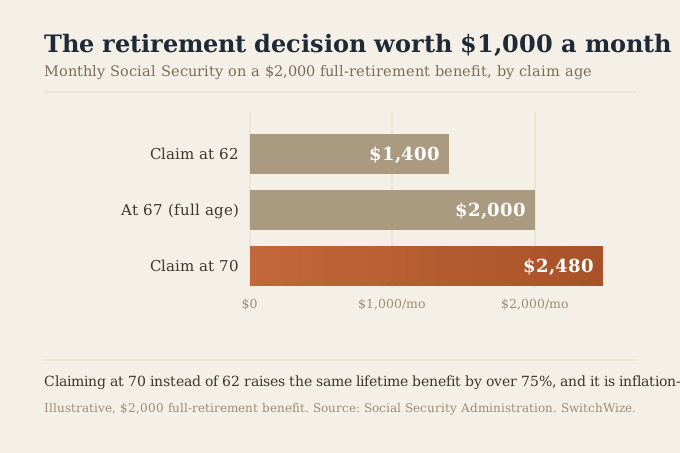
The Social Security claiming age is the highest-stakes reversible-looking decision that is actually permanent. Claim at 62 and your benefit is reduced by about 30% from your full retirement age of 67. Wait past 67 and it grows by roughly 8% a year up to 70, a total increase of about 24%. On a $2,000 full-retirement benefit, that is roughly $1,400 at 62 versus $2,480 at 70, and because the benefit is inflation-adjusted and paid for life, the gap compounds over a long retirement.
Delaying is, in effect, buying a larger guaranteed lifetime income, and it doubles as survivor protection, since a surviving spouse can step up to the larger benefit. Claiming early is defensible if you are in poor health, need the cash, or would invest it well, but for anyone expecting to reach their mid-80s, waiting usually wins. This is a longevity and tax bet as much as a math problem, so run it against your own situation:
Compare claiming ages by projected lifetime value, then review the real-world factors that can change the answer.
Check ssa.gov/myaccount for your estimate
Choose a planning age for the comparison; this is not a longevity forecast.
Recommended claiming age
70.0
The highest projected lifetime value is claiming at 70, which is $91,200 more than claiming at 62 in this scenario.
What to do
You have 4 years until early claiming begins. Based on your planning age, claiming at 70 produces the highest projected lifetime value, $91,200 more than claiming at 62. Use the runway to decide whether you can afford to wait.
Pre-tax estimates. For illustration only — not financial advice.
The gap years: the tax window that slams shut
Here is the part that separates a good retirement plan from an ordinary one, and it is invisible to most retirees until it is gone. Between the year you stop working and the year Social Security and required minimum distributions push your income back up, often your early 60s to 73, your taxable income can be unusually low. That low-income stretch is a fleeting window to do Roth conversions: move money from a traditional IRA or 401(k) into a Roth, pay tax on it now at a low rate, and never pay tax on it again, so it never lands on a future RMD schedule or stacks on top of Social Security.
The window is valuable precisely because it closes. Once RMDs begin at 73 and Social Security is flowing, your income rises, the low brackets fill, and conversions become expensive. The craft is to convert enough to fill the low brackets each year but not so much that you cross an IRMAA threshold two years out, since a conversion inflates the income Medicare looks back on. Done well across several gap years, this quietly shrinks the traditional balance the IRS was planning to tax on its own schedule.
Calculate a required minimum distribution, then estimate remaining distribution need, QCD impact, tax withholding, IRMAA headroom, and missed-RMD penalty exposure.
Use the retirement account balance as of December 31 of the prior year.
The rule engine derives your 2026 age and statutory RMD starting age from birth year.
Inherited accounts and the Joint Life table require additional facts; the calculator will stop and flag those cases.
For 2026, QCDs are generally limited to $111,000 and must go directly from an eligible IRA to a qualified charity.
The canonical 2026 IRMAA package supplies the threshold. A 2026 RMD may affect Medicare premiums after the usual two-year lookback.
Required Minimum Distribution
$20,325
Use this result as one input in your broader Money Map, not as a one-off number.
What to do
Build this in Money Map
Pre-tax estimates. For illustration only — not financial advice.
The tax torpedo and the drawdown order
Two final, interacting forces shape the transition. The first is required minimum distributions: at 73 (born 1951 to 1959) or 75 (born 1960 or later), the IRS forces taxable withdrawals from traditional accounts, whether you need the money or not, with a 25% penalty on any RMD you miss (10% if corrected within two years). Delaying your first RMD to the following April 1 stacks two into one year and can spike both your tax and your Medicare premium.
The second is the Social Security tax torpedo. As other income rises, more of your Social Security becomes taxable, up to 85% of it, so near the provisional-income thresholds ($25,000 to $34,000 single, $32,000 to $44,000 married) an extra $1,000 withdrawal can make additional benefit dollars taxable at the same time, effectively doubling the marginal rate on that withdrawal. The defenses are the same tools as above, managing which account you draw from and converting to Roth before you claim, which is why the drawdown order and the transition plan are really one plan.
The honest counterargument
None of this is one-size-fits-all. Some people should claim Social Security early: those in poor health, those who need the income to avoid worse debt, and those without the assets to bridge the gap. Medicare has genuine exceptions, chiefly ongoing employer coverage, that make a later enrollment penalty-free. And not everyone has a gap-year window worth exploiting; a retiree living on a pension and Social Security may already be in a bracket where conversions do not help.
But the exceptions do not change the core lesson, they refine it. The deadlines are real, the penalties for missing Medicare and mismanaging income are permanent, and the interactions are genuinely counterintuitive. The default posture should therefore be deliberate planning, ideally with a fee-only advisor or a CPA who does retirement tax work, rather than drifting across these thresholds and discovering the cost afterward. The stakes are a decade or more of higher taxes and premiums, on money you already saved.
Methodology
Figures are the 2026 amounts: the Medicare Part B standard premium of $202.90, IRMAA thresholds beginning at $109,000 (single) and $218,000 (married filing jointly), Social Security's full retirement age of 67, the roughly 8% annual delayed-retirement credit, and RMD ages of 73 and 75 under SECURE 2.0. The Social Security dollar figures are illustrative, scaled to a $2,000 full-retirement benefit; your amounts depend on your earnings record. IRMAA uses a two-year income lookback. The Roth-conversion strategy is a widely used planning approach, not a guarantee, and its value depends on your brackets and future rates. Tax and Medicare rules interact and change; a fee-only advisor or CPA is worth engaging. Nothing here is individualized financial, tax, or legal advice.
How we source this. Medicare figures come from Medicare.gov and CMS, Social Security figures from the Social Security Administration, and RMD rules from the IRS under SECURE 2.0, all cited with dates. See our methodology and editorial team. We take no payment for organic rankings.
Sources
- Medicare.gov and CMS, Medicare costs and late-enrollment penalties: the enrollment window, Part B penalty, 2026 premium, and IRMAA.
- Social Security Administration on full retirement age, early-claiming reduction, and delayed retirement credits.
- IRS on required minimum distributions under SECURE 2.0 (ages 73 and 75, the 25% penalty), and on the taxation of Social Security benefits.
Figures are current for 2026 and set by federal rules that change. This page is informational, not financial, tax, or legal advice. Free to cite with attribution to SwitchWize.
What to Do Now
Frequently Asked Questions
When should I enroll in Medicare?
Is it better to claim Social Security at 62, 67, or 70?
What are the gap years and why do they matter?
When do required minimum distributions start and what is the penalty?
What is the Social Security tax torpedo?
The 5-minute money briefing
One email per week. New rates, fed moves, and what to actually do about them.
No spam. Unsubscribe anytime.
Answer a few questions about your situation and goals. Money Map points you to the highest-value next step across savings, mortgage, cards, and debt.
Editorial review
What changed since the last update
Was this guide helpful?
Found an inaccurate, outdated, or missing claim? Report a correction. We verify reports against the relevant source before changing a guide or ranking.
