- A one-time $90 payment started going out in October 2026. About 20.8 million people get it, fewer than a third of the 64.2 million on Medicare.
- It is automatic. You are left out if you are in a Medicare Advantage plan, get Medicaid help with the Part B premium, or pay the income surcharge.
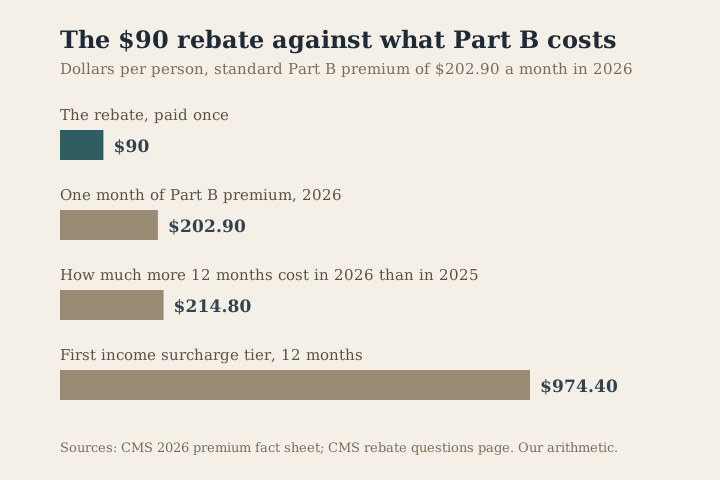
- $90 is about 44% of one month of the $202.90 Part B premium. It is smaller than the $214.80 that 12 months of premium rose between 2025 and 2026.
The one-time $90 Medicare rebate is going to about 20.8 million people, which is fewer than a third of the 64.2 million people on Medicare. If you have original Medicare and pay the standard premium, it is probably already in your account. If you have a Medicare Advantage plan, it is not coming. That surprises many couples, because the payment is made person by person.
Walter, 68, is made up for this example. He is not a real person. In early October he saw a $90 deposit he did not expect. His wife Joan, 66, has a Medicare Advantage plan. She got nothing. They keep their money in the same account, they are on the same street, and they pay for health care out of the same budget. Walter wanted to know why one deposit showed up and the other did not.
What the payment is
The White House announced it on October 2. The money comes from the Medicare Improvement Fund, a pool Congress created in 2008. The Associated Press reports this is the first time the fund has paid people directly. The administration puts the cost at about $2 billion.
CMS, the agency that runs Medicare, says each eligible person gets one $90 rebate in October 2026. Most people got a direct deposit from Social Security around October 8. People without direct deposit get a check from the U.S. Treasury later in October, mailed to the address Medicare has on file. The check says it is meant to cover part of the October premium, so do not throw it out as junk mail.
You do not need to apply. A KFF health policy expert told the Associated Press that people do not have to call or sign up.
Who gets it and who does not
News reports list four conditions. You need to be in original Medicare, the government plan, and have Part B, the part that covers doctor visits. You also need to live in the United States, get no Medicaid help with the Part B premium, and not pay the extra charge that higher earners pay, which we explain below. CMS's questions page words the last two conditions less clearly than the news reports do, so call 1-800-MEDICARE if you are unsure. On Medicare Advantage, CMS is plain: "Beneficiaries enrolled in Medicare Advantage are not eligible."
Medicare Advantage plans are private plans that replace original Medicare. The Kaiser Family Foundation, a health research group, estimates about 35 million people are in them. In figures reported by the Associated Press, about 12 million low-income people who get premium help are also left out. People who pay the surcharge, and others who do not meet the conditions, are also left out. That leaves 20.8 million of the 64.2 million. The payment is $90 per person, so a couple can get $180 if both meet the conditions.
In Walter's household, Walter qualifies and Joan does not. Their combined income is below the surcharge line, but she is in a Medicare Advantage plan, and that alone rules her out.
How $90 compares with what Part B costs
Part B pays for doctor visits and for care you get without staying overnight in a hospital. Most people pay a standard monthly premium. CMS set it at $202.90 for 2026, up $17.90 from $185.00 in 2025.
- Standard Part B premium per month
- $185.00
- Source
- CMS
- Standard Part B premium per month
- $202.90
- Source
- CMS
- Standard Part B premium per month
- $209.50
- Source
- 2026 Medicare Trustees Report, as reported by the Military Officers Association of America
Here is what $90 is worth against those numbers:
- It is 44% of one month of the premium ($90 divided by $202.90).
- It is 3.7% of a full year of premium. Twelve months at $202.90 is $2,434.80.
- The premium went up $17.90 a month from 2025 to 2026. Over a year that is $214.80. The $90 payment is about 42% of that extra cost.
- The Medicare trustees, who oversee the program's finances, project the 2027 premium will rise another $6.60 a month, or $79.20 over a year. That is less than the $90. Projections can miss: the trustees' 2026 projection was about $4 above the premium CMS actually set. CMS usually confirms the 2027 premium in November.
So the rebate is real money. It covers a bit under half of one month's premium. It does not undo the rise in the premium. The check's own wording says it is meant for the October premium, but you are free to spend it however you like.
The surcharge line costs far more than $90
People with higher incomes pay an extra charge on top of the standard premium. CMS calls it the income-related monthly adjustment amount. We call it the surcharge. For 2026, a single person starts paying it above $109,000 of income, and a married couple filing together above $218,000.
The first step adds $81.20 a month, which is $974.40 over 12 months. That is nearly eleven times the rebate, and a person who pays any surcharge is not eligible for the $90. Once your income is above the line, the charge is $974.40 a year, and you also lose the $90 payment. It is worked out from a tax return from two years ago, so changing this year's income will not change it. Our guide to this income limit explains how to plan for it.
What we could not confirm
Neither the CMS questions page nor the news reports we read say whether the $90 counts as income on your tax return. We did not find an IRS statement either. We also did not find how the $90 amount was chosen. If you file taxes, keep the deposit record and ask a tax preparer how to treat it.
CMS's wording on who qualifies is shorter than the news summaries. We used the Associated Press list of conditions and noted where CMS is less specific.
What to do now
- Look at your bank account for a $90 deposit from around October 8. If you have no direct deposit set up with Social Security, watch your mail for the Treasury check through the end of October.
- If you are in original Medicare and think you should have it, call 1-800-MEDICARE (1-800-633-4227) to check eligibility. Social Security (1-800-772-1213) answers questions about payment status.
- Do not give out your bank details to anyone who contacts you about the rebate. You do not need to sign up, so a message asking you to is a warning sign.
- If you are in Medicare Advantage, do not expect the payment, and do not switch plans for $90. Compare plans on cost and coverage during the yearly sign-up window, which runs through December 7. That is when you can switch Medicare plans for next year. Our Medicare Advantage premium guide has the numbers.
- Keep a note of the payment for tax time.
What Walter did
Walter called 1-800-MEDICARE and learned that Joan's plan was the reason she was left out, not a mistake. He put the $90 in their savings account and wrote the $218,000 limit for married couples on a card and put it in their tax folder, so they would know where the surcharge starts. Then he asked Joan to check each year what their plan costs against what original Medicare would cost them.
Quick answers
Who gets the $90? About 20.8 million people in original Medicare who get no Medicaid premium help and pay no income surcharge.
Do I apply? No.
Is it taxable? We could not find an answer. Ask a tax preparer.
Methodology
Eligibility, timing and the check wording come from the CMS page "Medicare Improvement Fund Premium Rebate Frequently Asked Questions," read October 27, 2026. The 20.8 million count, the KFF figures, the 2008 fund origin and the cost estimate come from the Associated Press story of October 8, 2026, as syndicated by local stations, and from a USAFacts explainer. The 2025 and 2026 premiums and the 2026 income table come from the CMS fact sheet "2026 Medicare Parts A and B Premiums and Deductibles." The 2027 projection comes from the 2026 Medicare Trustees Report as summarized by MOAA. The two-year lookback for the surcharge comes from SwitchWize's income cliff guide. Arithmetic was checked with a script: 90 / 202.90 = 0.4436; 202.90 x 12 = 2,434.80; 90 / 2,434.80 = 0.0370; 17.90 x 12 = 214.80; 90 / 214.80 = 0.4190; 81.20 x 12 = 974.40; 974.40 / 90 = 10.8; 6.60 x 12 = 79.20. Walter and Joan are an illustration. This is general information, not tax or medical advice.
Frequently Asked Questions
Who gets the $90 Medicare rebate?
Do I have to apply for the $90 Medicare payment?
Why did I not get the $90 payment?
Is the $90 Medicare rebate taxable?
Where does the money come from?
What is the income limit for the surcharge that blocks the payment?
The 5-minute money briefing
One email per week. New rates, fed moves, and what to actually do about them.
No spam. Unsubscribe anytime.
Answer a few questions about your situation and goals. Money Map points you to the highest-value next step across savings, mortgage, cards, and debt.
Editorial review
What changed since the last update
Was this guide helpful?
Found an inaccurate, outdated, or missing claim? Report a correction. We verify reports against the relevant source before changing a guide or ranking.
