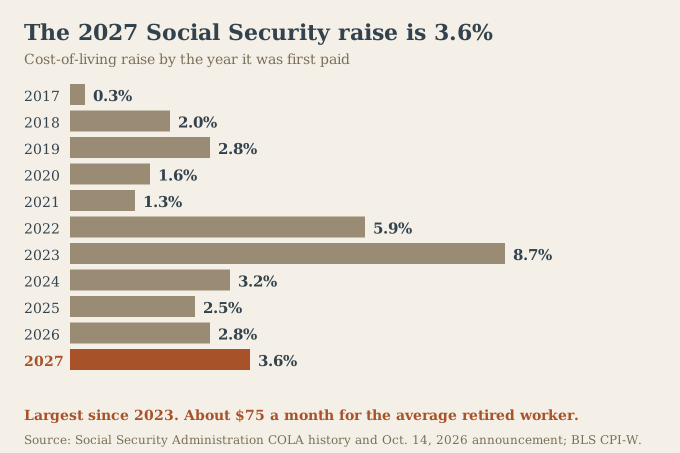
- The 2027 Social Security raise is 3.6%, about $75 a month on the average retired worker's $2,087.52 check. The new average check is $2,162.67.
- Early October estimates said 3.4% or 3.5%. Prices rose 0.66% from August to September, the biggest September jump since at least 2014, and that moved the raise up.
- After the Medicare Part B increase the program's trustees projected, the net raise is about $68.55 a month, or about $823 a year. The official Medicare number comes in November.
The 2027 Social Security raise is 3.6%. For the average retired worker, that is about $75 more a month, starting with January 2027 payments. Two weeks ago we wrote that it would almost certainly be 3.4% or 3.5%. September prices proved that call wrong.
Walter, 71, had already written a number in his budget. He is a composite, an illustration and not a real person. In early October he saw that most forecasters expected a raise near 3.5%. His check is $2,087 a month, almost exactly the national average, so he penciled in $71 more and stopped thinking about it.
What changed in September
The raise is built from three months of prices: July, August and September. Two of the three were already public when we wrote the earlier estimate. July prices were up 3.4% from a year earlier, and August prices were up 3.52%. Only September was unknown.
September came in at 3.93%. Using the Bureau of Labor Statistics' CPI-W, the index Social Security uses, prices rose 0.66% in that one month, from 328.481 in August to 330.654 in September. Our earlier estimate said a rise of more than about 0.46% would push the raise to 3.6%. The actual rise cleared that line by 0.2 points.
Gasoline drove much of it. In the broader consumer price index, gasoline rose 9.1% in September alone and was up 34.2% over 12 months, per the Bureau of Labor Statistics release of October 14. The same release showed prices excluding food and energy up only 2.6% over the year, so the jump came from fuel, not from everything at once.
How the 3.6% is calculated
The formula is fixed in law. The Social Security Administration averages the CPI-W for July, August and September, compares that with the same average from the last raise year, and rounds to the nearest tenth of a percent.
For 2027 the comparison number is 317.265, the average for July to September 2025. The 2026 average is (327.104 + 328.481 + 330.654) divided by 3, which is 328.746. That is 3.62% higher, and it rounds to 3.6%. The index values come from the Bureau of Labor Statistics CPI-W series, and the 3.6% matches the announcement reported by The Senior Citizens League.
What September has done before
In an earlier piece we checked the August-to-September change in the CPI-W for each year from 2014 to 2025. In 7 of those 12 years it rose less than 0.17%. Only once, in 2017, did it rise more than 0.46%. That year hurricanes pushed up gasoline prices and the rise was 0.62%.
The 2026 jump of 0.66% is larger than the 2017 one. It is the biggest of the 13 Septembers from 2014 to 2026. History was a fair guide to the usual case. It was a poor guide to a year when gasoline rose more than 9% in a month.
AARP's tracker was at 3.6% in early October, on a bet that September prices would jump. We called it the outlier. It turned out to be right.
What the raise is worth after Medicare
For the average retired worker, 3.6% of $2,087.52 is $75.15 a month. The new average check is $2,162.67.
Most retirees pay the Medicare Part B premium out of that check. It was $202.90 a month in 2026. The 2026 Medicare Trustees Report projected about $209.50 for 2027, a $6.60 increase, as reported by the Military Officers Association of America. The official 2027 premium has not been announced yet. It usually comes in November, and past projections have missed.
If the projection holds, the net raise is $75.15 minus $6.60, or $68.55 a month. That is about $823 a year.
Why prices are already ahead of the raise
The 3.6% is an average of three months. September alone ran at 3.93%. If prices keep rising at the September pace for a year, the raise falls about 0.33 points short. On the average check, that is about $7 a month.
That is a rough comparison, not a forecast. The raise is fixed for all of 2027. If gasoline falls back, prices could rise more slowly than 3.6% and the raise would come out ahead. If gasoline keeps climbing, it will fall behind. Nobody knows which, and the raise does not adjust either way until the next announcement in October 2027.
The raise can also bring a tax bill. Part of a benefit becomes taxable once half the benefit plus other income tops $25,000 for a single filer or $32,000 for a married couple filing jointly. Those lines have not been adjusted for inflation since the 1980s and 1990s, so each raise pushes a few more retirees closer to them.
What the same money earns in savings
The raise is set by formula. The interest on savings is not, and it can be worth as much.
The highest verified savings rate SwitchWize tracks as of October 20, 2026, is 4.27% at Peak Bank, an FDIC-insured account with a $100 minimum to open. Peak's terms say the rate is for new accounts and drops to 3.40% on balances of $500,000 and above. The FDIC's national average savings rate is 0.38%.
A balance of about $19,265 earns $823 a year at 4.27%. At 0.38% the same balance earns about $73. So the net raise, $823 a year, equals what $19,265 earns in a top account, and the gap between that and a bank paying the national average is about $750 a year. Rates can change at any time, and interest is taxable income.
You can compare current rates on our savings rate table, and see how far the best savings rates have pulled ahead of typical ones.
What Walter did
Walter erased the $71 and wrote $68 in its place, with a star beside it. Under the star he wrote "Nov: Medicare letter," because the official Part B premium decides whether $68 is right. Then he looked at the savings account where he keeps $19,000 for roof repairs, earning 0.38%. That is about $72 a year. He added one more line to his list: call the credit union this week and ask what rate they pay.
Quick answers
What is the 2027 Social Security COLA? It is 3.6%, announced October 14, 2026. The 2026 raise was 2.8%.
How much will the average check rise? About $75 a month, from $2,087.52 to $2,162.67, or about $68.55 after the projected Medicare increase.
Why did the estimates miss? September prices rose 0.66% in one month, mostly from gasoline, more than the 0.46% needed for 3.6%.
Methodology
CPI-W values are the not-seasonally-adjusted U.S. city average index (series CWUR0000SA0) from the Bureau of Labor Statistics, read on October 21, 2026. The 2027 raise is the three-month average of 2026 compared with 317.265, the July to September 2025 average, rounded to one decimal, the method the Social Security Administration publishes. The average retired worker benefit of $2,087.52 and the new $2,162.67 are as reported by The Senior Citizens League. The Medicare Part B figure of $209.50 is the trustees' projection, not an official premium. The savings rate comes from SwitchWize's approved rate snapshot of October 20, 2026. The savings example uses 4.27% and 0.38% on $19,265 and ignores taxes and rate changes. The September history chart uses the same BLS series for each year, 2014 to 2026.
Sources
- Bureau of Labor Statistics: Consumer Price Index news release, September 2026
- Bureau of Labor Statistics: CPI-W series CWUR0000SA0
- The Senior Citizens League: 2027 COLA announced at 3.6%
- Social Security Administration: COLA announcement, October 14, 2026
- Social Security Administration: COLA history
- Military Officers Association of America on the 2026 Medicare Trustees Report
Frequently Asked Questions
What is the Social Security COLA for 2027?
How much will the average Social Security check go up in 2027?
Why was the 2027 COLA higher than the 3.4% or 3.5% estimates?
How is the Social Security COLA calculated?
The 5-minute money briefing
One email per week. New rates, fed moves, and what to actually do about them.
No spam. Unsubscribe anytime.
Answer a few questions about your situation and goals. Money Map points you to the highest-value next step across savings, mortgage, cards, and debt.
Editorial review
What changed since the last update
Was this guide helpful?
Found an inaccurate, outdated, or missing claim? Report a correction. We verify reports against the relevant source before changing a guide or ranking.
