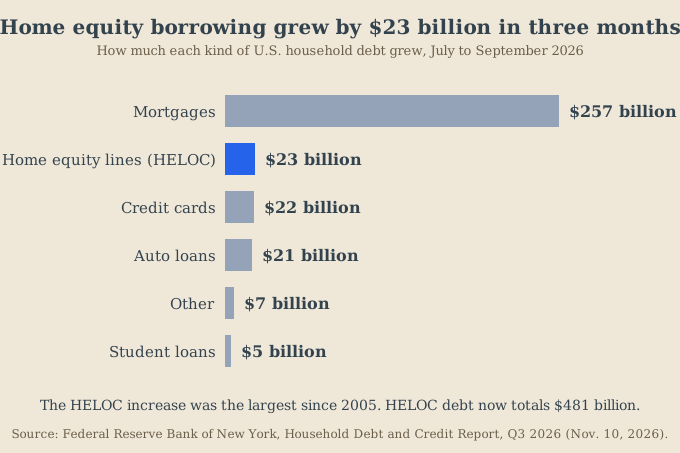
- Homeowners added $23 billion to home equity lines of credit (HELOCs) from July to September 2026, the largest quarterly rise since 2005, the New York Fed reported on November 10.
- A likely reason is the cost of the alternative. Refinancing a 3.00% mortgage at today's 7.18% average rate puts the new rate on the whole loan. A HELOC borrows only the extra money.
- In our example, a $50,000 HELOC next to a 3.00% mortgage costs about $13,000 in first-year interest. A refinance of the full $350,000 costs about $25,130.
- A HELOC rate moves with the Fed. After the September hike, each $50,000 borrowed costs about $125 more a year.
Take a homeowner we'll call Renata. She is an illustration, not a real person. She is a dental hygienist in Tulsa. In 2021 she took a $300,000 mortgage at 3.00%.
This fall her roof started leaking, and the furnace was next. She needs $50,000. A loan officer quoted her a cash-out refinance at about 7.18%, the national average.
She nearly said yes. Then she asked what that rate would apply to.
What the New York Fed reported
On November 10, the Federal Reserve Bank of New York published its quarterly look at household debt. Total debt reached $19.1 trillion at the end of September, up $334 billion in three months.
Most of that growth was mortgages, up $257 billion. The next biggest change was a surprise. Balances on home equity lines of credit, called HELOCs, rose $23 billion to $481 billion. The Fed said that was the largest increase in HELOC balances since 2005.
A HELOC works like a credit card backed by your house. The bank sets a limit based on your equity, which is what the home is worth minus what you owe on it. You borrow what you need and pay interest only on that.
Two other numbers point the same way. Over the past year, HELOC balances grew $59 billion. And banks raised the limits they offer by $31 billion in this quarter alone.
HELOCs are still small. At $481 billion, they equal about 3.6% of the $13.4 trillion in mortgage debt. They made up about 7% of the quarter's growth in debt. The change in direction is the news, not the size.
Why borrow against the house now
The New York Fed's report does not give reasons. It counts balances, not purposes. We can look at the price of the other choice.
Millions of homeowners hold a mortgage taken when rates were far lower. Freddie Mac reported that the average 30-year fixed rate was 7.18% on November 5, down from 7.32% on October 22. A year earlier it was 6.22%.
A homeowner with a 3.00% mortgage who needs cash faces an odd choice. A cash-out refinance replaces the old loan with a new one at today's rate. That puts the new rate on the whole balance, not just the extra money. Our piece on the mortgage rate lock-in effect explains why many people will not give up a low rate.
A HELOC leaves the first mortgage alone. It adds a second loan for only the amount you need.
What a HELOC costs next to a refinance
Here is Renata's choice in dollars. HELOC rates are usually the prime rate plus a margin the lender picks. The prime rate was 7.00% after the Fed's September 16 hike. We assume a margin of 1 point, so the HELOC rate is 8.00%. Your margin may be higher or lower.
- Keep the mortgage and add a HELOC. $300,000 at 3.00% costs about $9,000 in first-year interest. $50,000 at 8.00% costs about $4,000. The total is about $13,000.
- Refinance all $350,000. At 7.18%, first-year interest is about $25,130.
The refinance costs about $12,130 more in the first year, or about $1,011 a month. These are rough figures. The loan balance shrinks a little each month, and a refinance also brings closing costs.
The HELOC has a catch. Its rate can change. The Fed's September hike raised the prime rate by a quarter point, and HELOC rates moved with it. On $50,000, that is about $125 more a year, or about $10 a month. Another hike adds the same again. A savings account may take weeks to follow the Fed. A HELOC can follow within a billing cycle.
If prime rose a full point, the same $50,000 would cost $500 more a year. Even then, the HELOC route would still cost far less than the refinance in our example.
What the report cannot tell you
It does not say why people borrowed. Some may be paying for repairs. Some may be paying off credit cards. Some may be funding a business. The balances alone do not show it.
It also does not say whether the new borrowers can pay. The signs so far are calm. The share of HELOC balances newly 90 days or more late fell from 1.27% to 1.17% over the year. For mortgages it rose from 1.28% to 1.60%, which the Fed called low by historical standards. Overall, 5.0% of all household debt was in some stage of delinquency, up 0.3 points from the quarter before.
Our dollar example is an illustration. Your first mortgage rate, your HELOC margin and your closing costs will differ. A cash-out refinance can also be priced differently from the average purchase rate.
What to do
- Check what the extra money is for. A one-time repair is a different case from a habit of borrowing against the house.
- Compare the whole cost. Add up interest on the old loan plus the new one. Do not compare only the new rate with the old rate.
- Ask for the margin in writing. The HELOC rate is prime plus that number. Ask whether there is a cap on how high it can go.
- Plan for a higher rate. Check that you could pay the bill if prime rose a point or two.
- Borrow less than the limit. The lender's limit is not a target.
- See the guides. Our HELOC versus cash-out refinance comparison works through a $100,000 case, and how to get a HELOC lists the steps.
What Renata did next
Renata asked the loan officer to confirm that the 7.18% would apply to all $350,000. It would. She then asked a credit union for a HELOC and got the margin in writing. She drew only the amount the roof cost and left the rest of the line unused. The furnace can wait for spring.
Sources
- Federal Reserve Bank of New York, Quarterly Report on Household Debt and Credit, Q3 2026, press release of Nov. 10, 2026 (total debt $19.105 trillion, HELOC balances $481 billion, up $23 billion in the quarter and $59 billion over the year, mortgage balances $13.374 trillion, flow into serious delinquency for mortgages 1.28% to 1.60% and for HELOCs 1.27% to 1.17%, 5.0% of debt in some stage of delinquency)
- Freddie Mac Primary Mortgage Market Survey, as reported by the Associated Press, 30-year fixed rate of 7.18% on Nov. 5, 2026 and 6.22% a year earlier; 7.32% on Oct. 22, 2026
- Federal Reserve, FOMC statement of September 16, 2026 (target range 3.75% to 4.00%); bank prime rate 7.00% as the upper end of that range plus 3 points
Frequently Asked Questions
How much did HELOC balances rise in 2026?
Why are homeowners taking out HELOCs instead of refinancing?
Do HELOC rates go up when the Fed raises rates?
Is the rise in home equity borrowing a sign of trouble?
The 5-minute money briefing
One email per week. The biggest changes in savings, money market, checking and CD rates.
Send me the weekly SwitchWize rate briefing: the biggest changes in savings, money market, checking and CD rates. Unsubscribe in one click. We never share your address.
Act on this: today's top heloc


Ranked by SwitchWize's composite score. Some partner links may compensate SwitchWize.
Editorial review
What changed since the last update
Was this guide helpful?
Found an inaccurate, outdated, or missing claim? Report a correction. We verify reports against the relevant source before changing a guide or ranking.
