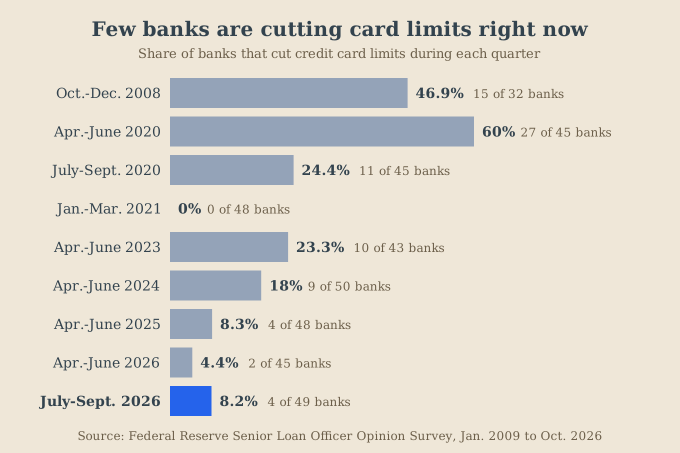
- Four of 49 banks cut credit card limits from July to September 2026, the Federal Reserve's loan officer survey found. One raised limits. The quarter before, 2 of 45 cut limits.
- That is low compared with past downturns. In April to June 2020, 60% of banks cut card limits. In late 2008 it was 47%.
- A lower limit raises the share of your limit you use, even with no new spending. In our example, a cut from $6,000 to $2,500 lifts it from 18% to 28% across two cards.
- Two federal rules help. A card company must give 45 days' notice before an over-limit fee or penalty rate caused by the cut. In most cases it must also give you the reasons.
Take a cardholder we'll call Ines. She is an illustration, not a real person. She has two credit cards. One has a $6,000 limit and a $1,800 balance. The other has a $4,000 limit and nothing on it.
In early November a letter arrives. Her first card's limit is now $2,500. She has not missed a payment. She has not bought anything new.
A few banks did this last quarter. The Federal Reserve's survey of bank loan officers, posted November 2, shows how many. It also shows that cuts like this are still rare compared with 2008 or 2020.
What the Fed's latest survey found
Four times a year the Fed asks bank loan officers how their lending changed. The October 2026 survey went to banks on September 21, with answers due October 5. It covers roughly July through September.
Forty-nine banks answered the question on card limits. Four said they cut limits on new or existing card accounts. One said it cut them "considerably" and three "somewhat." One bank raised limits. The other 44 made no change, the survey's table shows.
That is 8.2% of banks cutting limits. In the July survey, it was 2 of 45 banks, or 4.4%.
The same report found two other signs that banks are a bit more careful. They made fewer exceptions for people whose scores fall below the bank's minimum. And over the past year, banks became less likely to approve card applications from people with low scores.
Banks also said more people wanted to borrow on cards. The reason they cited most was customers' "spending needs in response to price changes" for goods and services. In other words, people needed to spend more as prices changed.
That fits the Fed's consumer credit report from November 6. Revolving credit, mostly card balances, grew at a 14.5% yearly pace in September, to $1,368.5 billion. We covered that report in our piece on card balances and card rates.
How today compares with 2008 and 2020
The Fed has asked about card limits for many years. Here is the share of banks that cut them in selected quarters, taken from each survey's own table.
- Banks that cut card limits
- 15 of 32
- Share
- 46.9%
- Banks that cut card limits
- 27 of 45
- Share
- 60.0%
- Banks that cut card limits
- 11 of 45
- Share
- 24.4%
- Banks that cut card limits
- 0 of 48
- Share
- 0.0%
- Banks that cut card limits
- 10 of 43
- Share
- 23.3%
- Banks that cut card limits
- 9 of 50
- Share
- 18.0%
- Banks that cut card limits
- 4 of 48
- Share
- 8.3%
- Banks that cut card limits
- 2 of 45
- Share
- 4.4%
- Banks that cut card limits
- 4 of 49
- Share
- 8.2%
In the January 2009 survey, the Fed's own summary rounded this to about 45% of banks.
The 2020 peak came in the first months of the pandemic. Then the cuts stopped. In early 2021, no bank cut limits and 9 of 48 raised them.
Cuts came back in 2023 and 2024, when about one bank in five trimmed limits. Since then the share has fallen. A year before last quarter, in July to September 2025, it was 6.5%, or 3 of 46 banks.
Why banks cut limits
Your limit is how much the bank agrees to lend you. Money you have not borrowed yet is still a risk to the bank.
If money gets tight, people often lean on their cards. So a bank that sees warning signs may lower the limit first. Banks can check your account and your credit report at any time to decide this.
So a cut does not always mean you did something wrong. A bank may cut many accounts that share a trait, such as a high balance or a lower score.
What a lower limit does to your credit score
Credit scores look at how much of your available credit you use. This is often called credit use, or utilization. It is your card balance divided by your limit.
FICO says "amounts owed" make up about 30% of its scores. That category includes how much of your credit you are using. Only payment history counts more, at 35%.
Here is what Ines's cut does. Her balance stays at $1,800.
- Before the cut
- $1,800 of $6,000, or 30%
- After the cut
- $1,800 of $2,500, or 72%
- Before the cut
- $1,800 of $10,000, or 18%
- After the cut
- $1,800 of $6,500, or about 28%
- Before the cut
- $4,200
- After the cut
- $700
Scores can look at each card and at all cards together. A single card near its limit can weigh on a score even when the total looks fine.
There is a second cost. Ines had planned about $1,200 of holiday gifts on that card. She now has $700 of room.
Two federal rules that protect you
The cut itself can happen without advance notice. But the rules limit what can follow.
Notice before fees or a penalty rate. An over-limit fee is a charge for going over your limit. A penalty rate is a higher interest rate a card can charge after you break its rules. A cut can leave you over your new limit. If the cut alone puts you over, the company must wait before charging either one. It must tell you at least 45 days before, under Regulation Z, section 1026.9(c)(2)(vi).
A reason for the cut. Under the Equal Credit Opportunity Act rules, an "unfavorable change in the terms of an account" is an adverse action. In plain words, a lower limit is a decision against you. The lender must tell you. It must list the reasons, or say you have 60 days to ask, section 1002.9 says.
There are exceptions. The reason rule does not cover a cut made because the account was inactive, late or in default. It also does not cover a change made to all or nearly all of a lender's accounts of that kind.
What the survey cannot tell you
The survey counts banks, not cardholders. A giant card company and a small bank each count as one answer. The Fed does not name the banks or say how many accounts were cut.
Four banks is a small number. If one bank had answered differently, the share would be 6.1% or 10.2%. Last quarter's 8.2% is also close to the 6.5% of a year earlier and the 8.3% of spring 2025. So the rise may mean little.
And a cut matters less for some people. If your statements show a zero balance, your credit use stays near zero, whatever the limit.
What to do if your limit is cut
- Compare the new limit with your balance. If you are over or close, stop using that card until you pay it down.
- Pay before the statement closing date. Most card companies report the balance on your statement to the credit bureaus. Our guide to credit use timing explains how.
- Ask why. Read the letter for the reasons. If it does not give them, ask within 60 days.
- Keep your other cards open. Closing a card removes its limit and can raise your credit use further. See what closing a card does.
- Use each card now and then. Banks can cut limits on cards you never use without giving a reason. A small charge you pay off keeps a card active.
- Ask for more later. After a few months of on-time payments, ask that company or another for a higher limit. Many companies review a request with a soft credit check, which does not affect your score. Our guide to raising your credit limit covers when to ask.
What Ines did next
Ines read the letter. It listed two reasons: her balance was high compared with her limit, and her total card debt had grown. She did not dispute them.
She paid $1,100 on the first card three days before its statement closed. The reported balance became $700. That is 28% of the new limit and about 11% across both cards. Her holiday gifts went on the second card instead, paid off when each bill came. In February she plans to ask for her old limit back.
Sources
- Federal Reserve, Senior Loan Officer Opinion Survey on Bank Lending Practices, October 2026, posted Nov. 2, 2026, and its table 1 (credit card terms, credit limits: 1 tightened considerably, 3 tightened somewhat, 44 unchanged, 1 eased somewhat, of 49)
- Federal Reserve, Senior Loan Officer survey table 1 for July 2026, October 2025, July 2025, July 2024, July 2023, April 2021, October 2020, July 2020 and January 2009 (credit card credit limits, all respondents)
- Federal Reserve, Consumer Credit, G.19, released Nov. 6, 2026 (revolving credit $1,368.5 billion; September growth 14.5% yearly pace)
- 12 CFR 1026.9(c)(2)(vi), Regulation Z, reduction of the credit limit
- 12 CFR 1002.2(c) and 1002.9, Regulation B, adverse action and notifications
- myFICO, What's in my FICO Scores (payment history 35%, amounts owed 30%)
Frequently Asked Questions
Are banks lowering credit card limits in 2026?
Does a lower credit limit hurt my credit score?
Can my credit card company lower my limit without warning?
Do they have to tell me why my credit limit went down?
What should I do if my credit limit was cut?
The 5-minute money briefing
One email per week. The biggest changes in savings, money market, checking and CD rates.
Send me the weekly SwitchWize rate briefing: the biggest changes in savings, money market, checking and CD rates. Unsubscribe in one click. We never share your address.
Act on this: today's top cards



Ranked by SwitchWize's composite score. Some partner links may compensate SwitchWize.
Editorial review
What changed since the last update
Was this guide helpful?
Found an inaccurate, outdated, or missing claim? Report a correction. We verify reports against the relevant source before changing a guide or ranking.
