The short answer
- Cash is not one asset: checking, high-yield savings, money market accounts and funds, CDs, Treasury bills, and I-bonds each trade liquidity, yield, and tax differently.
- The method is always the same: sort cash by its job, match each job to a vehicle by how fast you need it, then choose the highest after-tax yield that fits.
- Insured bank accounts and Treasuries are about as safe as cash gets, so the choice is mostly about fit. The account you pick can matter more than the amount you hold.
Most people treat cash as a single thing that lives in one account. That habit is quietly expensive. Think of the cash you spend this week, your emergency fund, next spring's down payment, and your idle surplus. Those are four kinds of money with four different jobs. Put them all in the same place and at least three of them are in the wrong one. Savings rates on this page were last verified recently.
This guide covers each place to keep cash. It shows what each one is for, what it pays, how fast you can reach it, and how it is taxed. The goal is not to find the single best account. It is to match every dollar to the account that fits its purpose.
How do you decide where to keep your cash?
Before any account names, the decision is always made in the same order:
- What is this money's job? Spending, an emergency reserve, a known near-term goal, or idle surplus.
- How fast might you need it? Instantly, within days, or on a known date.
- Only then, what pays the most after tax among the vehicles that fit the first two answers.
Chasing the highest rate first is the classic mistake. It can lock up money you need next week, or put your emergency fund where its value can drop. Fast access is a must. A higher rate is a bonus on top.
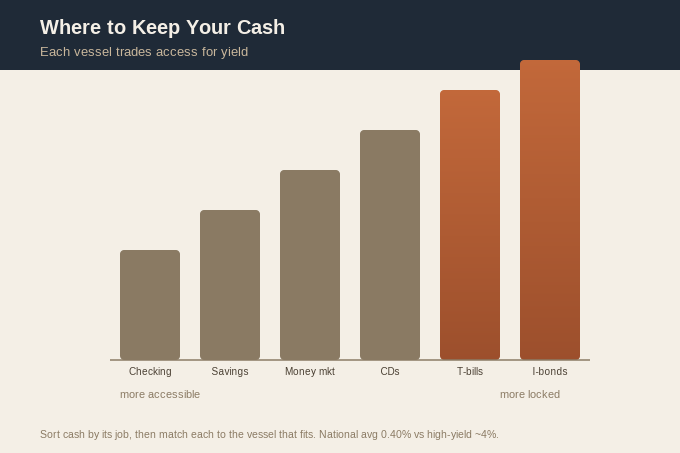
What are the places to keep cash, from easiest to reach to most locked?
Checking. The account you spend from. It pays almost nothing, and that is fine, because its job is access, not yield. Keep roughly one to two months of expenses plus a small buffer here, and no more. A large checking balance is interest you give up for nothing.
High-yield savings. The workhorse for cash that must stay safe and reachable. It is FDIC or NCUA insured, and the balance cannot dip. The best accounts pay 4.40% APY against a national average of 0.38%. This is the right home for an emergency fund and most short-term savings. Compare today's best savings rates.
Money market deposit accounts. A bank account close to high-yield savings, FDIC insured, sometimes with check-writing or a debit card and a higher minimum. Treat it as a savings-account variant, not a different asset class.
Money market funds. Held at a brokerage, not a bank. A government money market fund can pay a competitive rate and is handy for cash you keep beside investments. But it is an investment, not an insured deposit, and in rare cases its value could slip. Use it for brokerage cash, not for money that must never dip.
CDs. A fixed rate for a fixed term. You give up access, and in exchange you lock a rate that will not fall if the market does. The best 12-month CDs pay … APY today. CDs suit money with a known date. A CD ladder gives you both a locked rate and regular access.
Treasury bills. Short-term US government debt, from 4 to 52 weeks, paying close to short-term rates. Their interest is exempt from state and local income tax. In a high-tax state, a T-bill's after-tax yield can beat a bank account with a higher headline rate. A T-bill ladder restores regular liquidity.
I-bonds. Savings bonds whose rate follows inflation, for medium-term cash you want protected against rising prices. You cannot cash them for 12 months. Cashing before five years costs the last three months of interest. You can buy up to $10,000 a year per person at TreasuryDirect. They are a reserve, never an emergency fund.
Which account fits each job?
- Best home
- Checking
- Why
- Instant access; yield is irrelevant here
- Best home
- High-yield savings
- Why
- Insured, instant, cannot dip
- Best home
- High-yield savings or T-bills
- Why
- Safe, near-term, T-bills win after tax in high-tax states
- Best home
- CD or T-bill ladder
- Why
- Locks a rate for the horizon
- Best home
- I-bonds
- Why
- Rate tracks inflation; not liquid for a year
- Best home
- Government money market fund
- Why
- Convenient beside investments
Do taxes change where you should keep cash?
Two accounts with the same headline rate can pay different amounts after tax. Bank interest is taxed like your paycheck, by both the federal government and your state. Treasury bill interest is exempt from state and local income tax. Government money market funds that hold mostly Treasuries pass along some of that break, though the rules vary by state.
Example (hypothetical rates): You have $20,000 and live in a state with a 6% income tax.
- Rate
- 4.00%
- Interest in a year
- $800
- After state tax
- $752
- Rate
- 3.85%
- Interest in a year
- $770
- After state tax
- $770
The T-bill pays a lower rate but keeps $18 more after state tax. Both are still subject to federal tax. In a state with no income tax, the bank account would win. The state tax and cash yield calculator runs this for your state.
Is it safe to keep cash in these accounts?
For most savers, yes. Bank and credit union deposits are FDIC or NCUA insured up to $250,000 per depositor, per institution, per ownership type. Treasury bills and I-bonds are backed by the US government. Money market funds are the one exception. They are not insured, and SIPC only protects you if your broker fails, not if the fund loses value. Government money market funds are the most conservative kind. So the choice is mostly about fit, access and after-tax pay. If you hold more than $250,000 at one bank, see our guide to FDIC coverage planning.
How much more can the right split earn?
Here is what sorting cash by job can be worth.
Example (hypothetical rates): You hold $40,000 in cash.
- Amount
- $5,000
- Example rate
- 0.07%
- Interest in a year
- $3.50
- Amount
- $15,000
- Example rate
- 4.00%
- Interest in a year
- $600.00
- Amount
- $20,000
- Example rate
- 4.20%
- Interest in a year
- $840.00
- Amount
- $40,000
- Example rate
- Interest in a year
- $1,443.50
If the same $40,000 sat in checking at 0.07%, it would earn $28 a year. Sorting it adds $1,415.50, before tax. Try your own numbers in the Rate Gap calculator.
Run this routine once and your cash organizes itself. Keep your spending in checking and nothing more. Put the emergency fund in a high-yield savings account where it is insured and instant. Move known-horizon money into CDs or a Treasury ladder, and let an inflation-protected reserve sit in I-bonds. Sweep brokerage cash into a government money market fund. Then compare after-tax yields within each group and revisit as rates move.
Nothing here is exotic. Every dollar earns what it should and stays as easy to reach as its job needs.
Sources
Sources
- FDIC, National Rates and Rate Caps, for the national-average savings rate.
- US Treasury, TreasuryDirect for Treasury bill and I-bond rules, purchase limits and tax treatment.
- FDIC, Deposit Insurance for the $250,000 coverage rules.
- SwitchWize Research Desk framework for matching cash vehicles to their job.
Rates are current as of the last verification date above and change frequently; confirm current yields before acting. This is general educational information, not tax or investment advice.
Source: S&P Capital IQ Pro; SNL Financial Data. Calculations: FDIC. Reflects the $2,500 product tier for savings and interest checking accounts.
Frequently Asked Questions
Where should I keep my cash?
Is a high-yield savings account or a money market fund better for cash?
Do Treasury bills beat high-yield savings?
How much cash should I keep in checking?
Are I-bonds a good place to keep cash?
Is my cash safe if my bank fails?
The 5-minute money briefing
One email per week. The biggest changes in savings, money market, checking and CD rates.
Send me the weekly SwitchWize rate briefing: the biggest changes in savings, money market, checking and CD rates. Unsubscribe in one click. We never share your address.
Act on this: today's top savings


Ranked by SwitchWize's composite score. Some partner links may compensate SwitchWize.
Editorial review
What changed since the last update
Was this guide helpful?
Found an inaccurate, outdated, or missing claim? Report a correction. We verify reports against the relevant source before changing a guide or ranking.

Adeesh Setya is Head of Financial Research & Principal at SwitchWize, with 25+ years of experience in deposits, treasury management, banking products, and financial services. He previously served as Treasurer at Merrill Lynch Bank USA and Morgan Stanley Bank USA, where he managed bank funding, deposits, and interest-rate risk. He writes on Federal Reserve policy, the general marketplace for banking products, and what they mean for savers and consumers.
Available for on-record interviews, background briefings, and custom data cuts.
research@switchwize.com