- The 14-day home-rental rule applies to a dwelling unit, not a car rented through a car-sharing app.
- For personal property such as vehicles, the IRS distinguishes a rental business from a profit-motivated nonbusiness rental; the facts determine which reporting lane applies.
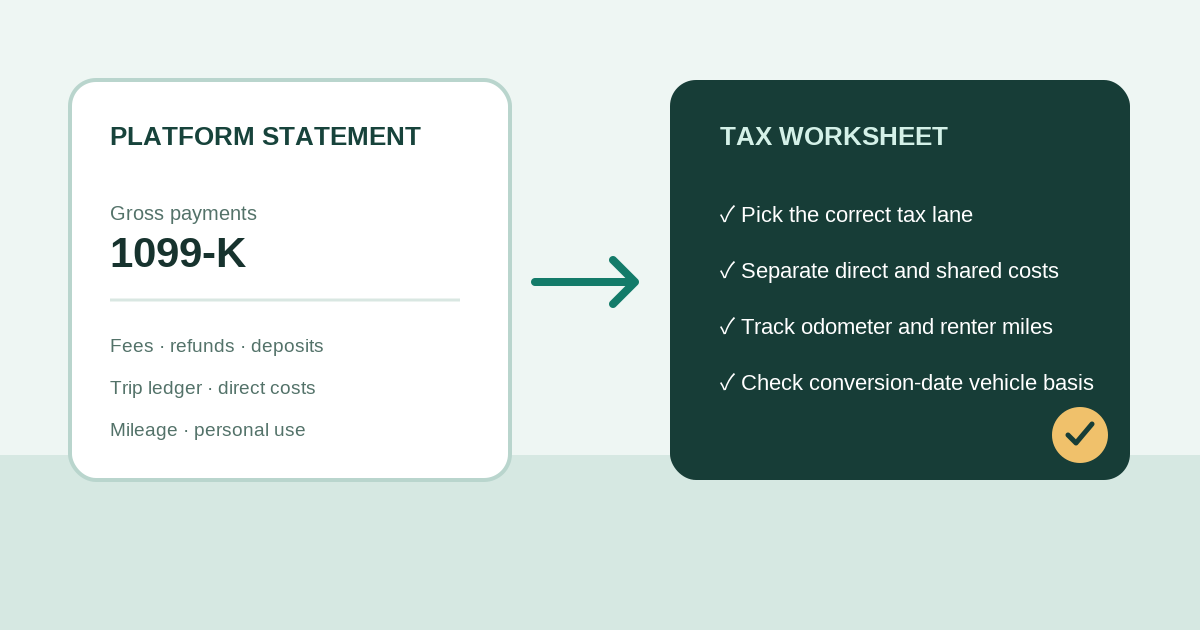
- Form 1099-K generally shows gross payments before fees and other adjustments. Reconcile it to the platform ledger and your bank deposits; the form does not decide how much is taxable.
- A personally owned car's rental use can affect expense allocation and depreciation, but the IRS does not provide a Turo-specific safe harbor for renter miles or a one-click deduction method.
- The calculator below is a gross-to-cash and records worksheet before depreciation and tax. It does not determine deductions, business status, or tax due.
Short answer: Turo hosts report federal rental income whether or not they receive Form 1099-K. Use Schedule C if renting vehicles is your business. For a 2025 profit rental outside a business, use Schedule 1 lines 8l and 24b for income and allowable expenses. Reconcile gross receipts and document vehicle costs before filing.
Which year are you filing? The return lines and example below use final tax-year 2025 instructions. The draft 2026 Schedule 1 keeps lines 8l and 24b. Draft line labels can change. For 2026 rentals generally reported in 2027, use the final 2026 forms when filing. IRS draft 2026 Schedule 1
Start with gross bookings
A host sees $12,000 in bookings and $9,600 in bank deposits. Fees, refunds, and payout timing can explain the gap. Form 1099-K is a starting record. Reconcile it to the trip ledger before working out allowable expenses.
Each shortcut skips a different step. The amount in Box 1a can be gross of platform fees, refunds, or credits. Cash deposited is not the same as gross rental receipts. Gross receipts are not the same as net taxable income after allowable expenses. And the residential “14-day rule” is written for a dwelling unit, not for a passenger car.
Start by classifying the activity. It can be a rental business, a nonbusiness rental conducted for profit, or an activity without a profit motive. Evaluate the facts of how you operate. A booking count or platform form cannot classify it. IRS Publication 525
There is no car-sharing version of the home-rental 14-day exception. IRC §280A(g) and IRS Publication 527 concern certain short-term rental use of a dwelling unit used as a home. A car is personal property; analyze it under the personal-property rental rules.
First decision: business, profit rental, or something else?
The IRS starts with two questions when you rent a vehicle or other personal property. Is the rental activity a business? Are you conducting it for profit? IRS Publication 525 For a business, the IRS describes the general test as a primary purpose of income or profit plus activity carried on with continuity and regularity. It gives no rule such as “more than 14 days,” “five trips,” or “two vehicles” that automatically turns a host into a business.
If you are in the business of renting personal property
The IRS directs rental-business income and expenses for personal property to Schedule C for a sole proprietor. The self-employed tax guide covers the broader filing workflow. Schedule E generally covers real-estate rentals and some other items.
A sole proprietor’s net earnings from the rental trade or business may also be subject to self-employment tax. Check the $400 net-earnings threshold and the Schedule SE calculation. Business expense eligibility generally rests on 26 U.S.C. § 162. IRS Schedule SE instructions
Section 1402(a)(1) generally excludes real-estate rents and rents from personal property leased with real estate. It makes an exception for those rents earned in a real-estate dealer’s trade or business. A standalone car rental falls outside that real-estate rule. Whether you have net earnings from a trade or business still depends on your facts. 26 U.S.C. § 1402(a)(1)
If you rent for profit but are not in that business
For tax year 2025, report profit-motivated, nonbusiness personal-property rental income on Schedule 1, line 8l. Report related allowable expenses on line 24b. 2025 Form 1040 instructions
Section 62(a)(4) generally treats allowable costs attributable to property held to produce rent as adjustments to gross income. Line 24b is that adjustment for this reporting lane. It is available even if you take the standard deduction. The separate § 67(h) rule applies to miscellaneous itemized deductions. Section 212 and other limits still determine which costs qualify. 26 U.S.C. § 62(a)(4) · § 67(h) · § 212
If costs exceed receipts, check for a deductible loss. Ask your preparer to apply the at-risk and passive loss rules. An average period of customer use of seven days or less can take an activity outside the passive rules’ definition of a rental activity. Material participation can still matter to whether a business is passive. IRS Publication 925
If the activity is not conducted for profit
A rental can lose money while still being conducted for profit. For an activity without a profit motive, check Schedule 1 line 8j for the 2025 return. IRS Form 1040 instructions The deduction limits for activities without a profit motive come from 26 U.S.C. § 183. A loss from such an activity cannot offset other income. If the purpose of the activity is mixed, some personal cost-sharing, some profit objective, keep contemporaneous records and get help classifying it before taking deductions.
The calculator lets you select the reporting lane only as a working assumption. It does not decide which category the facts support.
Reconcile Form 1099-K to the platform ledger
Form 1099-K reports gross payment transactions. The gross amount in Box 1a is measured before fees, refunds, credits, shipping, discounts, or similar items. 26 CFR § 1.6050W-1(a)(6) The form may therefore differ from both the amount shown as “earnings” in an app and the cash deposited in your bank account. For proceeds from selling your own possessions, see the personal sales guide.
For calendar years 2025 and 2026, the federal rule generally requires a third-party settlement organization to report a payee only when both tests are met. The payee must have more than $20,000 and more than 200 reportable transactions through that network in the calendar year. Payment-card transactions have no federal minimum threshold. Public Law 119-21 restored the thresholds for third-party network reporting. 26 U.S.C. § 6050W(e) · IRS Form 1099-K FAQs A platform may send a form at a lower amount, a state may have a lower threshold, and the threshold can change. None of that determines whether a rental payment is taxable. The IRS says income may still have to be reported even when no Form 1099-K arrives.
Build a transaction-level bridge:
- Start with Box 1a and any other tax forms for the activity. Do not substitute the net bank deposits for gross.
- Match each form amount against the platform's trip ledger, payment history, and annual tax summary.
- List platform fees and payment-processing charges separately. Preserve the statement that shows the amount and the trip it relates to.
- Identify refunds, canceled bookings, credits, chargebacks, and adjustments. Do not subtract a customer refund twice if the platform already removed it from another total.
- Separate payments for the use of the car from other amounts, such as a payment specifically tied to a repair or reimbursed cost. A Form 1099-K is not a determination that every component has identical tax treatment.
- Reconcile the adjusted amount to bank deposits. Explain timing differences, reserve holds, and payments carried into another statement period.
Keep the platform ledger, bank records and receipts together so you can explain every difference.
Damage payments and deposits
Match damage payouts to claim notices, invoices and amounts already reimbursed. Track what the payment replaces. A repair reimbursement, a payment replacing rental earnings and a fee kept from a guest can have different treatment. For a rental business, a payment for lost income generally follows the income it replaces.
A later reimbursement of a previously deducted repair can enter income to the extent the recovered deduction reduced your tax. If you deducted $500 and the full deduction reduced tax, recovering $500 the next year generally adds $500 to income. If none reduced tax, the exclusion may apply. Show both records to your preparer for a same-year reimbursement. 26 U.S.C. § 111
Keep refundable deposits separate until the trip closes. A deposit returned in full adds no rental proceeds. Record why you kept any part of a deposit. An amount applied to rent can differ in tax treatment from a damage recovery. Keep late and cleaning charges separate from damage settlements. Log any noncash or off-platform payment and ask how to value it. IRS Publication 538
Record toll, refueling and late charges as separate entries. Keep the underlying bills so your preparer can distinguish amounts you kept from amounts collected for someone else and apply your accounting method.
For a crash or theft, bring the insurance proceeds, adjusted basis and repair records to your preparer. The proceeds can change a casualty loss or create a gain. Mixed personal and income-producing use may require separate calculations. IRS Publication 547 · IRS Publication 334
The vehicle is both an asset and a personal-use car
Document the conversion-date basis
Depreciation for a mixed-use car applies to its business or investment-use portion. If you convert a personal car to income-producing use, start with the lower of adjusted basis or fair market value on the conversion date.
Save a valuation as of that date. Retain an appraisal or dated sales of comparable vehicles alongside the odometer reading, condition and options. IRS Publication 551
Passenger automobiles are generally listed property and have annual depreciation limits. These rules include an exception for some lessors. 26 U.S.C. § 280F The recovery method depends on business/investment use, placed-in-service date, prior depreciation, any clean-vehicle credit, and other facts. A personal vehicle put into rental use can therefore require more than entering the purchase price into a spreadsheet.
If you eventually sell the car, bring the conversion valuation and depreciation history to your preparer. IRS Publication 551 explains the separate rules for sale basis. IRS Publication 551
Keep annual and trip odometer records
IRS Publication 946 uses mileage to allocate use for a passenger auto with more than one purpose. Log the beginning and ending annual odometer readings in the vehicle file.
Record the start and end mileage for each rental trip. Log delivery, pickup, repositioning and personal miles separately. An app listing or an open booking day does not show how the vehicle was used. IRS Publication 946
Which miles count toward qualified business use?
- Qualification. The more-than-50% qualified business-use test affects Section 179, special depreciation and the MACRS method.
- Investment use. Investment miles may count when allocating depreciation. They do not count as qualified business miles for this test.
Publication 946 says another person’s use can count as business use if it is directly connected with your business or you receive fair-market rent. Related-party use can face separate limits.
The exception is for taxpayers regularly in the business of leasing listed property. Occasional or incidental leasing is insufficient. Publication 946 gives leasing only one passenger automobile in a tax year as an example that falls short. Multiple vehicles alone do not establish an exception. A fleet host should check the requirements using the entire operation. IRS Publication 946
For an occasional host: A profit rental can have income-producing mileage for depreciation without satisfying the qualified business-use test.
Keep the trip readings. Ask your preparer before applying the standard mileage rate to miles driven by a renter.
If your use changes later: A drop to 50% qualified business use or less can trigger recapture of excess depreciation previously claimed. Keep your original return, depreciation schedules, and annual use records.
Shared expenses need an allocation, not a guess
Separate expenses tied to a particular trip from annual costs that also support your personal driving. A platform fee directly tied to a booking is easier to trace than the entire annual premium on a personal auto policy. Repairs, insurance, registration, cleaning supplies, tolls, parking, delivery, and loan interest each have their own character and allocation questions. For a mixed-use car, “I rented it 20% of the days” is not a universal allocation method.
A mileage example, and what it does not prove
Suppose a car travels 12,000 total odometer miles in a year and trip records show 4,800 renter miles. The renter-mile share is 4,800 ÷ 12,000, or 40%. If the owner paid $2,400 for an annual insurance premium, multiplying $2,400 by 40% gives $960 as a starting allocation illustration. The $960 is a recordkeeping illustration.
First confirm the expense is allowable under the actual-expense method. Document why the allocation reflects the facts. Publication 334 limits a sole proprietor’s vehicle insurance deduction to the business portion. Publication 463 explains mixed-use car expense allocation. IRS Publication 334
Keep three separate mileage totals:
- Renter miles. Calculate these from each trip’s start and end odometer records.
- Delivery and repositioning miles. Log the date, mileage and purpose of each drive.
- Personal miles. Log commuting and errands separately. If you stop for a personal errand during delivery or pickup, record the personal detour in this bucket.
Track days available for booking separately.
If total annual mileage is zero or missing, leave the mileage allocation unresolved until you have odometer records. The 40% example does not establish “qualified business use” for the listed-property threshold: the activity's classification and the statutory definition still matter.
If a host uses the standard mileage method, actual insurance is already included. Keep trip-specific and annual costs in separate records. A preparer may need a different allocation for a trip-specific cleaning charge, annual registration, loan interest, or an expense that benefits the vehicle even while it is parked.
Check rental taxes separately from federal income tax
Check state and local requirements where each trip occurred. Match the invoice tax detail to what those agencies require. Turo says it collects and remits sales tax in most U.S. states. Review any host registration, filing or remittance obligation that still applies. Track government tax collections separately and confirm federal treatment with your preparer. Turo U.S. sales tax guidance
Create a record set with:
- Total odometer miles for the year and renter miles by trip.
- Dates the car was actually rented, personally driven, or unavailable for repair. “Available” time is not the same as actual use.
- Platform fees, refunds, and deposits by booking.
- Receipts for direct trip costs and any shared costs you have a documented method for allocating.
- The conversion date, fair market value on that date, adjusted basis, prior depreciation, and any vehicle credits or Section 179 elections.
- The exact tax method and forms used each year, including any depreciation recapture calculation.
Publication 463 describes eligibility for the standard mileage method. It gives no express Turo rule for renter-driven miles. Keep trip mileage for your records and confirm the method with your preparer before applying a rate.
Case study: one Form 1099-K, two possible tax lanes
Assume Dana is a single filer. Before the rental activity, her 2025 taxable income is $110,000, within the 2025 federal 24% marginal bracket for single filers (taxable income over $103,350 and not over $197,300). In 2025 she rents her personal sedan in four separate periods starting March 14, May 22, August 8, and November 14. For illustration, assume her preparer concludes that the activity was conducted for profit but was not a rental business. That conclusion is fact-specific; the dates alone do not establish it.
Her platform's annual ledger shows:
- Form 1099-K Box 1a reports $12,000. Assume the platform issued the form below the federal threshold.
- The platform retained $2,400. Dana paid $600 in trip cleaning costs her preparer confirmed were allowable.
- The worksheet shows $9,000 before depreciation and any additional eligible expenses.
Dana received $9,600 after platform fees, then paid $600 in cleaning. The $9,000 is a pre-depreciation amount under these assumed facts, not the final taxable result. Her preparer separately checks whether depreciation is available using the documented conversion-date basis, listed-property rules, and the actual use records. Assume the full $9,000 raises Dana’s taxable income from $110,000 to $119,000. That is below the $197,300 single-filer ceiling for the 24% bracket in 2025. Regular federal income tax rises by $2,160 ($9,000 × 24%). The illustration uses taxable income. Modified adjusted gross income is a separate figure for the net investment income tax test. 2025 tax computation worksheet · IRS Net Investment Income Tax
A rental business uses Schedule C. It also requires a separate self-employment-tax calculation. The underlying $12,000 Form 1099-K is still only a starting point, and the vehicle-use and depreciation work remains. Dana cannot select the less-taxed outcome; she must apply the facts and law to the activity.
Step-by-step execution
- Choose the tax year. Use the final IRS forms and instructions for the return you are filing. This guide's line references are for 2025 returns filed in 2026.
- Save the source records. In one folder for each tax year, save the platform’s trip ledger, payout details and receipts. Add Form 1099-K when it arrives. Keep bank statements in the same folder to check payout timing.
- Reconcile every dollar. Match every Form 1099-K, including one issued below the threshold, to trip and payout records. Record fees, refunds and damage payments separately. Count each adjustment once and leave unexplained differences visible. For a December trip paid out in January, save both dates and confirm when payment was received or made available. Ask the issuer to correct a genuinely wrong form. IRS Form 1099-K guidance
- Write a classification memo. Record why the activity is or is not a rental business and whether the main purpose was profit. Include the number and pattern of rentals, operating practices, marketing, time spent, and intent to continue. Update the memo if the number of rentals or the way you run them changes materially.
- Build the vehicle-use log. Record the conversion date and both annual odometer readings. Keep separate mileage buckets for renters, your personal trips, and delivery or repositioning. Keep vehicle-specific receipts.
- Reconstruct basis and prior tax history. Keep purchase, improvement, credit, trade-in and prior depreciation records in the vehicle file. Add your dated conversion valuation and loan or lease paperwork.
- Separate expense types. Mark direct booking costs apart from shared annual vehicle costs. Only include shared amounts after you have a supportable allocation and confirmed deductibility.
- Use the right reporting lane. For 2025, a profit rental that is not a business uses Schedule 1 lines 8l and 24b. A personal-property rental business generally uses Schedule C. Confirm current forms before filing; do not use Schedule E just because a booking is called a “rental.”
- Check for downstream tax items. Review self-employment tax, investment-income tax, loss limits and any depreciation recapture. Check local rental taxes separately. The self-employed money guide covers setting money aside for tax.
- Retain the method and records. Keep the return, depreciation schedule, trip-mileage records, allocation method, and supporting documents together. A change in use can affect future-year depreciation and recapture.
What the calculator does, and deliberately leaves for your return
Use the worksheet to reconcile reported gross with refunds, fees and costs. It shows cash before depreciation and tax and the share of miles driven by renters. The reporting selector shows the 2025 return references.
Use the worksheet for recordkeeping. The activity’s facts and federal rules determine classification, allowable costs, depreciation, mileage method and tax due.
Car-sharing gross-to-cash worksheet
Reconcile receipts and fees, then keep the mileage record separate from any tax deduction method.
Choose only a working classification from you or your tax preparer. The worksheet cannot classify the activity.
2025 return reference: a profit-motivated nonbusiness personal-property rental generally uses Schedule 1 lines 8l and 24b; a personal-property rental business generally uses Schedule C. Confirm the final instructions for the tax year you file.
Resolve the business/profit classification before using a return line. The selector changes only this note.
Gross records to reconcile
$12,000.00
1099-K plus other receipts entered
Receipts after entered refunds
$12,000.00
Before platform fees and costs
Cash subtotal before depreciation/tax
$9,000.00
Not taxable income or a deductible loss
Renter miles / annual miles
40.0%
Recordkeeping ratio only
Tax treatment reminder
No depreciation, standard mileage deduction, passenger-auto limit, Section 179 test, recapture, self-employment tax, passive-loss limit, NIIT, or tax bill is calculated. Confirm each separately.
This is a cash and record-reconciliation worksheet, not a tax-return calculator. Rental classification, expense allocation, mileage treatment, depreciation basis, deductions, and tax depend on facts and current IRS instructions.
Method and sources
This guide provides federal tax education. Consult a CPA or qualified tax professional before deciding how to classify your rentals, allocate costs, or claim depreciation.
Common questions
Is Turo income taxable if I never receive Form 1099-K?
Report taxable rental income even without Form 1099-K. Under 26 U.S.C. § 6050W(e), the federal third-party network reporting rule generally requires both gross payments over $20,000 and more than 200 transactions. Lower state thresholds or voluntary reporting can still produce a form.
Does the 14-day rental rule make car-sharing income tax-free?
No. The IRC §280A(g) rule is for the rental of a dwelling unit used as a home. It does not create a 14-day tax-free period for renting a car.
Should I report Turo income on Schedule C or Schedule 1?
The IRS says personal-property rental activity is generally reported on Schedule C when you are in the business of renting the property. If you rent for profit but are not in that business, the 2025 Form 1040 instructions use Schedule 1 line 8l and related allowable expenses on line 24b. The facts decide the lane. The draft 2026 Schedule 1 retains those lines. Check the final 2026 instructions before filing for 2026 rentals.
Can I deduct all my car expenses because I rented it?
No. Expenses must be substantiated and connected to rental or business use. Costs shared with personal use need a defensible allocation. Vehicle depreciation also involves conversion-date basis, listed-property and passenger-auto limits, and possible recapture.
Can I use the standard mileage rate for miles driven by renters?
Do not assume so. IRS guidance says fair-market rental by another person can affect listed-property business-use analysis, but it does not expressly give a Turo host permission to multiply renter miles by the standard mileage rate. Keep odometer and trip records and verify the method with a tax professional.
Connect the lesson
Turn the article into a next step.
SwitchWize takeaway
Find your number, not the market's.
Run a Money Map to see how your cash, debt, and rates stack up against the best available options.
Start Money Map →