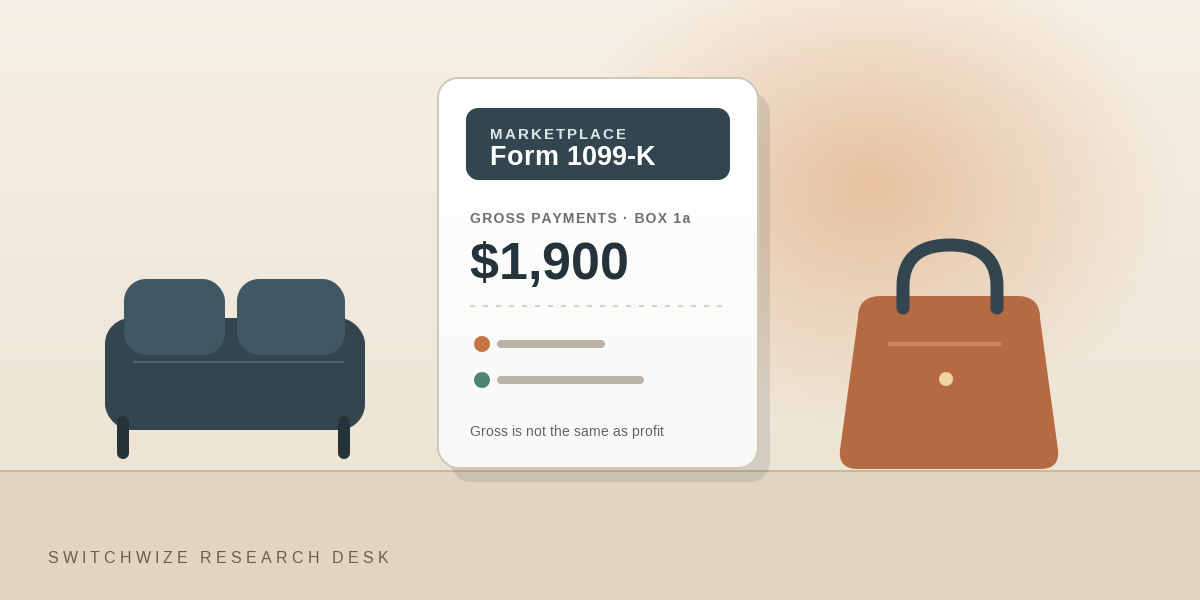
- Form 1099-K reports gross payments, not taxable income or profit.
- A loss on an ordinary personal-use item cannot be deducted or used to offset a gain on another personal item.
- The IRS's current 2025 return instructions provide a Schedule 1 entry-space method for reported personal-item losses; Form 8949 has an alternative nondeductible-loss adjustment.
Short answer: On a 2025 federal return, enter the Form 1099-K gross proceeds attributable to personal items sold at a loss at the top of Schedule 1. Form 8949 offers an alternative for those losses. Report gains separately on Form 8949 and Schedule D. If the form includes other payments, reconcile each item using its basis and selling expenses.
A marketplace can report $1,900 from a couch and a handbag when only $400 is taxable. Trace the gross payment to each item. Then compare what you received after selling costs with the item's adjusted basis.
The trap: a matching form is not the same as taxable income
Form 1099-K is an information return. Payment-card companies, payment apps, and marketplaces send it to report qualifying gross payment transactions. Its box 1a can include amounts before platform fees and other costs. It does not identify whether a payment was a sale, a reimbursement, a gift, a personal possession sold below cost, or a business receipt. It does not report your purchase basis.
The form is useful because the IRS receives a copy and may compare it with your return. Ignoring a form that looks too large can create a notice problem. Treating every dollar on it as profit can make you pay tax you do not owe. Use the transaction ledger to explain what makes up box 1a. For the wider filing workflow, see our federal tax filing guide.
Federal reporting by a third-party settlement organization generally requires both more than $20,000 in reportable payments and more than 200 transactions. Payment-card transactions have no federal dollar threshold. Platforms can send forms below their federal threshold, and a state can set lower thresholds. Calculate taxable gains even for sales without a form. 26 U.S.C. § 6050W(e)
The rule: treat each personal item on its own
For a typical item you bought and used personally, the purchase cost is usually its basis. Adjusted basis can differ if you made improvements, claimed depreciation, or acquired the property in a special way. Your amount realized is generally the sale proceeds reduced by expenses directly connected with the sale. Compare amount realized with adjusted basis.
- Amount realized below basis: you have an economic loss, but a loss on property held for personal use is generally not deductible.
- Amount realized above basis: the excess is a taxable gain. Report the gain on Form 8949 and Schedule D, even if you did not receive a 1099-K.
- Break-even: no gain or loss, though a reported 1099-K still needs to be reconciled as the return-year instructions require.
You cannot use the loss on your old couch to offset the gain on a handbag, concert ticket, collectible, or another personal item. Personal-use losses are nondeductible item by item. If some sales were at a gain and others at a loss, report them separately.
Selling fees matter. If a buyer paid $800 and the platform kept $80, you did not net $800 in cash. This guide subtracts selling expenses from the sale proceeds, following IRS Publication 550. Count each fee once. With a $500 basis, $800 gross sale price, and $80 fee, the gain is $220, not $300. Keep the platform statement showing the fee.
The simple purchase-price rule does not fit every item. Gifted and inherited property can have special basis rules. Check IRS Publication 551 before using the donor’s purchase price. A collectible can face a different maximum capital-gains rate. Items held for resale, inventory, rental, business use, or in exchange for services may fall under business or other rules rather than this personal-use worksheet. If you cannot substantiate basis, do not enter zero and treat the resulting difference as a confirmed gain.
What the IRS currently says to put on the return
On a 2025 federal return, use the entry space at the top of Schedule 1 for gross proceeds from reported personal items sold at a loss. Use that space for amounts reported in error, too. If box 1a includes other payments, classify and report those separately. A personal-use loss produces no deduction. 2025 Form 1040 instructions
Enter a personal item sold at a gain on Form 8949. A gain from an item held for one year or less goes in Part I. A gain from an item held for more than one year goes in Part II. For an ordinary item without a Form 1099-B or 1099-DA, use box C for short-term transactions or box F for long-term transactions. The totals carry to Schedule D. If you report net proceeds in column (d), leave those same selling expenses out of column (g). If you enter gross proceeds instead, follow the instructions for code E and report the expenses as a negative adjustment. 2025 Form 8949 instructions
The Form 8949 alternative for a reported loss
Use one reporting path per loss item. On Form 8949, enter proceeds in column (d) and basis in column (e). Enter code L in column (f). In column (g), enter the nondeductible loss as a positive amount to bring the result in column (h) to zero. Use net proceeds for the simple example here and count fees once. 2025 Form 8949 instructions
The IRS FAQ still contains older examples using Schedule 1 lines 8z and 24z for 2022 and 2023 returns. Do not copy those old line numbers onto a current return. Follow the instructions for the tax year you are filing. The draft 2026 Schedule 1 retains a top entry. Use the final 2026 form and instructions when filing for sales made during 2026.
Step-by-step: reconcile the form without inventing a deduction
- Download the form and transaction report. Save every 1099-K and the marketplace or payment-app ledger for the same tax year. Reconcile box 1a to individual transactions before making tax entries.
- Sort payments by what they were for. Separate personal property from services, business sales, rental activity, reimbursements, gifts, and transactions that belong to someone else. Ask the filer for a corrected form when the amount or payee is wrong. If the filer does not fix it, file on time and follow the return-year error instructions. The medical fundraiser tax guide covers a separate kind of payment that can be difficult to classify.
- Create one line per personal item. Record what it was, when and how you acquired it, its basis, sale date, gross buyer payment, refunds or price adjustments, and direct sale costs. A bundle of household goods may contain both gains and losses; use reasonable support for allocation rather than netting the bundle without records.
- Establish basis. Start with receipts, order history, credit-card statements, or bank records. Add capital improvements when applicable. For gifts and inheritances, find the donor or estate records and use the applicable basis rule. Keep a written note of any reasonable reconstruction if a receipt is missing.
- Calculate each item's gain or loss. Reduce sale proceeds by selling costs once, then compare the result with adjusted basis. Mark each item separately. Do not offset a loss from personal property against a gain on a different personal item.
- Use the right reporting path for the return year. On a 2025 return, enter the gross amounts from loss items in the Schedule 1 space. Report gains on Form 8949 and Schedule D. Alternatively, use Form 8949's code-L adjustment to zero a loss item. Tax software may ask questions in a different order; review the resulting forms.
- Keep the audit trail. Retain the 1099-K, itemized settlement report, purchase/basis support, sale listing, fee records, shipping records and your reconciliation. This evidence helps explain why the tax return does not treat all of box 1a as income.
Federal reconciliation helper · illustrative
Personal-item 1099-K worksheet
Classify each personal sale separately, estimate taxable gains, and identify the gross proceeds tied to nondeductible losses under the 2025 IRS reporting instructions.
Personal-use items on the form
Enter each item separately. Maximum 12 items. The sample starts with the IRS couch-and-handbag example; replace it with your records.
Sale 1: Couch
Amount after sale costs
$700
Item result
$300 loss
Federal treatment estimate
Personal loss · not deductible
Sale 2: Handbag
Amount after sale costs
$1,200
Item result
$400 gain
Federal treatment estimate
Taxable gain · Long-term
Reconciliation snapshot
Candidate figures based on the items and amounts you entered; not a tax-return result.
Assigned to box 1a
$1,900
Loss-item gross
$700
2025 Schedule 1 top-entry candidate; not a deductible loss.
Personal gains
$400
Reportable gain estimate before other return-level netting.
Loss not deductible
$300
Shown for understanding; never subtract it from another personal-item gain.
Short-term gain: $0
Long-term gain: $400
Term needs review: $0
The entered personal items and other amounts add up to box 1a.
How this worksheet calculates the figures
- Per item, estimated amount realized = assigned gross 1099-K proceeds − selling costs. Estimated gain/loss = amount realized − the basis you enter.
- Loss items contribute their assigned gross proceeds to the Schedule 1 candidate and display the economic loss separately as nondeductible. Personal losses never reduce the taxable gain on another personal item.
- Positive gains are split by holding period when valid dates are entered. Inherited items are treated as long-term only after you check the box and confirm basis separately.
- Refunds, canceled sales, collectibles rates, gift basis, business/resale activity, state tax, other capital gains/losses, and tax due are not modeled. Do not enter a fully canceled/refunded sale as an ordinary completed sale.
- The Schedule 1 candidate reflects the 2025 IRS instructions. Verify the tax-year-specific form instructions before filing.
Educational federal worksheet only. It does not establish tax eligibility, prepare Form 1040, or replace transaction records or professional advice. If basis is uncertain or the activity was not personal use, do not rely on the estimate.
A worked example: one reported loss, one taxable gain
Maya sells two personal items through the same marketplace in 2025. She bought the couch for $1,000 on April 15, 2023, and sells it for $700 on June 2, 2025. She bought the handbag for $800 on March 2, 2024, and sells it for $1,200 on October 1, 2025. The marketplace reports $1,900 in box 1a. Assume no fees, refunds, shipping charges, improvements, or unusual basis facts.
- Couch. The $700 buyer payment and $1,000 basis produce a $300 nondeductible loss. The 2025 Schedule 1 entry for the couch is $700.
- Handbag. The $1,200 buyer payment and $800 basis produce a $400 long-term gain. She held the handbag for more than one year. The gain goes on Form 8949 and carries to Schedule D.
- Reconciliation. The buyer payments add to $1,900. The return shows the $700 loss-item amount and the $400 gain on their respective forms.
If Maya chooses Form 8949 for the couch, she enters $700 of proceeds and $1,000 of basis. She uses code L and enters a positive $300 adjustment. The resulting amount in column (h) is zero. She still reports the handbag's $400 gain. The $300 loss is not a tax deduction and cannot reduce the handbag gain.
Suppose the platform instead retained a $60 selling fee from the handbag. The economic gain becomes $340 after subtracting the $60 once as a sale expense. If the fee is also shown as a reduction in proceeds and added to basis, the math would double-count it. Reconcile the actual transaction statement with the method your return software uses.
If Maya’s entire $400 gain falls in the 15% federal long-term capital-gains bracket, the additional federal tax on the gain is $60. This example assumes no offsetting investment losses, net investment income tax or other federal interactions. With the $60 selling fee, the same assumptions give $51 on a $340 gain. IRS Publication 550 explains the federal capital-gains rates. The digital-asset tax guide covers different sales that may also appear on Schedule D.
When a fee turns a higher sale price into a loss
An April 2025 sale of a camera for $330 looks profitable against a $325 basis. If the platform keeps a $30 selling fee, the amount realized is $300 and the personal loss is $25. If $330 is included in box 1a, the 2025 Schedule 1 candidate is $330. The fee changes the classification, while the loss-item entry follows the reported gross payment.
If the fee were $5, the sale would break even. The 2025 Schedule 1 instructions name personal items sold at a loss. Keep the reconciliation and check how your software reports an exact break-even sale. Refunds can also make reported gross differ from actual sale proceeds. Reconcile those with the platform statement first. The worksheet assumes the gross buyer payment you enter is also sale proceeds before costs.
Which sales need different rules?
This guide covers ordinary property you owned for personal use and sold through a platform that reported payments on Form 1099-K. Business use or repeated purchases for resale can change the filing path. Gifts and inheritances may have special basis rules. Collectibles can have a different maximum capital-gains rate. Those facts can change the form and calculation.
A personal item sold below cost can be correctly reported by a platform. Request a correction when the reported amount or recipient is wrong. Save the issuer correspondence alongside the transaction statement. See the IRS’s instructions for an incorrect Form 1099-K.
Method and sources
Sources
- Internal Revenue Service, 2025 Instructions for Form 1040, Schedule 1: Form(s) 1099-K: current return-year entry-space method and couch/handbag example.
- Internal Revenue Service, 2025 Instructions for Form 8949: gains from personal property, nondeductible personal losses, code L adjustment, basis and holding period.
- Internal Revenue Service, What to do with Form 1099-K: gross payment reporting, separate gain/loss treatment and personal-property examples.
- Internal Revenue Service, Form 1099-K FAQs: General information, updated October 23, 2025: payment-card transactions have no federal reporting threshold; the $20,000/more-than-200 rule applies to TPSOs.
- Internal Revenue Service, Publication 544 (2025), Sales and Other Dispositions of Assets: amount realized, basis, gains and nondeductible losses on personal-use property.
- Internal Revenue Service, Publication 550 (2025), Investment Income and Expenses: amount realized reduced by sale expenses; capital-gain rules.
- Internal Revenue Service, Publication 551 (2025), Basis of Assets: cost, adjusted, gift and inherited basis.
- Internal Revenue Service, 2023 Form 1099-K FAQ update (FS-2023-06): marketplace fees, gross amounts before fees/refunds, and recordkeeping. Its older Schedule 1 line references have been superseded by the 2025 Form 1040 instructions cited above.
- 26 U.S.C. § 6050W(e): reporting threshold for third-party settlement organizations. It is an information-reporting rule, not an income-tax threshold.
- IRS Form 1099-K FAQ on common situations. The entry at the top of Schedule 1 began in tax year 2024.
Checked November 21, 2026 against the final 2025 individual-return instructions and draft 2026 Schedule 1. This guide provides federal tax education. Consult a CPA or another qualified tax professional before relying on it for a filing decision.
Common questions
Does getting a 1099-K mean I owe tax?
No. Form 1099-K reports gross payment transactions. Whether any amount is taxable depends on what the payment was for, your basis and selling costs, and the rules for that property. A personal-use loss is generally nondeductible; a personal-use gain is taxable.
Can I deduct a loss when I sell my used couch or clothes?
Generally no. A loss on personal-use property is not deductible. If a 1099-K reported the sale, the IRS's 2025 Form 1040 instructions allow the proceeds attributable to the loss item to be entered in the space at the top of Schedule 1, or the transaction can be zeroed out on Form 8949 using adjustment code L. The entry prevents the gross form amount from being treated as taxable income; it does not create a deduction.
What if I sold some personal items for a loss and others for a gain?
Separate each item. Do not use a loss on one personal-use item to reduce a gain on another. Report the gross amount attributable to loss items in the Schedule 1 entry space under the current instructions, and report each gain on Form 8949 and Schedule D.
Are marketplace fees included in my 1099-K taxable amount?
Box 1a generally reports gross payments before fees. Selling and payment-processing fees affect the gain-or-loss calculation, so reconcile the form to transaction records and account for each fee once. Publication 550 describes amount realized as proceeds less expenses of sale.
Connect the lesson
Turn the article into a next step.
SwitchWize takeaway
Find your number, not the market's.
Run a Money Map to see how your cash, debt, and rates stack up against the best available options.
Start Money Map →