- Working for yourself means building the money infrastructure an employer used to provide: taxes, retirement, cash flow, and benefits, as four systems you run yourself.
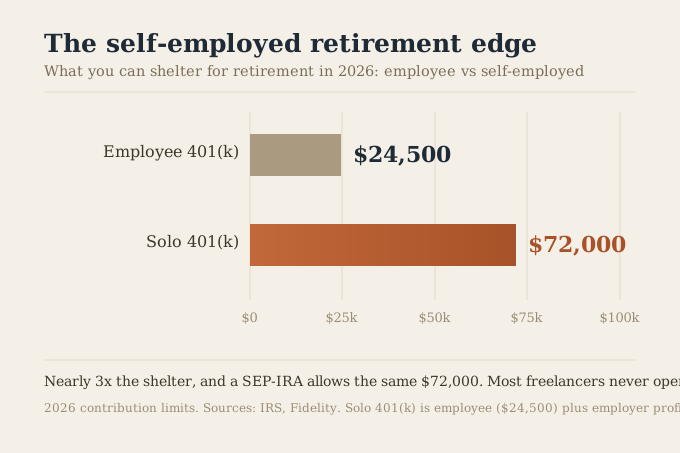
- The hidden upside is retirement: a solo 401(k) or SEP-IRA lets you shelter up to $72,000 in 2026, nearly three times an employee's $24,500 limit.
- The discipline is taxes and cash flow: reserve 25% to 30% of every payment for the 15.3% self-employment tax, pay quarterly, and pay yourself a steady draw from a buffer.
When you take a regular job, an invisible machine runs in the background. Payroll withholds your taxes and remits them. A 401(k) is offered, sometimes with a match. A chunk of your health premium is quietly paid by your employer. You never see most of it, which is exactly why it is so jarring when you go out on your own and it all stops. Self-employment does not just change how you earn; it hands you the entire back office. The freelancers and consultants who build real wealth are not necessarily the ones who earn the most. They are the ones who rebuild that machine deliberately, as four systems. This is how to build each one. This page is reviewed by the SwitchWize Editorial Team; the 2026 figures are sourced below with dates. Mastering self-employed money management means understanding these four systems and how they work together to replace what your employer once provided.
The reframe: you are now the back office
Every dollar you earn as a freelancer arrives raw, with nothing taken out and nothing set up. That is the whole challenge in one sentence. An employee's money is pre-processed: taxed, sorted, partly invested, partly insured, before it ever reaches them. Yours is not. So the job is to build the four systems that processing used to handle, taxes, retirement, cash flow, and benefits, and to build them as standing systems rather than annual scrambles.
None of the four is hard on its own. What makes self-employment feel financially precarious is running without them: taxes that arrive as a shock, retirement that never gets funded, income that feels random, and benefits that get skipped. Build the systems and the same income feels stable. Here they are, in the order that matters.
System 1: Taxes
The first surprise is the self-employment tax: a flat 15.3% on your net business income, 12.4% for Social Security and 2.9% for Medicare, per IRS rules. At a job, your employer pays half of that; on your own, you owe both halves, which is why it stings. It applies on top of ordinary income tax, and it is assessed on profit after expenses, so every legitimate deduction lowers it.
Two habits handle it. First, reserve 25% to 30% of every payment for taxes, moving it to a separate account the moment a client pays, so it is never available to spend. Second, pay quarterly, around April 15, June 15, September 15, and January 15, because the IRS expects payment as you earn and penalizes underpayment. One offset works in your favor: the 20% qualified business income deduction lowers your income tax, though not the 15.3% self-employment tax. See our self-employed taxes guide for the full picture.
Estimate self-employment tax using 92.35% of net profit, the Social Security wage base after W-2 wages, Medicare tax, and the Additional Medicare Tax threshold.
2026 SSA wage base. Social Security tax applies only up to this amount across W-2 and self-employment earnings.
Enter wages already subject to Social Security tax. They reduce the wage base available for self-employment earnings.
$200,000 for single filers, $250,000 for married filing jointly
Total Self-Employment Tax
$11,304
Use this result as one input in your broader Money Map, not as a one-off number.
What to do
Plan your tax strategy
Pre-tax estimates. For illustration only — not financial advice.
System 2: Retirement, your biggest advantage
Here is the part most freelancers never exploit. As your own employer, you can open a retirement plan far more generous than a typical workplace 401(k). A solo 401(k) allows up to $72,000 in 2026, because you contribute as both employee (up to $24,500) and employer (profit-sharing), versus the $24,500 an employee alone can put in a workplace plan. That is nearly three times the shelter, and it is the single largest financial benefit of working for yourself.
The main choice is between a solo 401(k) and a SEP-IRA, which also allows up to 25% of compensation, capped at the same $72,000, with less paperwork. The solo 401(k) usually permits a larger contribution at moderate income and offers a Roth option; the SEP-IRA wins on simplicity. Either one turns self-employment's biggest tax burden into its biggest tax advantage. Our solo 401(k) versus SEP-IRA guide compares them in detail.
A SEP IRA allows 25% of net self-employment income; a Solo 401(k) adds an employee deferral on top of that same employer contribution: see which allows more.
For an unincorporated owner, plan compensation generally requires a special self-employed adjustment and is not simply gross business profit.
A 20% planning rate is commonly used for a sole proprietor's adjusted compensation; incorporated businesses may use up to 25%, subject to plan and tax rules.
Solo 401(k) Max Contribution
$44,500
Use this result as one input in your broader Money Map, not as a one-off number.
What to do
Compare Solo 401(k) providers
Pre-tax estimates. For illustration only — not financial advice.
System 3: Cash flow, turning lumpy into steady
Irregular income is the complaint, but it is really a cash-flow design problem. The fix has three parts. First, separate business and personal accounts, so you can see what the business actually earns and keeps. Second, hold a buffer in the business account and pay yourself a fixed monthly draw from it, sized to a conservative average of your income, so strong months refill the buffer and weak months draw it down without touching your personal budget. Third, keep the tax reserve (the 25% to 30% above) and a business emergency fund as distinct pools.
That reserve cash is not idle; it is waiting for a deadline, and it should earn while it waits. Keep the tax and buffer reserves in a high-yield savings account, not a checking account paying nothing. These are current rates, live as of today, all FDIC-insured:
Create a baseline budget for freelance or variable income.
Baseline Spending Cap
$0
Use this result as one input in your broader Money Map, not as a one-off number.
What to do
Plan your next move
Pre-tax estimates. For illustration only — not financial advice.
System 4: Benefits and structure
Two pieces complete the machine. The first is benefits you now own. Health coverage usually comes from the ACA marketplace, and the self-employed can typically deduct their premiums, an above-the-line deduction that lowers taxable income. Disability insurance matters more without an employer plan behind you, since your income depends entirely on your ability to work.
The second is business structure. Most freelancers start as sole proprietors, which is fine. But once profit is consistently high, often cited around $80,000 to $100,000 or more, electing S-corp status can cut self-employment tax: you pay yourself a reasonable salary subject to payroll tax and take the rest as distributions that avoid the 15.3%. It adds payroll and a separate return, so it only pays above a threshold where the savings beat the complexity. Our banking guides for freelancers and small business cover the accounts that support either structure.
The order to build them
Build the four systems in sequence, not all at once. Separate the accounts first, because everything else depends on seeing business money clearly. Then stand up the tax reserve and quarterly payments, since unpaid taxes compound into the worst surprises. Next, open the retirement account and start contributing, even modestly, to capture the outsized shelter. Then formalize the draw and buffer so income feels steady. Finally, handle benefits and structure as profit grows. Done in order, the back office you inherited stops being a burden and becomes the reason self-employment can build more wealth than a salary, not less.
Methodology
The contribution limits, self-employment tax rate, and quarterly deadlines are the IRS's 2026 figures. The solo 401(k) and SEP-IRA maximums of $72,000 reflect the 2026 defined-contribution limit; actual amounts depend on your net income and, for the solo 401(k), your employee-plus-employer split, which is what the calculator computes. The 25% to 30% tax-reserve guidance is a practical rule, not a precise figure; your real rate depends on income, state, and deductions. The S-corp threshold is a common rule of thumb, not a bright line. Nothing here is individualized financial, tax, or legal advice, and an accountant is worth the cost as income grows.
For the full set of tools and guides built around self-employed and small-business finance, see the freelancer and small business finance hub.
How we source this. Tax rates, contribution limits, and deadlines come from the IRS; account mechanics from our maintained cluster guides, all cited with dates. See our methodology and editorial team. We take no payment for organic rankings.
Sources
- IRS, self-employment tax (Social Security and Medicare): the 15.3% rate.
- IRS, retirement plans for the self-employed and 2026 contribution limits for solo 401(k) and SEP-IRA.
- IRS, estimated taxes for the quarterly schedule; qualified business income deduction under Section 199A.
Figures are current for the 2026 tax year and vary by income, state, and structure. This page is informational, not financial, tax, or legal advice. Free to cite with attribution to SwitchWize.
Frequently Asked Questions
What is the self-employment tax and how much is it?
How much should I set aside for taxes as a freelancer?
Should I use a solo 401(k) or a SEP-IRA?
How do I manage irregular income as a freelancer?
When should a self-employed person form an S-corp?
Answer a few questions about your situation and goals. Money Map points you to the highest-value next step across savings, mortgage, cards, and debt.
Editorial review
What changed since the last update
Was this guide helpful?
Found an inaccurate, outdated, or missing claim? Report a correction. We verify reports against the relevant source before changing a guide or ranking.
