- Once your business makes real profit, four structural decisions move nearly all the money: the entity election and salary split, the salary that also funds retirement and QBI, estimated taxes, and the wall between the business and you.
- The reasonable salary is the master dial. Setting it low saves payroll tax but caps your solo 401(k) employer contribution (25% of W-2 wages) and can shrink your QBI, so the three goals fight each other.
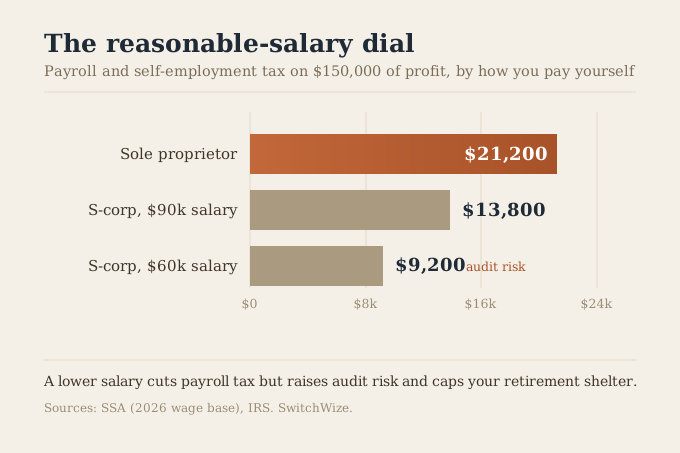
- On $150,000 of profit, an S-corp election saves roughly $7,000 to $12,000 a year in self-employment tax, but only if the salary survives IRS scrutiny.
There is a moment in a business's life when the freelancer playbook stops working. The profit is no longer just replacing a paycheck; it is real money, and suddenly the decisions that govern your personal finances are not budgeting habits but structural choices with tax code attached. How you are incorporated. How you pay yourself. How much of your own money is actually yours to spend. Most owners drift into these decisions or copy what a peer did, and quietly overpay for years. The thing to understand is that at this level, a handful of choices move nearly all the money, and they are tangled together in ways that are not obvious. This is the playbook for those choices. This page is reviewed by the SwitchWize Editorial Team; the 2026 figures are sourced below with dates. Small business owner money management is ultimately about making these structural decisions work together strategically.
The reframe: four dials, not a budget
Personal-finance advice for business owners tends to be the same advice everyone gets, with the word "business" bolted on: track your spending, build an emergency fund, save for retirement. None of that is wrong, but it misses what actually determines the outcome at this stage. When your business is profitable, your financial life is governed by four structural decisions, and each is worth more than a year of frugality:
- The entity and the salary split. How you are taxed, and how you divide profit into salary and distributions.
- Paying yourself twice. The salary that also unlocks your largest retirement shelter and your QBI deduction.
- The estimated-tax system. Nobody withholds for you, so cash-flow discipline replaces a payroll department.
- The wall. Keeping the business's money, and its liabilities, separate from your own.
What makes this genuinely hard, and genuinely different from the freelancer's version, is that the dials are connected. Turn one and the others move. The rest of this playbook walks them in order and shows where they collide. If you are earlier in the journey, still trading time for money as a solo operator, start with the self-employed money playbook; this one picks up where that leaves off.
Dial one: the entity and the salary split
As a sole proprietor or a default LLC, every dollar of profit is hit with self-employment tax: 15.3% (Social Security plus Medicare) on the first $184,500 of net earnings in 2026, then 2.9% above that, per the Social Security Administration. On $150,000 of profit, that is roughly $21,200 before income tax even enters the picture.
Electing to be taxed as an S corporation changes the structure. You split your profit into a W-2 salary, which still pays payroll tax, and distributions, which do not. Only the salary is exposed to the 15.3%. That is the entire savings mechanism, and it is why the election tends to pay off once profit clears roughly $60,000: below that, the cost of payroll, a separate return, and bookkeeping outweighs the savings; above it, the math turns in your favor and keeps turning. Model your own number before electing, because the election commits you to running real payroll:
Illustrate regular Social Security and Medicare tax differences between an entered reasonable-salary scenario and treating all owner compensation as salary.
Must be reasonable compensation for the services performed. The IRS scrutinizes salaries set unreasonably low
Current-year SSA wage base; confirm on ssa.gov
Modeled Regular Payroll-Tax Difference
$7,650
Use this result as one input in your broader Money Map, not as a one-off number.
What to do
Plan your tax strategy
Pre-tax estimates. For illustration only — not financial advice.
Dial two: the salary is the master dial
Here is the insight most owners miss, and it is the reason this is a system and not a checklist. The obvious move after electing S-corp status is to minimize your salary, since a lower salary means less payroll tax. But that same W-2 salary number is quietly load-bearing for the two biggest tax breaks you have.
The first is retirement. A solo 401(k) is usually the largest shelter available to an owner, and in 2026 it allows up to $72,000 in total for those under 50: a $24,500 employee deferral plus an employer contribution of up to 25% of your W-2 compensation, per IRS 2026 limits. That employer 25% is calculated only on your salary, not your distributions. Set your salary to $50,000 to dodge payroll tax, and you have just capped your employer contribution at $12,500, no matter how profitable the business is.
The second is the QBI deduction. Made permanent starting in 2026 under the OBBBA, it lets many pass-through owners deduct up to 20% of qualified business income, with the 2026 phase-in range for married-joint filers running $403,500 to $553,500 of taxable income ($201,750 to $276,750 for single filers), per IRS Rev. Proc. 2025-32. Above those thresholds, the deduction can hinge on the W-2 wages your business pays, so an artificially low salary can shrink it too.
So the salary is not a number to minimize. It is a dial to balance: high enough to be defensible to the IRS and to fund your retirement and QBI, low enough to keep payroll tax in check. Fund the shelter that the salary unlocks:
Estimate 2026 solo 401(k) contribution room using eligible compensation, age-based catch-ups, and an entered employer rate.
For an unincorporated owner, this generally means adjusted net earnings after the deductible part of self-employment tax and other required adjustments; for an S-corporation owner, use eligible W-2 compensation, not business profit.
A plan may permit an $8,000 catch-up at age 50 or older, or an $11,250 catch-up for a participant who turns 60, 61, 62, or 63 in 2026.
A 20% planning rate is commonly used for an unincorporated owner's adjusted compensation; an incorporated business may use up to 25%, subject to plan and tax rules.
Estimated Total Contribution
$48,500
Use this result as one input in your broader Money Map, not as a one-off number.
What to do
Compare Solo 401(k) Providers
Pre-tax estimates. For illustration only — not financial advice.
Dial three: no one withholds for you
An employee never feels their tax bill because it is skimmed from every paycheck. As an owner you get the whole amount and owe it later, which is how profitable businesses end up with cash-flow emergencies every April. The fix is quarterly estimated taxes, due April 15 and June 15, 2026, September 15, 2026, and January 15, 2027, covering both income tax and the payroll tax on your salary.
The discipline that makes this painless is the safe harbor. Pay at least 100% of last year's tax, or 110% if your prior-year AGI was over $150,000 ($75,000 if married filing separately), and the IRS charges no underpayment penalty no matter how much more you owe in April, per the IRS. Paying 90% of this year's tax also works, but that target moves with your profit. You still owe the full tax eventually, but you cap the penalty and you smooth the cash flow, which for a seasonal or lumpy business is the whole point. Set the quarterly number and automate it:
Estimate remaining 2026 federal safe-harbor funding and divide it across the entered number of remaining installments.
Remaining Safe-Harbor Funding
$20,000
Use this result as one input in your broader Money Map, not as a one-off number.
What to do
Plan your tax strategy
Pre-tax estimates. For illustration only — not financial advice.
Dial four: the wall between the business and you
The last decision is the least glamorous and the one that protects everything else. The business's money is not yours until you deliberately pay it out as salary or distribution, and treating it that way is both a legal and a tax position.
Never commingle. Running personal expenses through the business account, or vice versa, is how owners "pierce the corporate veil" and expose personal assets to business liabilities, and it is exactly the sloppiness the IRS looks for when deciding whether your salary split is real. A separate business checking account is the baseline, not an upgrade.
Hold a real cash reserve. Because your income is lumpy and your tax bill arrives in quarters, the business should hold its own operating reserve, commonly three to six months of operating expenses, separate from your personal emergency fund. That reserve is what lets you pay yourself a steady salary and hit every estimated-tax deadline without borrowing against a good month. When you do need outside capital, understand how small business loans work before a cash crunch forces a bad rate on you.
The honest counterargument
None of this is universal. An S-corp election is a poor fit below roughly $60,000 of profit, where the compliance cost eats the savings, and it adds real administrative weight even above that. Some owners genuinely should keep it simple and stay a sole proprietor or a default LLC, especially in the early, uncertain years. The retirement numbers assume you have the cash flow to fund them, which many growing businesses do not yet. And the "right" reasonable salary is a judgment call that depends on facts an article cannot see.
But the exceptions refine the lesson rather than overturn it. At real profit, the structure is worth more than the budgeting, the decisions are connected, and the most expensive ones are the ones owners make by default instead of on purpose. The right posture is deliberate structure, ideally with a CPA who does S-corp work, whose fee at this level is a rounding error against what the four dials move. The mistake is treating a profitable business's finances like a bigger version of a paycheck.
Methodology
Figures are the 2026 amounts: the Social Security wage base of $184,500 and the 15.3% self-employment tax rate, the solo 401(k) limits ($24,500 employee deferral, $72,000 combined under 50, employer contribution up to 25% of W-2 compensation), and the QBI deduction made permanent under the OBBBA with a 2026 married-joint phase-in range of $403,500 to $553,500 ($201,750 to $276,750 single), per IRS Rev. Proc. 2025-32. The $21,200 self-employment tax on $150,000 of profit reflects the tax on 92.35% of net earnings; the S-corp savings figures are illustrative for a $90,000 and a $60,000 salary and depend on your actual salary, state, and income tax. The roughly $60,000 profit threshold for electing S-corp status is a common planning benchmark, not a rule. Reasonable-salary determinations are facts-and-circumstances judgments. Tax rules interact and change; a CPA is worth engaging at this level. Nothing here is individualized financial, tax, or legal advice.
How we source this. Payroll-tax and wage-base figures come from the Social Security Administration and IRS, retirement limits from the IRS, and QBI rules from the OBBBA statute and the IRS 2026 inflation adjustments, all cited with dates. See our methodology and editorial team. We take no payment for organic rankings.
Sources
- Social Security Administration, contribution and benefit base: the 2026 Social Security wage base of $184,500 and the 15.3% self-employment tax.
- IRS on 2026 401(k) and profit-sharing limits: the solo 401(k) employee deferral, combined limit, and 25%-of-compensation employer contribution.
- One Big Beautiful Bill Act (Public Law 119-21, sec. 70105) on the QBI deduction continuing past 2025 with a wider phase-in range and a $400 minimum deduction; IRS Rev. Proc. 2025-32 for the 2026 thresholds; IRS estimated-tax penalty and safe-harbor rules including the 110% threshold.
Figures are current for 2026 and set by federal rules that change. This page is informational, not financial, tax, or legal advice. Free to cite with attribution to SwitchWize.
What to Do Now
Frequently Asked Questions
When should I elect S-corp status for my business?
What is a reasonable salary for an S-corp owner, and why does it matter so much?
How does my salary affect how much I can save for retirement?
What is the QBI deduction and did it survive into 2026?
How do quarterly estimated taxes and the safe harbor work for a business owner?
The 5-minute money briefing
One email per week. New rates, fed moves, and what to actually do about them.
No spam. Unsubscribe anytime.
Answer a few questions about your situation and goals. Money Map points you to the highest-value next step across savings, mortgage, cards, and debt.
Editorial review
What changed since the last update
Was this guide helpful?
Found an inaccurate, outdated, or missing claim? Report a correction. We verify reports against the relevant source before changing a guide or ranking.