- Financial inertia is the cost of no decision: money lost by leaving accounts, rates, and policies unchanged, not by any active mistake.
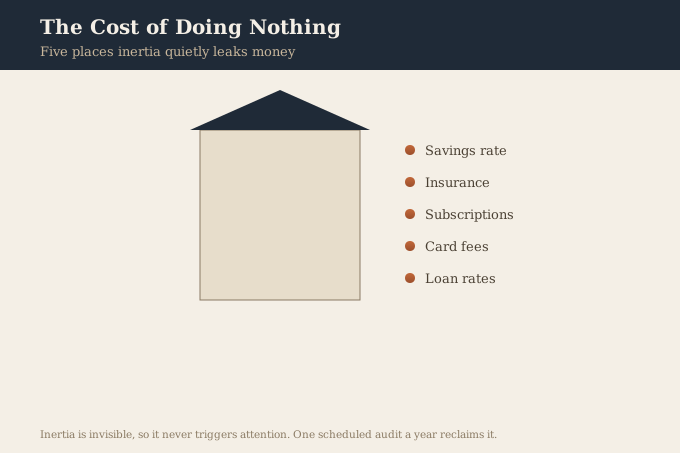
- It hides across categories, the stale savings rate, the unshopped insurance, the forgotten subscription, the outdated card fee, and often totals four figures a year for an ordinary household.
- The fix is not constant vigilance but a single scheduled annual audit across five categories, which recovers more than any one price cut.
Ask people where their money goes and they will name their mistakes: the impulse buy, the bad investment, the vacation they overspent on. Almost no one names the largest leak, because it does not look like spending and it does not look like a mistake. It looks like nothing happening. The cash that has sat at the same rate since 2021. The insurance that renews itself every year without a second quote. The subscription billing quietly for a service no one has opened in months. This is financial inertia, and for most households it is the single most expensive thing in their finances. This page was last reviewed recently. Understanding the cost of financial inertia 2026 means auditing these invisible drains before they compound further.
The reason it persists is precisely that it is invisible. A visible cost gets attention. A number that simply fails to grow, or a charge buried in a statement, does not. This is a complete audit of where inertia hides, what it costs, and how to reclaim it, not through constant vigilance, but through one scheduled pass a year.
Why inertia beats intention
The instinct is to fight inertia with discipline: stay on top of everything, all the time. That fails, because the enemy is not laziness, it is invisibility. You cannot stay vigilant against a loss that never signals itself. The account balance does not fall when the rate lags the market. The insurance renewal does not flag that a cheaper quote exists. The subscription does not remind you that you stopped using it.
So the answer is not more attention day to day. It is a single scheduled audit that forces the invisible into view a few times, in a few categories, once a year. Structure beats willpower here, because structure does not depend on noticing.
The five categories where inertia hides
1. Your savings rate. The largest and most common gap. Money at the national-average 0.40% while high-yield accounts pay near 4% forgoes hundreds of dollars a year on an ordinary balance, guaranteed and federally insured. Most people cannot name their own rate, which is the tell.
2. Insurance. Auto and home premiums drift upward for customers who do not shop, a loyalty penalty that rewards inertia and punishes nothing. A policy that has auto-renewed for years is almost always due for a fresh quote.
3. Subscriptions. Small, automatic, and scattered, subscriptions are engineered to be forgotten. Americans routinely underestimate the total by more than a hundred dollars a month, much of it on services no longer used.
4. Credit card annual fees. A fee that made sense when you used the card's perks may now cost more than you get back. An annual review catches the card that has quietly become a net negative.
5. Loan rates. Variable-rate debt reprices with the market, and even fixed loans can sometimes be refinanced. Rates you locked in a different environment deserve a periodic check against current offers.
What inertia costs, by category
- The inertia
- Cash at the old, low rate
- Roughly what it costs a year
- Hundreds, on an ordinary balance
- The inertia
- Auto-renewed without shopping
- Roughly what it costs a year
- Hundreds, via the loyalty penalty
- The inertia
- Forgotten recurring charges
- Roughly what it costs a year
- Often over $1,000
- The inertia
- Fee outlives the value
- Roughly what it costs a year
- The fee itself, if unused
- The inertia
- Rate from a different market
- Roughly what it costs a year
- Varies with the balance
The audit itself
The whole thing takes an afternoon, once a year:
- Look up your savings rate and compare it to current high-yield accounts. If the gap is meaningful, move the money.
- Get one fresh insurance quote for any policy older than a year.
- List every recurring charge from a single month of statements, and cancel what you no longer use.
- Check each card's annual fee against the perks you actually redeem.
- Review your loan rates against current offers, especially anything variable.
You are not optimizing every line of your finances. You are catching the handful of gaps where staying put has a real cost, and closing them in a single deliberate pass.
The point is not to become obsessive
The goal of this audit is the opposite of financial anxiety. It is to earn the right to not think about these things the rest of the year. You run the five-category sweep once, close the gaps that matter, and then leave the life you enjoy untouched, knowing the invisible leaks have been checked. Inertia costs money precisely because it hides from ongoing attention; a scheduled audit is the one thing that reliably drags it into the light. Do it annually and you keep both the money and the peace of mind.
Sources
- SwitchWize Research Desk, The Idle-Cash Tax and The Automation Premium, for the underlying savings and subscription figures and their primary sources (FDIC, Federal Reserve, subscription surveys).
- FDIC, National Rates and Rate Caps, for the national-average savings rate.
Figures are illustrative and vary by household. This is general educational information, not personalized financial advice.
What to Do Now
Frequently Asked Questions
What is financial inertia and why does it cost money?
How much is financial inertia actually costing me?
What should a financial inertia audit cover?
How often should I audit my finances for inertia?
Answer a few questions about your situation and goals. Money Map points you to the highest-value next step across savings, mortgage, cards, and debt.
Editorial review
What changed since the last update
Was this guide helpful?
Found an inaccurate, outdated, or missing claim? Report a correction. We verify reports against the relevant source before changing a guide or ranking.
